

Page 1 of 40
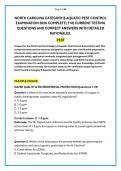
NORTH CAROLINA CATEGORY B AQUATIC PEST CONTROL
EXAMINATION 2026 COMPLETE (110) CURRENT TESTING
QUESTIONS AND CORRECT ANSWERS WITH DETAILED
RATIONALES.
PEST
Prepare for the North Carolina Category B Aquatic Pest Control Examination with this
comprehensive practice resource designed to support your certification preparation.
It features exam-style questions covering aquatic weed and algae management,
pesticide safety, application methods, integrated pest management (IPM),
environmental protection, water resource stewardship, and North Carolina pesticide
regulations. Use it to reinforce essential concepts, assess your knowledge, and build
confidence before test day. An excellent study aid for candidates preparing for the
North Carolina Category B Aquatic Pest Control certification.
MULTIPLE CHOICE.
WATER QUALITY & ENVIRONMENTAL PROTECTION (Questions 1–15)
Question 1: What is the maximum allowable concentration of copper in
public drinking water supplies under NC regulations?
A. 0.5 ppm
B. 1.0 ppm
C. 1.3 ppm
D. 2.5 ppm
Correct answer: C. 1.3 ppm
Rationale: The NC Department of Environmental Quality enforces the USEPA
action level of 1.3 ppm for copper in drinking water to prevent gastrointestinal
and liver toxicity.
Question 2: Which of the following is the primary federal law governing the
registration and use of aquatic pesticides in North Carolina?
A. Clean Water Act (CWA)
B. Federal Insecticide, Fungicide, and Rodenticide Act (FIFRA)
, Page 2 of 40
C. Safe Drinking Water Act (SDWA)
D. Endangered Species Act (ESA)
Correct answer: B. Federal Insecticide, Fungicide, and Rodenticide Act
(FIFRA)
Rationale: FIFRA is the foundational law for pesticide registration and use;
the CWA and SDWA address water quality standards but do not register
pesticides.
Question 3: Under NC law, a "Restricted-Use" aquatic pesticide may only be
applied by:
A. Any certified applicator or someone under their direct supervision
B. Any private applicator with a valid driver’s license
C. Any commercial applicator without additional training
D. Any homeowner with a permit from the county
Correct answer: A. Any certified applicator or someone under their direct
supervision
Rationale: NC Pesticide Law requires that restricted-use pesticides be
applied by or under the direct supervision of a certified applicator to ensure
safety and competency.
Question 4: What is the recommended re-entry interval (REI) for most aquatic
herbicides labeled for use in NC after treatment?
A. 0 hours (no restriction)
B. 24 hours
C. 48 hours
D. 7 days
Correct answer: A. 0 hours (no restriction)
Rationale: Most aquatic herbicides (e.g., glyphosate, 2,4-D amine) have no
REI for recreational water use, but irrigation and drinking water restrictions
still apply per the label.
, Page 3 of 40
Question 5: Which NC agency has primary authority over the application of
pesticides to public waters for mosquito control?
A. NC Department of Agriculture and Consumer Services (NCDA&CS)
B. NC Department of Environmental Quality (DEQ)
C. NC Wildlife Resources Commission
D. NC Department of Health and Human Services (DHHS)
Correct answer: B. NC Department of Environmental Quality (DEQ)
Rationale: DEQ issues permits for aquatic pesticide applications to public
waters under the Clean Water Act and state water quality statutes.
Question 6: The NC Pesticide Law requires that all aquatic pesticide
applicators must maintain records of application for how many years?
A. 1 year
B. 2 years
C. 3 years
D. 5 years
Correct answer: B. 2 years
Rationale: NC regulations mandate a 2-year record-keeping period for all
commercial and private pesticide applications, including aquatic treatments.
Question 7: Which of the following is the most sensitive life stage of fish to
aquatic pesticides?
A. Adult spawning females
B. Juvenile fingerlings
C. Eggs and larvae
D. Sub-adult males
Correct answer: C. Eggs and larvae
Rationale: Fish eggs and larvae have underdeveloped detoxification systems
and higher surface-to-volume ratios, making them significantly more
susceptible to pesticide toxicity.
, Page 4 of 40
Question 8: A fish kill occurs 48 hours after an aquatic herbicide treatment.
The applicator's first required action under NC law is to:
A. Retreat with a different herbicide
B. Notify the NC DEQ within 24 hours
C. Notify the NC Wildlife Resources Commission within 72 hours
D. Apply activated charcoal to the water
Correct answer: B. Notify the NC DEQ within 24 hours
Rationale: NC DEQ requires immediate (within 24 hours) reporting of any fish
kill or adverse environmental incident associated with pesticide use.
Question 9: What is the maximum penalty for a civil violation of NC pesticide
laws related to aquatic applications?
A. $500 per violation
B. $1,000 per violation
C. $5,000 per violation
D. $10,000 per violation
**Correct answer: C. $5,000 per violation**
**Rationale:** Under the NC Pesticide Law, civil penalties can reach up to
$5,000 per violation, with higher penalties for willful or repeated offenses.
Question 10: Which water hardness level generally reduces the toxicity of
copper-based aquatic algaecides?
A. Soft water (0–50 ppm CaCO₃)
B. Moderately hard water (50–100 ppm)
C. Hard water (100–200 ppm)
D. Very hard water (>200 ppm)
Correct answer: D. Very hard water (>200 ppm)
Rationale: Calcium and magnesium ions in hard water compete with copper
for binding sites on fish gills, reducing the free copper ion concentration and
thus lowering toxicity.
NORTH CAROLINA CATEGORY B AQUATIC PEST CONTROL
EXAMINATION 2026 COMPLETE (110) CURRENT TESTING
QUESTIONS AND CORRECT ANSWERS WITH DETAILED
RATIONALES.
PEST
Prepare for the North Carolina Category B Aquatic Pest Control Examination with this
comprehensive practice resource designed to support your certification preparation.
It features exam-style questions covering aquatic weed and algae management,
pesticide safety, application methods, integrated pest management (IPM),
environmental protection, water resource stewardship, and North Carolina pesticide
regulations. Use it to reinforce essential concepts, assess your knowledge, and build
confidence before test day. An excellent study aid for candidates preparing for the
North Carolina Category B Aquatic Pest Control certification.
MULTIPLE CHOICE.
WATER QUALITY & ENVIRONMENTAL PROTECTION (Questions 1–15)
Question 1: What is the maximum allowable concentration of copper in
public drinking water supplies under NC regulations?
A. 0.5 ppm
B. 1.0 ppm
C. 1.3 ppm
D. 2.5 ppm
Correct answer: C. 1.3 ppm
Rationale: The NC Department of Environmental Quality enforces the USEPA
action level of 1.3 ppm for copper in drinking water to prevent gastrointestinal
and liver toxicity.
Question 2: Which of the following is the primary federal law governing the
registration and use of aquatic pesticides in North Carolina?
A. Clean Water Act (CWA)
B. Federal Insecticide, Fungicide, and Rodenticide Act (FIFRA)
, Page 2 of 40
C. Safe Drinking Water Act (SDWA)
D. Endangered Species Act (ESA)
Correct answer: B. Federal Insecticide, Fungicide, and Rodenticide Act
(FIFRA)
Rationale: FIFRA is the foundational law for pesticide registration and use;
the CWA and SDWA address water quality standards but do not register
pesticides.
Question 3: Under NC law, a "Restricted-Use" aquatic pesticide may only be
applied by:
A. Any certified applicator or someone under their direct supervision
B. Any private applicator with a valid driver’s license
C. Any commercial applicator without additional training
D. Any homeowner with a permit from the county
Correct answer: A. Any certified applicator or someone under their direct
supervision
Rationale: NC Pesticide Law requires that restricted-use pesticides be
applied by or under the direct supervision of a certified applicator to ensure
safety and competency.
Question 4: What is the recommended re-entry interval (REI) for most aquatic
herbicides labeled for use in NC after treatment?
A. 0 hours (no restriction)
B. 24 hours
C. 48 hours
D. 7 days
Correct answer: A. 0 hours (no restriction)
Rationale: Most aquatic herbicides (e.g., glyphosate, 2,4-D amine) have no
REI for recreational water use, but irrigation and drinking water restrictions
still apply per the label.
, Page 3 of 40
Question 5: Which NC agency has primary authority over the application of
pesticides to public waters for mosquito control?
A. NC Department of Agriculture and Consumer Services (NCDA&CS)
B. NC Department of Environmental Quality (DEQ)
C. NC Wildlife Resources Commission
D. NC Department of Health and Human Services (DHHS)
Correct answer: B. NC Department of Environmental Quality (DEQ)
Rationale: DEQ issues permits for aquatic pesticide applications to public
waters under the Clean Water Act and state water quality statutes.
Question 6: The NC Pesticide Law requires that all aquatic pesticide
applicators must maintain records of application for how many years?
A. 1 year
B. 2 years
C. 3 years
D. 5 years
Correct answer: B. 2 years
Rationale: NC regulations mandate a 2-year record-keeping period for all
commercial and private pesticide applications, including aquatic treatments.
Question 7: Which of the following is the most sensitive life stage of fish to
aquatic pesticides?
A. Adult spawning females
B. Juvenile fingerlings
C. Eggs and larvae
D. Sub-adult males
Correct answer: C. Eggs and larvae
Rationale: Fish eggs and larvae have underdeveloped detoxification systems
and higher surface-to-volume ratios, making them significantly more
susceptible to pesticide toxicity.
, Page 4 of 40
Question 8: A fish kill occurs 48 hours after an aquatic herbicide treatment.
The applicator's first required action under NC law is to:
A. Retreat with a different herbicide
B. Notify the NC DEQ within 24 hours
C. Notify the NC Wildlife Resources Commission within 72 hours
D. Apply activated charcoal to the water
Correct answer: B. Notify the NC DEQ within 24 hours
Rationale: NC DEQ requires immediate (within 24 hours) reporting of any fish
kill or adverse environmental incident associated with pesticide use.
Question 9: What is the maximum penalty for a civil violation of NC pesticide
laws related to aquatic applications?
A. $500 per violation
B. $1,000 per violation
C. $5,000 per violation
D. $10,000 per violation
**Correct answer: C. $5,000 per violation**
**Rationale:** Under the NC Pesticide Law, civil penalties can reach up to
$5,000 per violation, with higher penalties for willful or repeated offenses.
Question 10: Which water hardness level generally reduces the toxicity of
copper-based aquatic algaecides?
A. Soft water (0–50 ppm CaCO₃)
B. Moderately hard water (50–100 ppm)
C. Hard water (100–200 ppm)
D. Very hard water (>200 ppm)
Correct answer: D. Very hard water (>200 ppm)
Rationale: Calcium and magnesium ions in hard water compete with copper
for binding sites on fish gills, reducing the free copper ion concentration and
thus lowering toxicity.


