
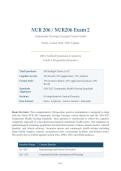
NUR 206 / NUR206 Exam 2
Community Nursing Concepts Course Guide
Fortis | Latest Update
100% Verified Questions & Answers
Grade A Preparation Resource
Total Questions: 100 Multiple Choice (A-D)
Cognitive Levels: 30% Recall | 45% Application | 25% Analysis
Format Style: 70% Scenario-Based | 20% Application/Analysis | 10%
Recall
Standards 2026-2027 Community Health Nursing Standards
Alignment:
Sections: 8 Comprehensive Content Domains
Item Format: Stem + 4 Options + Correct Answer + Rationale
Exam Overview. This comprehensive 100-question practice examination is designed to align
with the Fortis NUR 206 Community Nursing Concepts course objectives and the 2026-2027
Community Health Nursing Standards. Each question is constructed to reflect the cognitive
complexity expected of a baccalaureate-prepared community health nurse, with emphasis on
epidemiological reasoning, population-focused interventions, evidence-based practice, cultural
humility, and ethical advocacy. Scenarios mirror real community health settings including
home health, hospice, schools, occupational sites, correctional facilities, and disaster zones.
The answer key is verified against current ANA, APHA, CDC, and OSHA guidance.
Question Range Content Domain
Q1 - Q20 Epidemiology and Disease Prevention
Q21 - Q35 Community Health Assessment and Planning
Page 1
,NUR 206 Exam 2 - Community Nursing Concepts Guide | Fortis Update
Q36 - Q50 Vulnerable Populations and Health Disparities
Q51 - Q60 Health Promotion and Education
Q61 - Q70 Home Health and Hospice Nursing
Q71 - Q80 School, Occupational, and Correctional Health Nursing
Q81 - Q90 Environmental Health and Disaster Management
Q91 - Q100 Policy, Advocacy, and Ethics in Community Health
Page 2
,NUR 206 Exam 2 - Community Nursing Concepts Guide | Fortis Update
Examination Instructions and Blueprint
Purpose of this Examination. This practice examination is structured to mirror the depth,
complexity, and topical weighting of NUR 206 Exam 2 as administered in the Fortis Community
Nursing Concepts course. The questions have been constructed using current evidence-based
community health nursing standards and validated against the Healthy People 2030 framework,
ANA Code of Ethics for Nurses, APHA public health principles, CDC guidance, OSHA
regulations, and FEMA disaster response frameworks. Each item is designed to assess the
candidate's ability to integrate theoretical knowledge with population-focused clinical
reasoning in community settings.
Cognitive Level Distribution. The examination follows the recommended cognitive
distribution for community health nursing assessments: approximately 30% of items target
recall and comprehension of foundational concepts such as epidemiological terminology and
prevention levels; 45% target application of concepts to community health scenarios including
community assessment, program planning, and direct care interventions; and 25% target
analysis, requiring the candidate to interpret data, prioritize interventions, and evaluate
outcomes. This distribution ensures that candidates demonstrate both foundational knowledge
and the higher-order thinking required for safe, effective community health nursing practice.
How to Use This Guide. Candidates are encouraged to attempt all 100 questions under timed
conditions approximating the actual examination (approximately 90 minutes). After completing
the examination, review each rationale carefully, paying particular attention to why the correct
answer is correct and why each distractor is incorrect. The distractors have been deliberately
constructed to reflect common community nursing exam pitfalls, including confusion between
prevention levels, misapplication of epidemiological terminology, errors in intervention
prioritization, and misunderstandings of vulnerable population needs and health policy.
Mastery of both correct responses and the underlying reasoning is the strongest predictor of
success on the actual NUR 206 examination.
Format Conventions. Each question presents a stem (which may include a clinical scenario,
data set, or direct knowledge query) followed by four options labeled A through D. Only one
option is correct. The correct answer is identified with the [CORRECT] marker and reinforced
with a 3-4 sentence rationale grounded in community health nursing principles. The rationale
addresses why the correct option is correct and why each distractor fails to meet the question
requirements, providing comprehensive review value beyond simple answer verification.
Page 3
, NUR 206 Exam 2 - Community Nursing Concepts Guide | Fortis Update
Section 1: Epidemiology and Disease Prevention
Topics: Epidemiological Principles, Disease Transmission, Prevention Levels
(Primary/Secondary/Tertiary), Communicable Diseases, and Surveillance
Q1: A community health nurse is investigating a foodborne illness outbreak at a
community picnic. Of 200 attendees, 80 developed gastroenteritis within 24 hours.
Which calculation represents the attack rate?
A. 80 divided by total population of the surrounding city
B. 80 divided by 200, multiplied by 100 (primary attack rate among attendees) [CORRECT]
C. Number of deaths divided by 80 cases
D. Number of new cases in the next month divided by 200
Correct Answer: B
Rationale: The attack rate is calculated as the number of new cases divided by the population
at risk during a specific time period, expressed as a percentage. In this outbreak scenario, the
at-risk population is the 200 picnic attendees, and 80 became ill, yielding a 40% attack rate.
Choice A incorrectly uses the general population rather than those exposed; choice C
describes case fatality rate; choice D misrepresents incidence over a different time frame.
Q2: Which of the following best describes the difference between incidence and
prevalence?
A. Incidence measures all current cases; prevalence measures only new cases
B. Incidence measures new cases during a time period; prevalence measures all existing
cases at a point in time [CORRECT]
C. Incidence and prevalence are interchangeable terms in epidemiology
D. Incidence measures mortality; prevalence measures morbidity
Correct Answer: B
Rationale: Incidence refers to the number of NEW cases of a disease occurring in a
population at risk during a specified time period, while prevalence refers to ALL existing
cases (new plus pre-existing) at a given point or period in time. Prevalence is influenced by
both incidence and disease duration. Choice A reverses the definitions; choice C is incorrect
because they convey distinct epidemiological information; choice D confuses these measures
with mortality and morbidity, which are different constructs.
Page 4
Community Nursing Concepts Course Guide
Fortis | Latest Update
100% Verified Questions & Answers
Grade A Preparation Resource
Total Questions: 100 Multiple Choice (A-D)
Cognitive Levels: 30% Recall | 45% Application | 25% Analysis
Format Style: 70% Scenario-Based | 20% Application/Analysis | 10%
Recall
Standards 2026-2027 Community Health Nursing Standards
Alignment:
Sections: 8 Comprehensive Content Domains
Item Format: Stem + 4 Options + Correct Answer + Rationale
Exam Overview. This comprehensive 100-question practice examination is designed to align
with the Fortis NUR 206 Community Nursing Concepts course objectives and the 2026-2027
Community Health Nursing Standards. Each question is constructed to reflect the cognitive
complexity expected of a baccalaureate-prepared community health nurse, with emphasis on
epidemiological reasoning, population-focused interventions, evidence-based practice, cultural
humility, and ethical advocacy. Scenarios mirror real community health settings including
home health, hospice, schools, occupational sites, correctional facilities, and disaster zones.
The answer key is verified against current ANA, APHA, CDC, and OSHA guidance.
Question Range Content Domain
Q1 - Q20 Epidemiology and Disease Prevention
Q21 - Q35 Community Health Assessment and Planning
Page 1
,NUR 206 Exam 2 - Community Nursing Concepts Guide | Fortis Update
Q36 - Q50 Vulnerable Populations and Health Disparities
Q51 - Q60 Health Promotion and Education
Q61 - Q70 Home Health and Hospice Nursing
Q71 - Q80 School, Occupational, and Correctional Health Nursing
Q81 - Q90 Environmental Health and Disaster Management
Q91 - Q100 Policy, Advocacy, and Ethics in Community Health
Page 2
,NUR 206 Exam 2 - Community Nursing Concepts Guide | Fortis Update
Examination Instructions and Blueprint
Purpose of this Examination. This practice examination is structured to mirror the depth,
complexity, and topical weighting of NUR 206 Exam 2 as administered in the Fortis Community
Nursing Concepts course. The questions have been constructed using current evidence-based
community health nursing standards and validated against the Healthy People 2030 framework,
ANA Code of Ethics for Nurses, APHA public health principles, CDC guidance, OSHA
regulations, and FEMA disaster response frameworks. Each item is designed to assess the
candidate's ability to integrate theoretical knowledge with population-focused clinical
reasoning in community settings.
Cognitive Level Distribution. The examination follows the recommended cognitive
distribution for community health nursing assessments: approximately 30% of items target
recall and comprehension of foundational concepts such as epidemiological terminology and
prevention levels; 45% target application of concepts to community health scenarios including
community assessment, program planning, and direct care interventions; and 25% target
analysis, requiring the candidate to interpret data, prioritize interventions, and evaluate
outcomes. This distribution ensures that candidates demonstrate both foundational knowledge
and the higher-order thinking required for safe, effective community health nursing practice.
How to Use This Guide. Candidates are encouraged to attempt all 100 questions under timed
conditions approximating the actual examination (approximately 90 minutes). After completing
the examination, review each rationale carefully, paying particular attention to why the correct
answer is correct and why each distractor is incorrect. The distractors have been deliberately
constructed to reflect common community nursing exam pitfalls, including confusion between
prevention levels, misapplication of epidemiological terminology, errors in intervention
prioritization, and misunderstandings of vulnerable population needs and health policy.
Mastery of both correct responses and the underlying reasoning is the strongest predictor of
success on the actual NUR 206 examination.
Format Conventions. Each question presents a stem (which may include a clinical scenario,
data set, or direct knowledge query) followed by four options labeled A through D. Only one
option is correct. The correct answer is identified with the [CORRECT] marker and reinforced
with a 3-4 sentence rationale grounded in community health nursing principles. The rationale
addresses why the correct option is correct and why each distractor fails to meet the question
requirements, providing comprehensive review value beyond simple answer verification.
Page 3
, NUR 206 Exam 2 - Community Nursing Concepts Guide | Fortis Update
Section 1: Epidemiology and Disease Prevention
Topics: Epidemiological Principles, Disease Transmission, Prevention Levels
(Primary/Secondary/Tertiary), Communicable Diseases, and Surveillance
Q1: A community health nurse is investigating a foodborne illness outbreak at a
community picnic. Of 200 attendees, 80 developed gastroenteritis within 24 hours.
Which calculation represents the attack rate?
A. 80 divided by total population of the surrounding city
B. 80 divided by 200, multiplied by 100 (primary attack rate among attendees) [CORRECT]
C. Number of deaths divided by 80 cases
D. Number of new cases in the next month divided by 200
Correct Answer: B
Rationale: The attack rate is calculated as the number of new cases divided by the population
at risk during a specific time period, expressed as a percentage. In this outbreak scenario, the
at-risk population is the 200 picnic attendees, and 80 became ill, yielding a 40% attack rate.
Choice A incorrectly uses the general population rather than those exposed; choice C
describes case fatality rate; choice D misrepresents incidence over a different time frame.
Q2: Which of the following best describes the difference between incidence and
prevalence?
A. Incidence measures all current cases; prevalence measures only new cases
B. Incidence measures new cases during a time period; prevalence measures all existing
cases at a point in time [CORRECT]
C. Incidence and prevalence are interchangeable terms in epidemiology
D. Incidence measures mortality; prevalence measures morbidity
Correct Answer: B
Rationale: Incidence refers to the number of NEW cases of a disease occurring in a
population at risk during a specified time period, while prevalence refers to ALL existing
cases (new plus pre-existing) at a given point or period in time. Prevalence is influenced by
both incidence and disease duration. Choice A reverses the definitions; choice C is incorrect
because they convey distinct epidemiological information; choice D confuses these measures
with mortality and morbidity, which are different constructs.
Page 4


