

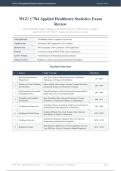
WGU C784 Applied Healthcare Statistics Exam Review 2026/2027 Edition
WGU C784 Applied Healthcare Statistics Exam
Review
Latest 2026/2027 Update - Questions and Verified Answers - 100% Correct - Grade A
Aligned with 2026-2027 WGU C784 Applied Healthcare Statistics Standards
Total Questions 120 Multiple-Choice (4 options, one correct)
Cognitive Mix 25% Recall / 50% Application / 25% Analysis
Question Mix 50% Conceptual / 30% Calculation / 20% Application
Sections 8 sections covering all WGU C784 course competencies
Answer Format Verified answers with detailed statistical rationale
Clinical Context Healthcare scenarios and clinical interpretation throughout
Section Overview
# Section Topic Coverage Questions
Data Representation and Data Types, Scales of Measurement, Data Visualization
1 Q1 - Q20
Measurement Techniques, & Frequency Distributions
Measures of Central Tendency Mean, Median, Mode, Range, Variance, Standard Deviation,
2 Q21 - Q40
and Variability Interquartile Range, & Coefficient of Variation
Data Distribution, Percentiles, Normal Distribution, Z-Scores, Percentiles, Empirical Rule,
3 Q41 - Q60
and Standard Scores Outlier Detection, & Assessing Normality
Probability and Probability Basic Probability Rules, Binomial Distribution, Poisson
4 Q61 - Q75
Distributions Distribution, Conditional Probability, & Independence
Scatterplots, Pearson Correlation Coefficient, Coefficient of
5 Correlation and Regression Q76 - Q88
Determination, Linear Regression, & Prediction
Sampling Methods, Bias, Study Designs, Data Collection,
6 Sampling and Study Design Q89 - Q100
Data Quality, & Ethical Considerations
Point/Interval Estimates, Margin of Error, Z/T Intervals,
7 Confidence Intervals Q101 - Q110
Interpretation, & Sample Size Calculation
Null/Alternative Hypotheses, P-Values, Significance Levels,
8 Hypothesis Testing Q111 - Q120
Type I/II Errors, Power, & Testing for Means/Proportions
WGU C784 - Applied Healthcare Statistics Comprehensive Exam Review - 120 Questions Page 1
,WGU C784 Applied Healthcare Statistics Exam Review 2026/2027 Edition
Section 1: Data Representation and Measurement
Data Types, Scales of Measurement, Data Visualization Techniques, & Frequency Distributions (Q1-Q20)
Q1: A nurse records each patient's blood type (A, B, AB, O) on admission. What type of data is being
collected?
A. Quantitative continuous
B. Qualitative nominal [CORRECT]
C. Quantitative discrete
D. Qualitative ordinal
Correct Answer: B
Rationale: Blood type is a category with no natural ordering, making it qualitative nominal data.
Quantitative data involve numerical counts or measurements (eliminating A and B). Ordinal data require a
meaningful rank order (eliminating D, since blood types have no inherent hierarchy). Nominal data are
common in healthcare for variables such as blood type, gender, and insurance provider.
Q2: A clinical researcher measures each patient's body temperature in degrees Celsius. This variable is
best classified as:
A. Quantitative continuous [CORRECT]
B. Qualitative ordinal
C. Qualitative nominal
D. Quantitative discrete
Correct Answer: A
Rationale: Body temperature is a measurable quantity that can take any value within a range (including
decimals like 37.4 C), making it quantitative continuous data. Discrete data involve countable whole numbers
(eliminating D). Qualitative data describe categories rather than numerical measurements (eliminating A and
C). Continuous variables are essential in healthcare for vital signs, lab values, and anthropometric measures.
Q3: Which of the following healthcare variables is BEST classified as discrete?
A. Patient weight in kilograms
B. Systolic blood pressure in mmHg
C. Length of hospital stay in days and hours
D. Number of emergency department visits per month [CORRECT]
Correct Answer: D
Rationale: The number of ED visits is a countable whole number with no fractional values possible, making
it discrete. Weight, blood pressure, and length of stay measured in days and hours all allow fractional values
along a continuum, making them continuous (eliminating A, B, and D). Discrete healthcare variables
commonly include counts such as number of pregnancies, number of medications, and number of
comorbidities.
WGU C784 - Applied Healthcare Statistics Comprehensive Exam Review - 120 Questions Page 2
,WGU C784 Applied Healthcare Statistics Exam Review 2026/2027 Edition
Q4: A hospital uses the Emergency Severity Index (ESI) with levels 1 (most urgent) through 5 (least
urgent). The ESI level represents which type of variable?
A. Qualitative nominal
B. Quantitative discrete
C. Qualitative ordinal [CORRECT]
D. Quantitative continuous
Correct Answer: C
Rationale: ESI levels have a meaningful rank order (level 1 is more urgent than level 5), but the numerical
differences between levels are not equal or quantitatively meaningful, making this qualitative ordinal data.
Nominal data lack any ordering (eliminating A), and the numbers represent labels rather than true quantities
(eliminating C and D). The ESI is a classic ordinal scale used in emergency department triage.
Q5: Which of the following is an example of nominal-level data in healthcare?
A. Patient insurance provider (Medicare, Medicaid, Private, Uninsured) [CORRECT]
B. Cancer stage (I, II, III, IV)
C. Patient satisfaction rating (1-5 scale)
D. Body temperature in Fahrenheit
Correct Answer: A
Rationale: Insurance provider categories have no inherent ordering or ranking, defining nominal-level data.
Patient satisfaction ratings (eliminating A) and cancer stages (eliminating B) both imply order, making them
ordinal. Temperature (eliminating D) is interval-level because it has equal intervals but an arbitrary zero
point. Nominal data allow only counting and mode calculations.
Q6: A numeric pain scale of 0 to 10 used in clinical nursing assessments represents which scale of
measurement?
A. Nominal
B. Interval
C. Ordinal [CORRECT]
D. Ratio
Correct Answer: C
Rationale: A pain scale ranks discomfort in order, but the intervals between values are not necessarily equal
(the perceived difference between 4 and 5 may not equal that between 9 and 10), making it ordinal. Nominal
data lack ordering (eliminating A). Interval requires equal intervals without a true zero (eliminating C). Ratio
requires a meaningful zero indicating absence plus equal intervals (eliminating D, since equal intervals are
not guaranteed for subjective pain ratings).
WGU C784 - Applied Healthcare Statistics Comprehensive Exam Review - 120 Questions Page 3
, WGU C784 Applied Healthcare Statistics Exam Review 2026/2027 Edition
Q7: Which healthcare measurement is recorded at the interval level?
A. Number of patients seen per shift
B. Body temperature in degrees Celsius [CORRECT]
C. Apgar score (0-10)
D. Birth weight in grams
Correct Answer: B
Rationale: Celsius temperature has equal intervals between degrees but 0 C does not represent 'no
temperature' (the zero is arbitrary), making it interval level. Counts such as patients per shift are ratio
(eliminating A, true zero exists). Apgar scores are ordinal (eliminating C, no equal intervals guaranteed).
Weight is ratio (eliminating D, true zero exists). Kelvin would be ratio-level temperature.
Q8: Which of the following variables is measured at the ratio level?
A. Patient satisfaction score (1-10)
B. Calendar year of admission (2020, 2021, 2022)
C. Triage category (1-5)
D. Serum cholesterol level in mg/dL [CORRECT]
Correct Answer: D
Rationale: Cholesterol level has equal intervals and a true zero (0 mg/dL means absence of cholesterol),
making it ratio level. Satisfaction scores are ordinal (eliminating A). Calendar years are interval (eliminating
B, year 0 is arbitrary). Triage categories are ordinal (eliminating D). Ratio data support all mathematical
operations, including meaningful ratios such as 'twice the cholesterol.'
Q9: A nurse records the following patient data: heart rate (beats/min), blood type, pain score (0-10),
and weight (kg). Which variable is correctly paired with its measurement scale?
A. Blood type - nominal [CORRECT]
B. Heart rate - ordinal
C. Pain score - ratio
D. Weight - interval
Correct Answer: A
Rationale: Blood type (A, B, AB, O) has no inherent order, making it nominal. Heart rate is ratio
(eliminating A, true zero exists). Pain score is ordinal (eliminating C, intervals not equal). Weight is ratio
(eliminating D, true zero exists). Accurate scale identification guides selection of appropriate statistical tests
and summary measures.
Q10: Which graph is MOST appropriate for displaying the distribution of a continuous quantitative
variable such as systolic blood pressure?
A. Pie chart
B. Histogram [CORRECT]
C. Bar chart
D. Frequency table only
WGU C784 - Applied Healthcare Statistics Comprehensive Exam Review - 120 Questions Page 4
WGU C784 Applied Healthcare Statistics Exam
Review
Latest 2026/2027 Update - Questions and Verified Answers - 100% Correct - Grade A
Aligned with 2026-2027 WGU C784 Applied Healthcare Statistics Standards
Total Questions 120 Multiple-Choice (4 options, one correct)
Cognitive Mix 25% Recall / 50% Application / 25% Analysis
Question Mix 50% Conceptual / 30% Calculation / 20% Application
Sections 8 sections covering all WGU C784 course competencies
Answer Format Verified answers with detailed statistical rationale
Clinical Context Healthcare scenarios and clinical interpretation throughout
Section Overview
# Section Topic Coverage Questions
Data Representation and Data Types, Scales of Measurement, Data Visualization
1 Q1 - Q20
Measurement Techniques, & Frequency Distributions
Measures of Central Tendency Mean, Median, Mode, Range, Variance, Standard Deviation,
2 Q21 - Q40
and Variability Interquartile Range, & Coefficient of Variation
Data Distribution, Percentiles, Normal Distribution, Z-Scores, Percentiles, Empirical Rule,
3 Q41 - Q60
and Standard Scores Outlier Detection, & Assessing Normality
Probability and Probability Basic Probability Rules, Binomial Distribution, Poisson
4 Q61 - Q75
Distributions Distribution, Conditional Probability, & Independence
Scatterplots, Pearson Correlation Coefficient, Coefficient of
5 Correlation and Regression Q76 - Q88
Determination, Linear Regression, & Prediction
Sampling Methods, Bias, Study Designs, Data Collection,
6 Sampling and Study Design Q89 - Q100
Data Quality, & Ethical Considerations
Point/Interval Estimates, Margin of Error, Z/T Intervals,
7 Confidence Intervals Q101 - Q110
Interpretation, & Sample Size Calculation
Null/Alternative Hypotheses, P-Values, Significance Levels,
8 Hypothesis Testing Q111 - Q120
Type I/II Errors, Power, & Testing for Means/Proportions
WGU C784 - Applied Healthcare Statistics Comprehensive Exam Review - 120 Questions Page 1
,WGU C784 Applied Healthcare Statistics Exam Review 2026/2027 Edition
Section 1: Data Representation and Measurement
Data Types, Scales of Measurement, Data Visualization Techniques, & Frequency Distributions (Q1-Q20)
Q1: A nurse records each patient's blood type (A, B, AB, O) on admission. What type of data is being
collected?
A. Quantitative continuous
B. Qualitative nominal [CORRECT]
C. Quantitative discrete
D. Qualitative ordinal
Correct Answer: B
Rationale: Blood type is a category with no natural ordering, making it qualitative nominal data.
Quantitative data involve numerical counts or measurements (eliminating A and B). Ordinal data require a
meaningful rank order (eliminating D, since blood types have no inherent hierarchy). Nominal data are
common in healthcare for variables such as blood type, gender, and insurance provider.
Q2: A clinical researcher measures each patient's body temperature in degrees Celsius. This variable is
best classified as:
A. Quantitative continuous [CORRECT]
B. Qualitative ordinal
C. Qualitative nominal
D. Quantitative discrete
Correct Answer: A
Rationale: Body temperature is a measurable quantity that can take any value within a range (including
decimals like 37.4 C), making it quantitative continuous data. Discrete data involve countable whole numbers
(eliminating D). Qualitative data describe categories rather than numerical measurements (eliminating A and
C). Continuous variables are essential in healthcare for vital signs, lab values, and anthropometric measures.
Q3: Which of the following healthcare variables is BEST classified as discrete?
A. Patient weight in kilograms
B. Systolic blood pressure in mmHg
C. Length of hospital stay in days and hours
D. Number of emergency department visits per month [CORRECT]
Correct Answer: D
Rationale: The number of ED visits is a countable whole number with no fractional values possible, making
it discrete. Weight, blood pressure, and length of stay measured in days and hours all allow fractional values
along a continuum, making them continuous (eliminating A, B, and D). Discrete healthcare variables
commonly include counts such as number of pregnancies, number of medications, and number of
comorbidities.
WGU C784 - Applied Healthcare Statistics Comprehensive Exam Review - 120 Questions Page 2
,WGU C784 Applied Healthcare Statistics Exam Review 2026/2027 Edition
Q4: A hospital uses the Emergency Severity Index (ESI) with levels 1 (most urgent) through 5 (least
urgent). The ESI level represents which type of variable?
A. Qualitative nominal
B. Quantitative discrete
C. Qualitative ordinal [CORRECT]
D. Quantitative continuous
Correct Answer: C
Rationale: ESI levels have a meaningful rank order (level 1 is more urgent than level 5), but the numerical
differences between levels are not equal or quantitatively meaningful, making this qualitative ordinal data.
Nominal data lack any ordering (eliminating A), and the numbers represent labels rather than true quantities
(eliminating C and D). The ESI is a classic ordinal scale used in emergency department triage.
Q5: Which of the following is an example of nominal-level data in healthcare?
A. Patient insurance provider (Medicare, Medicaid, Private, Uninsured) [CORRECT]
B. Cancer stage (I, II, III, IV)
C. Patient satisfaction rating (1-5 scale)
D. Body temperature in Fahrenheit
Correct Answer: A
Rationale: Insurance provider categories have no inherent ordering or ranking, defining nominal-level data.
Patient satisfaction ratings (eliminating A) and cancer stages (eliminating B) both imply order, making them
ordinal. Temperature (eliminating D) is interval-level because it has equal intervals but an arbitrary zero
point. Nominal data allow only counting and mode calculations.
Q6: A numeric pain scale of 0 to 10 used in clinical nursing assessments represents which scale of
measurement?
A. Nominal
B. Interval
C. Ordinal [CORRECT]
D. Ratio
Correct Answer: C
Rationale: A pain scale ranks discomfort in order, but the intervals between values are not necessarily equal
(the perceived difference between 4 and 5 may not equal that between 9 and 10), making it ordinal. Nominal
data lack ordering (eliminating A). Interval requires equal intervals without a true zero (eliminating C). Ratio
requires a meaningful zero indicating absence plus equal intervals (eliminating D, since equal intervals are
not guaranteed for subjective pain ratings).
WGU C784 - Applied Healthcare Statistics Comprehensive Exam Review - 120 Questions Page 3
, WGU C784 Applied Healthcare Statistics Exam Review 2026/2027 Edition
Q7: Which healthcare measurement is recorded at the interval level?
A. Number of patients seen per shift
B. Body temperature in degrees Celsius [CORRECT]
C. Apgar score (0-10)
D. Birth weight in grams
Correct Answer: B
Rationale: Celsius temperature has equal intervals between degrees but 0 C does not represent 'no
temperature' (the zero is arbitrary), making it interval level. Counts such as patients per shift are ratio
(eliminating A, true zero exists). Apgar scores are ordinal (eliminating C, no equal intervals guaranteed).
Weight is ratio (eliminating D, true zero exists). Kelvin would be ratio-level temperature.
Q8: Which of the following variables is measured at the ratio level?
A. Patient satisfaction score (1-10)
B. Calendar year of admission (2020, 2021, 2022)
C. Triage category (1-5)
D. Serum cholesterol level in mg/dL [CORRECT]
Correct Answer: D
Rationale: Cholesterol level has equal intervals and a true zero (0 mg/dL means absence of cholesterol),
making it ratio level. Satisfaction scores are ordinal (eliminating A). Calendar years are interval (eliminating
B, year 0 is arbitrary). Triage categories are ordinal (eliminating D). Ratio data support all mathematical
operations, including meaningful ratios such as 'twice the cholesterol.'
Q9: A nurse records the following patient data: heart rate (beats/min), blood type, pain score (0-10),
and weight (kg). Which variable is correctly paired with its measurement scale?
A. Blood type - nominal [CORRECT]
B. Heart rate - ordinal
C. Pain score - ratio
D. Weight - interval
Correct Answer: A
Rationale: Blood type (A, B, AB, O) has no inherent order, making it nominal. Heart rate is ratio
(eliminating A, true zero exists). Pain score is ordinal (eliminating C, intervals not equal). Weight is ratio
(eliminating D, true zero exists). Accurate scale identification guides selection of appropriate statistical tests
and summary measures.
Q10: Which graph is MOST appropriate for displaying the distribution of a continuous quantitative
variable such as systolic blood pressure?
A. Pie chart
B. Histogram [CORRECT]
C. Bar chart
D. Frequency table only
WGU C784 - Applied Healthcare Statistics Comprehensive Exam Review - 120 Questions Page 4


