

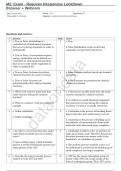
M2: Exam - Requires Respondus LockDown
Browser + Webcam
Due No due date Points 100 Questions 27
Time Limit 60 Minutes Requires Respondus LockDown Browser
Questions and Answers:
# Question Points Answer
1 a. True or False: Metabolism is a 2 a. True
controlled set of biochemical reactions
that occur in living organisms in order to b. False (Metabolism occurs in all living
maintain life. organisms, not just those that move).
b. True or False: As movement requires
energy, metabolism can be defined as a
controlled set of biochemical reactions
that occur in only motile organisms in
ta
order to maintain life.
2 a. True or False: Enzymes slow down 2 a. False (Enzyme catalyze (speed up) chemical
chemical reactions to conserve energy. reactions).
da
b. True or False: Enzymes are b. False (Enzymes are proteins that catalyze
polysaccharides that catalyze chemical chemical reactions).
reactions.
on
3 a. What is the term for metal ions that 5 a. Cofactors are usually metal ions and assist
assist enzymes during the catalysis enzymes during the catalysis reaction.
reaction?
b. A cofactor is a small chemical component
b. What is a cofactor? And give a general that assists an enzyme during the catalysis
example. reactions. A cofactor is usually metal ions.
ta
4 a. Define catabolism. 5 a. Catabolism is the process of breaking down
larger molecules into useful energy sources.
b. Define anabolism.
da
b. Anabolism is the process of building up or
biosynthesis of macromolecules from small
molecular units into much larger complexes.
5 a. In order to convert proteins into amino 5 a. Catabolism would be active as proteins are
acids which metabolic process would be made up of amino acids. Therefore the process
active? described (proteins into amino acids) is the
breakdown, or catabolism of protein.
b. Upon cellular injury, which metabolic
process is involved during the growth and b. The anabolic process would be active as it
repair phases of the cell? (by definition) is involved in the building up of
small complexes into larger complexes.
6 a. Describe the energy transfer process 10 a. ATP has the energy (phosphate group) to
relative to both ATP and ADP. donate while ADP can accept energy in the
form of a phosphate group. Thus, ATP can be
, M2: Exam - Requires Respondus LockDown
Browser + Webcam
Due No due date Points 100 Questions 27
Time Limit 60 Minutes Requires Respondus LockDown Browser
# Question Points Answer
dephosphorylated (ATP -> ADP + Pi), while
ADP can be phosphorylated into ATP (ADP +
Pi -> ATP).
7 a. From what source do chemotrophs 2 a. Chemotrophs acquire energy from
acquire energy? preformed chemicals found in the
environment.
b. An organism that derives its energy
(generates ATP) from photons of light is b. Phototrophic microorganism
called a _________?
ta
8 a. An organism that derives its energy by 2 a. Lithotroph
removing electrons from elemental sulfur
would be classified as a __________? b. Autotroph
da
b. An organism that obtains its source of
carbon from inorganic molecules such as
carbon dioxide is referred to as a
________?
on
9 a. A reactive intermediate would be 2 a. Substrate-level phosphorylation (The
present in which phosphorylation chemical compound losing the phosphate
process? group is referred to as the phosphorylated
- Oxidative phosphorylation reactive intermediate).
- Photophosphorylation
ta
- Substrate-level phosphorylation b. Oxidative phosphorylation
b. This phosphorylation process occurs in
the mitochondria of chemotropic
eukaryotes.
da
- Oxidative phosphorylation
- Photophosphorylation
- Substrate-level phosphorylation
10 a. The catabolism of a single molecule of 5 a. The breakdown of glucose goes through (1)
glucose goes through what 3 distinct Glycolysis then (2) Fermentation or Respiration
transitions? and finally through (3) the electron transport
chain (ETC).
11 a. What is the most energetic transition in 5 a. The electron transport chain yields 34 ATP
the catabolism of glucose? while both glycolysis and fermentation (or
respiration) each yield only 2 ATP.
12 a. Identify the reactants of the following 2 a. The reactants are to the left of the arrow:
chemical equation: Glucose + 2NAD+ -> 2 Glucose and 2NAD+
NADH + 2 Pyruvate + 2 ATP
Browser + Webcam
Due No due date Points 100 Questions 27
Time Limit 60 Minutes Requires Respondus LockDown Browser
Questions and Answers:
# Question Points Answer
1 a. True or False: Metabolism is a 2 a. True
controlled set of biochemical reactions
that occur in living organisms in order to b. False (Metabolism occurs in all living
maintain life. organisms, not just those that move).
b. True or False: As movement requires
energy, metabolism can be defined as a
controlled set of biochemical reactions
that occur in only motile organisms in
ta
order to maintain life.
2 a. True or False: Enzymes slow down 2 a. False (Enzyme catalyze (speed up) chemical
chemical reactions to conserve energy. reactions).
da
b. True or False: Enzymes are b. False (Enzymes are proteins that catalyze
polysaccharides that catalyze chemical chemical reactions).
reactions.
on
3 a. What is the term for metal ions that 5 a. Cofactors are usually metal ions and assist
assist enzymes during the catalysis enzymes during the catalysis reaction.
reaction?
b. A cofactor is a small chemical component
b. What is a cofactor? And give a general that assists an enzyme during the catalysis
example. reactions. A cofactor is usually metal ions.
ta
4 a. Define catabolism. 5 a. Catabolism is the process of breaking down
larger molecules into useful energy sources.
b. Define anabolism.
da
b. Anabolism is the process of building up or
biosynthesis of macromolecules from small
molecular units into much larger complexes.
5 a. In order to convert proteins into amino 5 a. Catabolism would be active as proteins are
acids which metabolic process would be made up of amino acids. Therefore the process
active? described (proteins into amino acids) is the
breakdown, or catabolism of protein.
b. Upon cellular injury, which metabolic
process is involved during the growth and b. The anabolic process would be active as it
repair phases of the cell? (by definition) is involved in the building up of
small complexes into larger complexes.
6 a. Describe the energy transfer process 10 a. ATP has the energy (phosphate group) to
relative to both ATP and ADP. donate while ADP can accept energy in the
form of a phosphate group. Thus, ATP can be
, M2: Exam - Requires Respondus LockDown
Browser + Webcam
Due No due date Points 100 Questions 27
Time Limit 60 Minutes Requires Respondus LockDown Browser
# Question Points Answer
dephosphorylated (ATP -> ADP + Pi), while
ADP can be phosphorylated into ATP (ADP +
Pi -> ATP).
7 a. From what source do chemotrophs 2 a. Chemotrophs acquire energy from
acquire energy? preformed chemicals found in the
environment.
b. An organism that derives its energy
(generates ATP) from photons of light is b. Phototrophic microorganism
called a _________?
ta
8 a. An organism that derives its energy by 2 a. Lithotroph
removing electrons from elemental sulfur
would be classified as a __________? b. Autotroph
da
b. An organism that obtains its source of
carbon from inorganic molecules such as
carbon dioxide is referred to as a
________?
on
9 a. A reactive intermediate would be 2 a. Substrate-level phosphorylation (The
present in which phosphorylation chemical compound losing the phosphate
process? group is referred to as the phosphorylated
- Oxidative phosphorylation reactive intermediate).
- Photophosphorylation
ta
- Substrate-level phosphorylation b. Oxidative phosphorylation
b. This phosphorylation process occurs in
the mitochondria of chemotropic
eukaryotes.
da
- Oxidative phosphorylation
- Photophosphorylation
- Substrate-level phosphorylation
10 a. The catabolism of a single molecule of 5 a. The breakdown of glucose goes through (1)
glucose goes through what 3 distinct Glycolysis then (2) Fermentation or Respiration
transitions? and finally through (3) the electron transport
chain (ETC).
11 a. What is the most energetic transition in 5 a. The electron transport chain yields 34 ATP
the catabolism of glucose? while both glycolysis and fermentation (or
respiration) each yield only 2 ATP.
12 a. Identify the reactants of the following 2 a. The reactants are to the left of the arrow:
chemical equation: Glucose + 2NAD+ -> 2 Glucose and 2NAD+
NADH + 2 Pyruvate + 2 ATP


