

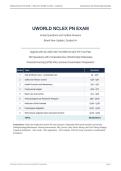
UWORLD NCLEX PN EXAM | 2026-2027 NCSBN Test Plan | Graded A+ 150 Questions with UWorld-Style Rationales
UWORLD NCLEX PN EXAM
Actual Questions and Verified Answers
Brand New Update | Graded A+
Aligned with the 2026-2027 NCSBN NCLEX-PN Test Plan
150 Questions with Comprehensive UWorld-Style Rationales
Practical Nursing (LPN/LVN) Licensure Examination Preparation
Section Topic Questions
1 Safe & Effective Care - Coordinated Care Q1 - Q25
2 Safety and Infection Control Q26 - Q40
3 Health Promotion and Maintenance Q41 - Q55
4 Psychosocial Integrity Q56 - Q70
5 Basic Care and Comfort Q71 - Q85
6 Pharmacological and Parenteral Therapies Q86 - Q105
7 Reduction of Risk Potential Q106 - Q120
8 Physiological Adaptation Q121 - Q145
9 NGN Clinical Judgment (Next Generation NCLEX) Q146 - Q150
TOTAL 150 Questions
Instructions: Select the single best answer for each question. Rationales follow each question and include
Pathophysiology/Mechanism, Nursing Interventions, Why Correct, Why Others Wrong, and Test-Taking Strategy.
Cognitive distribution: ~20% recall, ~50% application, ~30% analysis. PN/LVN scope of practice is emphasized
throughout.
Practical Nursing Licensure Examination Preparation Page 1
,UWORLD NCLEX PN EXAM | 2026-2027 NCSBN Test Plan | Graded A+ 150 Questions with UWorld-Style Rationales
SECTION 1: Safe and Effective Care Environment - Coordinated Care
(Q1-Q25)
Advocacy | Client Rights | Delegation | Supervision | Assignment | Ethics | Legal Issues | Advance Directives |
HIPAA | Continuity | Interdisciplinary Collaboration | Case Management | Resource Management
Q1. An LPN/LVN is caring for a 78-year-old client with stage IV pancreatic cancer who tells the
nurse, "I don't want any more chemotherapy. I just want to go home and be comfortable." The
oncologist writes an order to restart chemotherapy. Which action by the LPN/LVN best
demonstrates client advocacy?
A. Administer the chemotherapy as ordered because the provider prescribed it
B. Withhold the chemotherapy and immediately notify the RN and the oncologist of the client's wishes
[CORRECT]
C. Document the client's statement and administer the chemotherapy later in the shift
D. Tell the client they must follow the oncologist's treatment plan
Correct Answer: B
Rationale:
Pathophysiology: Stage IV pancreatic cancer carries a poor prognosis, and clients have the right to refuse
treatment under the ethical principle of autonomy. The LPN/LVN functions as a client advocate by communicating
the client's informed refusal upward through the chain of command.
Nursing Interventions: Withhold the medication pending clarification, notify the RN who can then contact the
prescribing provider, document the client's statement verbatim, and facilitate a goals-of-care conversation. The PN
does not independently decide to discontinue treatment but ensures the team is aware of the client's wishes.
Why Correct: Withholding the chemotherapy and notifying the RN and oncologist immediately protects the client's
autonomy and ensures the provider is aware of the refusal before any medication is given.
Why Others Wrong: A is wrong - administering against the client's expressed wishes violates autonomy and
informed consent. C is wrong - delaying administration without notification fails advocacy and could result in the
medication being given later. D is wrong - clients have the legal right to refuse treatment; the nurse must not coerce.
Test-Taking Strategy: When a client refuses treatment, remember the advocacy sequence: (1) ensure informed
refusal, (2) notify the provider/RN, (3) document. Never administer a treatment the client has refused.
Q2. Which of the following tasks is most appropriate for the RN to delegate to an experienced
LPN/LVN on a medical-surgical unit?
A. Initial admission assessment of a client newly diagnosed with acute heart failure
B. Teaching a newly diagnosed client about self-administration of enoxaparin injections
C. Reinforcing discharge teaching about a low-sodium diet for a client with heart failure [CORRECT]
D. Developing the plan of care for a client with new-onset diabetic ketoacidosis
Correct Answer: C
Rationale:
Pathophysiology: Delegation follows the Five Rights: Right Task, Right Circumstance, Right Person, Right
Direction/Communication, and Right Supervision/Evaluation. The LPN/LVN scope includes reinforcing teaching,
caring for stable clients, and performing routine treatments.
Nursing Interventions: LPN/LVNs may reinforce teaching already initiated by the RN, monitor stable clients,
administer oral and subcutaneous medications (per state practice act), and perform wound care. Initial assessments,
initial teaching, care plan development, and unstable clients require RN scope.
Practical Nursing Licensure Examination Preparation Page 2
,UWORLD NCLEX PN EXAM | 2026-2027 NCSBN Test Plan | Graded A+ 150 Questions with UWorld-Style Rationales
Why Correct: Reinforcing existing discharge teaching about a low-sodium diet is within LPN/LVN scope and is
appropriate to delegate.
Why Others Wrong: A is wrong - initial admission assessment requires RN scope. B is wrong - initial teaching of a
high-alert anticoagulant injection is RN responsibility. D is wrong - developing the plan of care for an unstable DKA
client is RN scope.
Test-Taking Strategy: On NCLEX, LPN/LVN scope = stable clients + reinforce (not initiate) teaching + routine
treatments. Initial assessment, initial teaching, care plan development, and unstable clients stay with the RN.
Q3. A client is scheduled for an elective cholecystectomy and the surgeon has explained the
procedure, risks, and alternatives. The client signs the consent form. Later, the client tells the
LPN/LVN, "I'm not really sure what I signed - my mind was elsewhere." What is the priority action?
A. Re-explain the surgery to the client using simple language
B. Notify the surgeon and the RN that the client may not have given informed consent [CORRECT]
C. Document the client's statement in the medical record and continue preoperative preparation
D. Cancel the surgery and notify the family
Correct Answer: B
Rationale:
Pathophysiology: Informed consent requires four elements: capacity, disclosure, comprehension, and
voluntariness. If the client does not understand, consent is not valid. The provider (not the nurse) is responsible for
explaining the procedure, risks, benefits, and alternatives.
Nursing Interventions: The nurse's role is to witness the signature and assess for understanding. If the client
expresses lack of understanding, the nurse must notify the surgeon (who must re-consent the client) and the RN.
The nurse should NOT attempt to provide the surgical explanation.
Why Correct: Notifying the surgeon and RN is correct because the provider is responsible for ensuring informed
consent; the nurse identifies the gap and escalates.
Why Others Wrong: A is wrong - the nurse should not provide the surgical explanation; this is the provider's
responsibility. C is wrong - proceeding without valid consent is a battery risk. D is wrong - the nurse does not have
the authority to cancel surgery; the surgeon and client make that decision.
Test-Taking Strategy: For informed consent questions, remember: the provider explains, the nurse witnesses and
assesses understanding. If understanding is questionable, notify the provider - do not explain, do not proceed.
Q4. Which client situation requires mandatory reporting by the LPN/LVN to the appropriate
authorities?
A. A 32-year-old client who refuses a blood transfusion due to religious beliefs
B. A 6-year-old child with patterned bruises on the back and buttocks inconsistent with the stated history
[CORRECT]
C. An 80-year-old client who chooses to discontinue dialysis and pursue hospice care
D. A 45-year-old client who leaves the hospital against medical advice
Correct Answer: B
Rationale:
Pathophysiology: Mandatory reporting laws require nurses to report suspected child abuse, elder abuse, domestic
violence, certain communicable diseases, and gunshot wounds. Patterned bruises (e.g., belt marks, handprints) on
atypical areas like the back or buttocks are highly suggestive of non-accidental trauma.
Nursing Interventions: Document objectively (location, size, pattern, color of bruises), report to the charge
nurse/RN and provider, and file a report with Child Protective Services or law enforcement per state law. Do not
interrogate the family; do not delay reporting to gather more evidence.
Practical Nursing Licensure Examination Preparation Page 3
, UWORLD NCLEX PN EXAM | 2026-2027 NCSBN Test Plan | Graded A+ 150 Questions with UWorld-Style Rationales
Why Correct: Suspected child abuse with patterned bruises inconsistent with the history is a mandated report;
failure to report can result in civil/criminal liability and loss of licensure.
Why Others Wrong: A is wrong - competent adults may refuse treatment; this is autonomy, not reportable. C is
wrong - a competent adult may choose to discontinue dialysis; this is end-of-life autonomy. D is wrong - AMA
discharge is documented but is not a mandatory report to authorities.
Test-Taking Strategy: Mandatory reporting triggers: suspected child/elder abuse, certain infectious diseases (TB,
HIV varies by state), gunshot wounds, and births. Competent refusals and AMA discharges are not reportable.
Q5. A client with a terminal illness has a valid Do-Not-Resuscitate (DNR) order. The client goes into
pulseless electrical activity (PEA) arrest. The LPN/LVN walks in and finds the UAP about to begin
chest compressions. What is the best action?
A. Help the UAP begin CPR because all arrests require resuscitation
B. Stop the UAP and remind them the client has a DNR order [CORRECT]
C. Call a code blue and let the team decide whether to resuscitate
D. Call the family to ask if they want resuscitation
Correct Answer: B
Rationale:
Pathophysiology: A DNR order is a medical order that directs health care providers not to perform CPR in the event
of cardiac or respiratory arrest. It must be respected in all settings, including hospitals, long-term care, and home.
Honoring a DNR is both an ethical and legal obligation.
Nursing Interventions: Verify the DNR is current and valid, stop resuscitative efforts, provide comfort care, notify
the provider and family, and document. The UAP may not be aware of the order, so the nurse must intervene
immediately.
Why Correct: Stopping the UAP and reminding them of the DNR order honors the client's wishes and prevents
unwanted resuscitation.
Why Others Wrong: A is wrong - performing CPR on a client with a valid DNR is battery. C is wrong - calling a code
blue may trigger resuscitation; the DNR must be honored. D is wrong - the family does not override a valid DNR; the
order stands.
Test-Taking Strategy: DNR orders must be respected. Verify the order is valid, stop CPR if initiated in error, and
provide comfort care. The family cannot override a valid DNR once written.
Q6. An LPN/LVN overhears a colleague discussing a client's diagnosis in the hospital elevator.
Which action by the LPN/LVN is most appropriate?
A. Ignore it because the colleague is licensed and knows better
B. Report the colleague to the nursing supervisor for a HIPAA violation [CORRECT]
C. Join the conversation to redirect it to a more private setting
D. Wait to see if it happens again before taking any action
Correct Answer: B
Rationale:
Pathophysiology: HIPAA (Health Insurance Portability and Accountability Act) protects Protected Health
Information (PHI). Discussing client information in public areas (elevators, hallways, cafeterias) is a breach of
confidentiality. All nurses are mandated to report known violations.
Nursing Interventions: If safe, the witness should quietly redirect the colleague to stop the conversation. Then
report the incident through the facility's chain of command so it can be documented and addressed. Failure to report
can implicate the witness.
Practical Nursing Licensure Examination Preparation Page 4
UWORLD NCLEX PN EXAM
Actual Questions and Verified Answers
Brand New Update | Graded A+
Aligned with the 2026-2027 NCSBN NCLEX-PN Test Plan
150 Questions with Comprehensive UWorld-Style Rationales
Practical Nursing (LPN/LVN) Licensure Examination Preparation
Section Topic Questions
1 Safe & Effective Care - Coordinated Care Q1 - Q25
2 Safety and Infection Control Q26 - Q40
3 Health Promotion and Maintenance Q41 - Q55
4 Psychosocial Integrity Q56 - Q70
5 Basic Care and Comfort Q71 - Q85
6 Pharmacological and Parenteral Therapies Q86 - Q105
7 Reduction of Risk Potential Q106 - Q120
8 Physiological Adaptation Q121 - Q145
9 NGN Clinical Judgment (Next Generation NCLEX) Q146 - Q150
TOTAL 150 Questions
Instructions: Select the single best answer for each question. Rationales follow each question and include
Pathophysiology/Mechanism, Nursing Interventions, Why Correct, Why Others Wrong, and Test-Taking Strategy.
Cognitive distribution: ~20% recall, ~50% application, ~30% analysis. PN/LVN scope of practice is emphasized
throughout.
Practical Nursing Licensure Examination Preparation Page 1
,UWORLD NCLEX PN EXAM | 2026-2027 NCSBN Test Plan | Graded A+ 150 Questions with UWorld-Style Rationales
SECTION 1: Safe and Effective Care Environment - Coordinated Care
(Q1-Q25)
Advocacy | Client Rights | Delegation | Supervision | Assignment | Ethics | Legal Issues | Advance Directives |
HIPAA | Continuity | Interdisciplinary Collaboration | Case Management | Resource Management
Q1. An LPN/LVN is caring for a 78-year-old client with stage IV pancreatic cancer who tells the
nurse, "I don't want any more chemotherapy. I just want to go home and be comfortable." The
oncologist writes an order to restart chemotherapy. Which action by the LPN/LVN best
demonstrates client advocacy?
A. Administer the chemotherapy as ordered because the provider prescribed it
B. Withhold the chemotherapy and immediately notify the RN and the oncologist of the client's wishes
[CORRECT]
C. Document the client's statement and administer the chemotherapy later in the shift
D. Tell the client they must follow the oncologist's treatment plan
Correct Answer: B
Rationale:
Pathophysiology: Stage IV pancreatic cancer carries a poor prognosis, and clients have the right to refuse
treatment under the ethical principle of autonomy. The LPN/LVN functions as a client advocate by communicating
the client's informed refusal upward through the chain of command.
Nursing Interventions: Withhold the medication pending clarification, notify the RN who can then contact the
prescribing provider, document the client's statement verbatim, and facilitate a goals-of-care conversation. The PN
does not independently decide to discontinue treatment but ensures the team is aware of the client's wishes.
Why Correct: Withholding the chemotherapy and notifying the RN and oncologist immediately protects the client's
autonomy and ensures the provider is aware of the refusal before any medication is given.
Why Others Wrong: A is wrong - administering against the client's expressed wishes violates autonomy and
informed consent. C is wrong - delaying administration without notification fails advocacy and could result in the
medication being given later. D is wrong - clients have the legal right to refuse treatment; the nurse must not coerce.
Test-Taking Strategy: When a client refuses treatment, remember the advocacy sequence: (1) ensure informed
refusal, (2) notify the provider/RN, (3) document. Never administer a treatment the client has refused.
Q2. Which of the following tasks is most appropriate for the RN to delegate to an experienced
LPN/LVN on a medical-surgical unit?
A. Initial admission assessment of a client newly diagnosed with acute heart failure
B. Teaching a newly diagnosed client about self-administration of enoxaparin injections
C. Reinforcing discharge teaching about a low-sodium diet for a client with heart failure [CORRECT]
D. Developing the plan of care for a client with new-onset diabetic ketoacidosis
Correct Answer: C
Rationale:
Pathophysiology: Delegation follows the Five Rights: Right Task, Right Circumstance, Right Person, Right
Direction/Communication, and Right Supervision/Evaluation. The LPN/LVN scope includes reinforcing teaching,
caring for stable clients, and performing routine treatments.
Nursing Interventions: LPN/LVNs may reinforce teaching already initiated by the RN, monitor stable clients,
administer oral and subcutaneous medications (per state practice act), and perform wound care. Initial assessments,
initial teaching, care plan development, and unstable clients require RN scope.
Practical Nursing Licensure Examination Preparation Page 2
,UWORLD NCLEX PN EXAM | 2026-2027 NCSBN Test Plan | Graded A+ 150 Questions with UWorld-Style Rationales
Why Correct: Reinforcing existing discharge teaching about a low-sodium diet is within LPN/LVN scope and is
appropriate to delegate.
Why Others Wrong: A is wrong - initial admission assessment requires RN scope. B is wrong - initial teaching of a
high-alert anticoagulant injection is RN responsibility. D is wrong - developing the plan of care for an unstable DKA
client is RN scope.
Test-Taking Strategy: On NCLEX, LPN/LVN scope = stable clients + reinforce (not initiate) teaching + routine
treatments. Initial assessment, initial teaching, care plan development, and unstable clients stay with the RN.
Q3. A client is scheduled for an elective cholecystectomy and the surgeon has explained the
procedure, risks, and alternatives. The client signs the consent form. Later, the client tells the
LPN/LVN, "I'm not really sure what I signed - my mind was elsewhere." What is the priority action?
A. Re-explain the surgery to the client using simple language
B. Notify the surgeon and the RN that the client may not have given informed consent [CORRECT]
C. Document the client's statement in the medical record and continue preoperative preparation
D. Cancel the surgery and notify the family
Correct Answer: B
Rationale:
Pathophysiology: Informed consent requires four elements: capacity, disclosure, comprehension, and
voluntariness. If the client does not understand, consent is not valid. The provider (not the nurse) is responsible for
explaining the procedure, risks, benefits, and alternatives.
Nursing Interventions: The nurse's role is to witness the signature and assess for understanding. If the client
expresses lack of understanding, the nurse must notify the surgeon (who must re-consent the client) and the RN.
The nurse should NOT attempt to provide the surgical explanation.
Why Correct: Notifying the surgeon and RN is correct because the provider is responsible for ensuring informed
consent; the nurse identifies the gap and escalates.
Why Others Wrong: A is wrong - the nurse should not provide the surgical explanation; this is the provider's
responsibility. C is wrong - proceeding without valid consent is a battery risk. D is wrong - the nurse does not have
the authority to cancel surgery; the surgeon and client make that decision.
Test-Taking Strategy: For informed consent questions, remember: the provider explains, the nurse witnesses and
assesses understanding. If understanding is questionable, notify the provider - do not explain, do not proceed.
Q4. Which client situation requires mandatory reporting by the LPN/LVN to the appropriate
authorities?
A. A 32-year-old client who refuses a blood transfusion due to religious beliefs
B. A 6-year-old child with patterned bruises on the back and buttocks inconsistent with the stated history
[CORRECT]
C. An 80-year-old client who chooses to discontinue dialysis and pursue hospice care
D. A 45-year-old client who leaves the hospital against medical advice
Correct Answer: B
Rationale:
Pathophysiology: Mandatory reporting laws require nurses to report suspected child abuse, elder abuse, domestic
violence, certain communicable diseases, and gunshot wounds. Patterned bruises (e.g., belt marks, handprints) on
atypical areas like the back or buttocks are highly suggestive of non-accidental trauma.
Nursing Interventions: Document objectively (location, size, pattern, color of bruises), report to the charge
nurse/RN and provider, and file a report with Child Protective Services or law enforcement per state law. Do not
interrogate the family; do not delay reporting to gather more evidence.
Practical Nursing Licensure Examination Preparation Page 3
, UWORLD NCLEX PN EXAM | 2026-2027 NCSBN Test Plan | Graded A+ 150 Questions with UWorld-Style Rationales
Why Correct: Suspected child abuse with patterned bruises inconsistent with the history is a mandated report;
failure to report can result in civil/criminal liability and loss of licensure.
Why Others Wrong: A is wrong - competent adults may refuse treatment; this is autonomy, not reportable. C is
wrong - a competent adult may choose to discontinue dialysis; this is end-of-life autonomy. D is wrong - AMA
discharge is documented but is not a mandatory report to authorities.
Test-Taking Strategy: Mandatory reporting triggers: suspected child/elder abuse, certain infectious diseases (TB,
HIV varies by state), gunshot wounds, and births. Competent refusals and AMA discharges are not reportable.
Q5. A client with a terminal illness has a valid Do-Not-Resuscitate (DNR) order. The client goes into
pulseless electrical activity (PEA) arrest. The LPN/LVN walks in and finds the UAP about to begin
chest compressions. What is the best action?
A. Help the UAP begin CPR because all arrests require resuscitation
B. Stop the UAP and remind them the client has a DNR order [CORRECT]
C. Call a code blue and let the team decide whether to resuscitate
D. Call the family to ask if they want resuscitation
Correct Answer: B
Rationale:
Pathophysiology: A DNR order is a medical order that directs health care providers not to perform CPR in the event
of cardiac or respiratory arrest. It must be respected in all settings, including hospitals, long-term care, and home.
Honoring a DNR is both an ethical and legal obligation.
Nursing Interventions: Verify the DNR is current and valid, stop resuscitative efforts, provide comfort care, notify
the provider and family, and document. The UAP may not be aware of the order, so the nurse must intervene
immediately.
Why Correct: Stopping the UAP and reminding them of the DNR order honors the client's wishes and prevents
unwanted resuscitation.
Why Others Wrong: A is wrong - performing CPR on a client with a valid DNR is battery. C is wrong - calling a code
blue may trigger resuscitation; the DNR must be honored. D is wrong - the family does not override a valid DNR; the
order stands.
Test-Taking Strategy: DNR orders must be respected. Verify the order is valid, stop CPR if initiated in error, and
provide comfort care. The family cannot override a valid DNR once written.
Q6. An LPN/LVN overhears a colleague discussing a client's diagnosis in the hospital elevator.
Which action by the LPN/LVN is most appropriate?
A. Ignore it because the colleague is licensed and knows better
B. Report the colleague to the nursing supervisor for a HIPAA violation [CORRECT]
C. Join the conversation to redirect it to a more private setting
D. Wait to see if it happens again before taking any action
Correct Answer: B
Rationale:
Pathophysiology: HIPAA (Health Insurance Portability and Accountability Act) protects Protected Health
Information (PHI). Discussing client information in public areas (elevators, hallways, cafeterias) is a breach of
confidentiality. All nurses are mandated to report known violations.
Nursing Interventions: If safe, the witness should quietly redirect the colleague to stop the conversation. Then
report the incident through the facility's chain of command so it can be documented and addressed. Failure to report
can implicate the witness.
Practical Nursing Licensure Examination Preparation Page 4


