

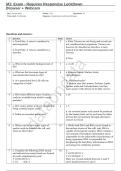
M1: Exam - Requires Respondus LockDown
Browser + Webcam
Due No due date Points 100 Questions 21
Time Limit 60 Minutes Requires Respondus LockDown Browser
Questions and Answers:
# Question Points Answer
1 a. True/False. A virus is considered a 3 a. False (Viruses are not living and as such are
microorganism. not considered microorganisms. Viruses can,
however, be classified as microbes, a more
b. True/False. A virus is classified as a general term that includes microorganisms and
microbe. viruses).
b. True
2 a. What is the smallest biological unit of 3 a. A cell
ta
life?
3 a. What are the four main types of 4 a. Proteins, Lipids, Nucleic Acids,
macromolecules found in cells? Carbohydrates
da
b. At a generalized level, all cells are b. Macromolecules*
comprised of what? *A student may also answer: Proteins, Lipids,
Nucleic acids and Carbohydrates, but they
must answer with all four to be fully correct.
on
4 a. How many different types of amino 3 a. 20
acids are available from which to make
proteins?
5 a. How many amino acids are classified as 4 a. 9
ta
being essential amino acids?
b. An essential amino acid cannot be produced
b. Define an essential amino acid. by the human body and as such must be taken
in from the environment through alternative
da
sources (i.e) food.
6 a. Where can the two major types of 10 a. While both DNA and RNA can be found in
nucleic acids be found in the cell, and the nucleus (center of the cell), only RNA is
what are their roles? capable of leaving the nucleus. DNA contains a
vast amount of hereditary information and is
responsible for the inheritable characteristics of
living organisms. RNA is responsible for
deciphering the hereditary information in DNA
and using it to synthesize proteins.
7 a. Complete the following DNA strand, 10 a.
and indicate how many bonds are formed 3’ GGTCATCG 5’
for each complementary pair: 5’ CCAGTAGC 3’
3’ GGTCATCG 5’ There are 2 bonds formed between A and T,
5’ CC AGC 3’ and 3 bonds between G and C.
, M1: Exam - Requires Respondus LockDown
Browser + Webcam
Due No due date Points 100 Questions 21
Time Limit 60 Minutes Requires Respondus LockDown Browser
# Question Points Answer
8 a. The plasma membrane (select all that 5 a.
are true): - Restricts movement of materials in and out of
- Restricts movement of materials in and the cell
out of the cell - Prevents essential nutrients from escaping
- Is often a triple layer comprised of lipids
- Prevents essential nutrients from b.
escaping - Is often a bilayer layer comprised of lipids
- Contains hydrophobic tails pointing - Contains hydrophobic tails pointing inward
outward
ta
b. The plasma membrane (select all that
are true):
- Only restricts movement of materials
into the cell
da
- Is often a bilayer layer comprised of
lipids
- Cannot prevent essential nutrients from
escaping
- Contains hydrophobic tails pointing
on
inward
9 a. How many carbon atoms are present in 5 a. 6 (The molecular formula of Glucose is
glucose? C6H12O6)
-1
ta
-3 b. Carbohydrates.
-6 Any sugar is acceptable: Glucose, sucrose,
- 12 fructose, galactose, lactose, maltose, etc.
Also options: Starch, glycogen, cellulose or
da
b. Carbon, hydrogen and oxygen atoms chitin
come together to form what primary
macromolecule? Give an example.
10 a. True or False: The genetic material 3 a. False (Only eukaryotic cells contain its
within a prokaryotic cell is contained genetic material within a nucleus).
within a membrane-enclosed region.
11 a. Describe the 4 basic bacterial 4 a. Coccus (round/spherical), bacillus (rod),
morphologies. vibrio (curved rod) or spirillum
(spiral/corkscrew).
b. True or False: Prokaryotic cells can be
subdivided into Bacteria and Archaea. b. True
Browser + Webcam
Due No due date Points 100 Questions 21
Time Limit 60 Minutes Requires Respondus LockDown Browser
Questions and Answers:
# Question Points Answer
1 a. True/False. A virus is considered a 3 a. False (Viruses are not living and as such are
microorganism. not considered microorganisms. Viruses can,
however, be classified as microbes, a more
b. True/False. A virus is classified as a general term that includes microorganisms and
microbe. viruses).
b. True
2 a. What is the smallest biological unit of 3 a. A cell
ta
life?
3 a. What are the four main types of 4 a. Proteins, Lipids, Nucleic Acids,
macromolecules found in cells? Carbohydrates
da
b. At a generalized level, all cells are b. Macromolecules*
comprised of what? *A student may also answer: Proteins, Lipids,
Nucleic acids and Carbohydrates, but they
must answer with all four to be fully correct.
on
4 a. How many different types of amino 3 a. 20
acids are available from which to make
proteins?
5 a. How many amino acids are classified as 4 a. 9
ta
being essential amino acids?
b. An essential amino acid cannot be produced
b. Define an essential amino acid. by the human body and as such must be taken
in from the environment through alternative
da
sources (i.e) food.
6 a. Where can the two major types of 10 a. While both DNA and RNA can be found in
nucleic acids be found in the cell, and the nucleus (center of the cell), only RNA is
what are their roles? capable of leaving the nucleus. DNA contains a
vast amount of hereditary information and is
responsible for the inheritable characteristics of
living organisms. RNA is responsible for
deciphering the hereditary information in DNA
and using it to synthesize proteins.
7 a. Complete the following DNA strand, 10 a.
and indicate how many bonds are formed 3’ GGTCATCG 5’
for each complementary pair: 5’ CCAGTAGC 3’
3’ GGTCATCG 5’ There are 2 bonds formed between A and T,
5’ CC AGC 3’ and 3 bonds between G and C.
, M1: Exam - Requires Respondus LockDown
Browser + Webcam
Due No due date Points 100 Questions 21
Time Limit 60 Minutes Requires Respondus LockDown Browser
# Question Points Answer
8 a. The plasma membrane (select all that 5 a.
are true): - Restricts movement of materials in and out of
- Restricts movement of materials in and the cell
out of the cell - Prevents essential nutrients from escaping
- Is often a triple layer comprised of lipids
- Prevents essential nutrients from b.
escaping - Is often a bilayer layer comprised of lipids
- Contains hydrophobic tails pointing - Contains hydrophobic tails pointing inward
outward
ta
b. The plasma membrane (select all that
are true):
- Only restricts movement of materials
into the cell
da
- Is often a bilayer layer comprised of
lipids
- Cannot prevent essential nutrients from
escaping
- Contains hydrophobic tails pointing
on
inward
9 a. How many carbon atoms are present in 5 a. 6 (The molecular formula of Glucose is
glucose? C6H12O6)
-1
ta
-3 b. Carbohydrates.
-6 Any sugar is acceptable: Glucose, sucrose,
- 12 fructose, galactose, lactose, maltose, etc.
Also options: Starch, glycogen, cellulose or
da
b. Carbon, hydrogen and oxygen atoms chitin
come together to form what primary
macromolecule? Give an example.
10 a. True or False: The genetic material 3 a. False (Only eukaryotic cells contain its
within a prokaryotic cell is contained genetic material within a nucleus).
within a membrane-enclosed region.
11 a. Describe the 4 basic bacterial 4 a. Coccus (round/spherical), bacillus (rod),
morphologies. vibrio (curved rod) or spirillum
(spiral/corkscrew).
b. True or False: Prokaryotic cells can be
subdivided into Bacteria and Archaea. b. True


