
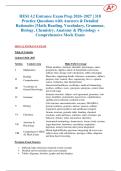
HESI A2 Entrance Exam Prep 2026–2027 | 318
Practice Questions with Answers & Detailed
Rationales | Math, Reading, Vocabulary, Grammar,
Biology, Chemistry, Anatomy & Physiology +
Comprehensive Mock Exam
HESI A2 ENTRANCE EXAM
Table of Contents
Updated 2026–2027
Section Content Area High-Yield Coverage
Whole numbers, fractions, decimals, percentages, ratios,
I Mathematics proportions, algebra, metric & household conversions,
military time, dosage-style calculations, tables and graphs
Reading Main idea, supporting details, inference, summaries, author's
II purpose, tone, context clues, sequencing, fact vs. opinion,
Comprehension
source evaluation, data interpretation
General and healthcare vocabulary, medical terminology,
Vocabulary &
III prefixes, suffixes, roots, synonyms, antonyms, context clues
General Knowledge
and word usage
Sentence structure, subject–verb agreement, pronouns, verb
IV Grammar tense, modifiers, punctuation, possessives, capitalization,
spelling and commonly confused words
Cell structure, macromolecules, enzymes, DNA/RNA,
V Biology protein synthesis, genetics, mitosis, meiosis, cellular
respiration, photosynthesis and membrane transport
Atomic structure, periodic table, bonding, chemical
VI Chemistry reactions, acids and bases, solutions, states of matter, gas
behavior, density, redox and nuclear chemistry
Anatomy & Anatomical terminology, homeostasis, tissues, body systems,
VII Physiology organ functions, hormones, circulation, respiration,
digestion, urinary function and system integration
Mixed high-difficulty questions integrating all seven core
Comprehensive HESI
VIII subject areas with calculations, passages, tables, diagrams
A2 Mock Exam
and data-based reasoning
Premium Exam Features
Difficult, high-yield and commonly tested concepts
Detailed answer rationales and exam strategies
Tables, diagrams, sketches, graphs and data displays
, Clinical and real-world application questions
Integrated multistep and critical-reasoning problems
Section-by-section answer keys
Updated 2026–2027 comprehensive preparation
HESI A2 ENTRANCE EXAM — SECTION I: MATHEMATICS
Question 1
A supply department begins with 5,460 examination gloves. During the morning, 1,785
gloves are used. An afternoon delivery adds 2,240 gloves, after which another 675 gloves are
used. How many gloves remain?
A. 4,365 B. 4,565 C. 5,015 D. 5,240
Correct Answer: D — 5,240
Rationale:
[ 5460-1785+2240-675=5240 ]
🎯 HESI Strategy: Process multistep inventory problems in the exact chronological order
given.
• Math Pearl: Intermediate values are often included as distractors.
Question 2
A nursing student needs to convert 2.75 liters of IV fluid into milliliters. How many
milliliters are equivalent to 2.75 liters?
A. 27.5 mL
B. 275 mL
C. 2,750 mL
D. 27,500 mL
Correct Answer: C — 2,750 mL
Rationale:
There are 1,000 milliliters (mL) in 1 liter (L).
2.75 L×1,000 mL1 L=2,750 mL2.75\text{ L}\times\frac{1,000\text{ mL}}{1\text{
L}}=2,750\text{ mL}
Therefore, 2.75 L = 2,750 mL.
,🎯 HESI Strategy: Memorize the most frequently tested metric conversions: 1 L = 1,000
mL, 1 g = 1,000 mg, and 1 kg = 1,000 g.
• Math Pearl: When converting a larger metric unit to a smaller unit, the numerical value
increases.
Question 3
A patient drinks 34\frac{3}{4} of a 240-mL bottle of water. How many milliliters of water
did the patient drink?
A. 160 mL
B. 180 mL
C. 200 mL
D. 210 mL
Correct Answer: B — 180 mL
Rationale:
Multiply the total volume by the fraction consumed:
34×240\frac{3}{4}\times240
First divide:
240÷4=60240\div4=60
Then multiply:
60×3=18060\times3=180
Therefore, the patient drank 180 mL.
🎯 HESI Strategy: For fraction-of-a-number questions, divide by the denominator first and
multiply by the numerator.
• Math Pearl: Always identify whether the question asks for the amount used, remaining,
increased, or decreased.
Question 4
A clinic has 360 syringes. If 15% are defective, how many syringes are defective?
, A. 36
B. 45
C. 54
D. 60
Correct Answer: C — 54
Rationale:
Convert 15% to a decimal:
15%=0.1515\%=0.15
Then calculate:
360×0.15=54360\times0.15=54
Therefore, 54 syringes are defective.
🎯 HESI Strategy: Convert percentages to decimals before multiplying.
• Math Pearl: To find a percentage of a quantity, multiply the quantity by the decimal form
of the percentage.
Question 5
A medication bottle contains 480 mg of medication. A patient receives 160 mg. What
percentage of the medication was administered?
A. 25%
B. 30%
C. 33.3%
D. 40%
Correct Answer: C — 33.3%
Rationale:
Use:
amount administeredtotal amount×100\frac{\text{amount administered}}{\text{total
amount}}\times100 160480×100=33.3%\frac{160}{480}\times100=33.3\%
Therefore, approximately 33.3% of the medication was administered.
🎯 HESI Strategy: For “what percent” questions, use part ÷ whole × 100.
Practice Questions with Answers & Detailed
Rationales | Math, Reading, Vocabulary, Grammar,
Biology, Chemistry, Anatomy & Physiology +
Comprehensive Mock Exam
HESI A2 ENTRANCE EXAM
Table of Contents
Updated 2026–2027
Section Content Area High-Yield Coverage
Whole numbers, fractions, decimals, percentages, ratios,
I Mathematics proportions, algebra, metric & household conversions,
military time, dosage-style calculations, tables and graphs
Reading Main idea, supporting details, inference, summaries, author's
II purpose, tone, context clues, sequencing, fact vs. opinion,
Comprehension
source evaluation, data interpretation
General and healthcare vocabulary, medical terminology,
Vocabulary &
III prefixes, suffixes, roots, synonyms, antonyms, context clues
General Knowledge
and word usage
Sentence structure, subject–verb agreement, pronouns, verb
IV Grammar tense, modifiers, punctuation, possessives, capitalization,
spelling and commonly confused words
Cell structure, macromolecules, enzymes, DNA/RNA,
V Biology protein synthesis, genetics, mitosis, meiosis, cellular
respiration, photosynthesis and membrane transport
Atomic structure, periodic table, bonding, chemical
VI Chemistry reactions, acids and bases, solutions, states of matter, gas
behavior, density, redox and nuclear chemistry
Anatomy & Anatomical terminology, homeostasis, tissues, body systems,
VII Physiology organ functions, hormones, circulation, respiration,
digestion, urinary function and system integration
Mixed high-difficulty questions integrating all seven core
Comprehensive HESI
VIII subject areas with calculations, passages, tables, diagrams
A2 Mock Exam
and data-based reasoning
Premium Exam Features
Difficult, high-yield and commonly tested concepts
Detailed answer rationales and exam strategies
Tables, diagrams, sketches, graphs and data displays
, Clinical and real-world application questions
Integrated multistep and critical-reasoning problems
Section-by-section answer keys
Updated 2026–2027 comprehensive preparation
HESI A2 ENTRANCE EXAM — SECTION I: MATHEMATICS
Question 1
A supply department begins with 5,460 examination gloves. During the morning, 1,785
gloves are used. An afternoon delivery adds 2,240 gloves, after which another 675 gloves are
used. How many gloves remain?
A. 4,365 B. 4,565 C. 5,015 D. 5,240
Correct Answer: D — 5,240
Rationale:
[ 5460-1785+2240-675=5240 ]
🎯 HESI Strategy: Process multistep inventory problems in the exact chronological order
given.
• Math Pearl: Intermediate values are often included as distractors.
Question 2
A nursing student needs to convert 2.75 liters of IV fluid into milliliters. How many
milliliters are equivalent to 2.75 liters?
A. 27.5 mL
B. 275 mL
C. 2,750 mL
D. 27,500 mL
Correct Answer: C — 2,750 mL
Rationale:
There are 1,000 milliliters (mL) in 1 liter (L).
2.75 L×1,000 mL1 L=2,750 mL2.75\text{ L}\times\frac{1,000\text{ mL}}{1\text{
L}}=2,750\text{ mL}
Therefore, 2.75 L = 2,750 mL.
,🎯 HESI Strategy: Memorize the most frequently tested metric conversions: 1 L = 1,000
mL, 1 g = 1,000 mg, and 1 kg = 1,000 g.
• Math Pearl: When converting a larger metric unit to a smaller unit, the numerical value
increases.
Question 3
A patient drinks 34\frac{3}{4} of a 240-mL bottle of water. How many milliliters of water
did the patient drink?
A. 160 mL
B. 180 mL
C. 200 mL
D. 210 mL
Correct Answer: B — 180 mL
Rationale:
Multiply the total volume by the fraction consumed:
34×240\frac{3}{4}\times240
First divide:
240÷4=60240\div4=60
Then multiply:
60×3=18060\times3=180
Therefore, the patient drank 180 mL.
🎯 HESI Strategy: For fraction-of-a-number questions, divide by the denominator first and
multiply by the numerator.
• Math Pearl: Always identify whether the question asks for the amount used, remaining,
increased, or decreased.
Question 4
A clinic has 360 syringes. If 15% are defective, how many syringes are defective?
, A. 36
B. 45
C. 54
D. 60
Correct Answer: C — 54
Rationale:
Convert 15% to a decimal:
15%=0.1515\%=0.15
Then calculate:
360×0.15=54360\times0.15=54
Therefore, 54 syringes are defective.
🎯 HESI Strategy: Convert percentages to decimals before multiplying.
• Math Pearl: To find a percentage of a quantity, multiply the quantity by the decimal form
of the percentage.
Question 5
A medication bottle contains 480 mg of medication. A patient receives 160 mg. What
percentage of the medication was administered?
A. 25%
B. 30%
C. 33.3%
D. 40%
Correct Answer: C — 33.3%
Rationale:
Use:
amount administeredtotal amount×100\frac{\text{amount administered}}{\text{total
amount}}\times100 160480×100=33.3%\frac{160}{480}\times100=33.3\%
Therefore, approximately 33.3% of the medication was administered.
🎯 HESI Strategy: For “what percent” questions, use part ÷ whole × 100.


