

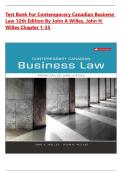
Test Bank For Contemporary Canadian Business
Law 12th Edition By John A Willes, John H
Willes Chapter 1-35
,Table of contents
1. Chapter 1: The Law and the Legal System
2. Chapter 2: The Judicial System and Alternative Dispute Resolution
3. Chapter 3: Business Regulation
4. Chapter 4: Intentional Torts
5. Chapter 5: Negligence and Unintentional Torts
6. Chapter 6: Special Tort Liabilities of Business Professionals
7. Chapter 7: An Introduction to Contracts
8. Chapter 8: The Requirement of Consideration
9. Chapter 9: Legal Capacity to Contract and the Requirement of Legality
10. Chapter 10: The Requirements of Form and Writing
11. Chapter 11: Failure to Create an Enforceable Contract
12. Chapter 12: The Extent of Contractual Rights
13. Chapter 13: Performance of Contractual Obligations
14. Chapter 14: Breach of Contract and Remedies
15. Chapter 15: Law of Agency
16. Chapter 16: Law of Sole Proprietorship and Partnership
17. Chapter 17: Corporation Law
18. Chapter 18: Securities Regulation
19. Chapter 19: Employment and Labour Relations
20. Chapter 20: The Law of Bailment
21. Chapter 21: The Sale of Goods
22. Chapter 22: Interests in Land
23. Chapter 23: The Law of Mortgages
24. Chapter 24: Leasehold Interests
25. Chapter 25: Commercial and Residential Real Estate Transactions
26. Chapter 26: Intellectual Property, Patents, Trademarks, Copyright, and Franchising
27. Chapter 27: Consumer Protection Legislation
28. Chapter 28: Law of Negotiable Instruments
29. Chapter 29: Security for Debt
30. Chapter 30: Bankruptcy and Insolvency
31. Chapter 31 Insurance Law
32. Chapter 32: Restrictive Trade Practices
33. Chapter 33: International Business Law
34. Chapter 34: Environmental Law
35. Chapter 35: Privacy Law
,Chapter 1: The Law and the Legal System
Student:
1. Maxine, an accountant annoyed with her employer for telling her that her work was substandard,
created a computer virus that would erase key accounting data if Maxine's name was removed
from the payroll. This is a crime under the Criminal Code. If Maxine is caught, she will be
A. prosecuted by the Crown because the Code is public law.
B. sued by the Crown because the Code is private law.
C. sued by her employer under the Criminal Code because it is a civil law matter.
D. sued by her employer under the Criminal Code because it is a private law matter.
E. prosecuted by the Crown for breach of the Civil Code.
2. The federal government placed new legislation before Parliament regarding the
regulation of telecommunication companies. Which of the following statements is not
true?
A. This proposed legislation is called a "bill."
B. This legislation must be brought before the House of Commons three times and then it will be law
if it is passed.
C. Once the proposed legislation has been passed by the Parliament of Canada; it must be given
royal assent and be proclaimed.
D. Once the proposed legislation has been passed by the Parliament of Canada it can be
amended by another statute.
E. All of the answers are correct.
3. The Simpson brothers have applied to the Liquor Licence Board of the province for a wine and
beer licence for their new restaurant. Which of the following is not true?
A. The board is an administrative tribunal, not a court of law.
B. The decisions of the board become part of the administrative law of the province.
C. Agencies and boards such as this one are part of the expanding government regulation of
private citizens and businesses.
D. The Simpsons will deal with civil servants rather than elected representatives while applying for
their licence.
E The right to make its own rules and procedures is delegated to the board, but these are subject to
the
. approval of the provincial legislature.
4. The government of the province has introduced a bill into the legislature to make the
recycling of household garbage mandatory. Once it has passed third reading, the next step is
that it must be
A. sent to the relevant committee for clause-by-clause study.
B. given royal assent by the Lieutenant-Governor.
C. debated in principle by the members of the legislature.
D. sent to the Senate for approval.
E. amended and prepared for its final reading.
5. When judges apply the principle of stare decisis in deciding a case before them they are, in
effect, applying the
A. substantive law.
B. doctrine of precedent.
C. principles of equity.
D. rules of public administrative law.
E. doctrine of precedent and substantive law.
, 6. The Big Time Construction Company is erecting a large office tower for a major commercial property
developer. In the course of construction, a dispute arises as to the timing of cash advances from the
developer to finance the next stage of construction. The parties had executed a contract between
them which stated that each cash advance from the developer would be provided to the builder
after the work on the previous stage had been completed and inspected by the developer. The
builder now says that the developer is delaying the inspections and that it cannot carry on to the
next stage without the cash advance. The developer says that the builder is deliberately delaying
the progress of the construction by not beginning the next stage while it waits for the inspection
required to release the next cash advance. The developer intends to take legal action against the
builder.
A. The developer must use procedural law to sue the builder.
B. The dispute between the parties will be resolved by substantive law.
C. The contract which the parties made will be interpreted by private law.
D. The court will reach a decision in the case using administrative law.
E. All types of law except administrative law will apply.
7. If it were decided to amend the Constitution to make ownership of property a right, it would be
necessary to have the agreement of
i. at least two-thirds of the provinces, which together make up at least half of the population of
Canada.
ii. at least half of the provinces, which together make up at least two-thirds of the population of
Canada.
iii. more than half of the members of the federal Parliament.
iv. at least two-thirds of the members of the federal Parliament.
v. all ten provinces.
A. i.
B. ii.
C. i and iii.
D. ii and iv.
E. iii and v.
8. The provincial legislature is about to pass a piece of legislation that conflicts with one of the
following rights. It had intended to do so under s. 33(1), the notwithstanding clause, but has just
found out that s. 33 is not effective against this right. Which of the following is it?
A. The right to life, liberty and security of the person.
B. Freedom of speech.
C. Freedom of religion.
D. The right to vote.
E. Equality rights.
9. A small Ontario town passes a bylaw which says that shop signs must be only in English. A
butcher's shop which caters to the local German-speaking population is charged with infringing the
bylaw and the proprietor raises s. 2(b) of the Charter in his defence.
A. Since only political speech is protected by the Charter, he will lose.
B. Since the Charter does not apply to non-government bodies like a butcher's shop, he will lose.
C.Since the Charter protects commercial expression because it helps individuals make informed
economic choices, he will win.
DSince the Charter protects commercial expression, regardless of any value it may have, simply
because
. we must all be free to say what we choose, he will win.
E. None of the answers are correct.
Law 12th Edition By John A Willes, John H
Willes Chapter 1-35
,Table of contents
1. Chapter 1: The Law and the Legal System
2. Chapter 2: The Judicial System and Alternative Dispute Resolution
3. Chapter 3: Business Regulation
4. Chapter 4: Intentional Torts
5. Chapter 5: Negligence and Unintentional Torts
6. Chapter 6: Special Tort Liabilities of Business Professionals
7. Chapter 7: An Introduction to Contracts
8. Chapter 8: The Requirement of Consideration
9. Chapter 9: Legal Capacity to Contract and the Requirement of Legality
10. Chapter 10: The Requirements of Form and Writing
11. Chapter 11: Failure to Create an Enforceable Contract
12. Chapter 12: The Extent of Contractual Rights
13. Chapter 13: Performance of Contractual Obligations
14. Chapter 14: Breach of Contract and Remedies
15. Chapter 15: Law of Agency
16. Chapter 16: Law of Sole Proprietorship and Partnership
17. Chapter 17: Corporation Law
18. Chapter 18: Securities Regulation
19. Chapter 19: Employment and Labour Relations
20. Chapter 20: The Law of Bailment
21. Chapter 21: The Sale of Goods
22. Chapter 22: Interests in Land
23. Chapter 23: The Law of Mortgages
24. Chapter 24: Leasehold Interests
25. Chapter 25: Commercial and Residential Real Estate Transactions
26. Chapter 26: Intellectual Property, Patents, Trademarks, Copyright, and Franchising
27. Chapter 27: Consumer Protection Legislation
28. Chapter 28: Law of Negotiable Instruments
29. Chapter 29: Security for Debt
30. Chapter 30: Bankruptcy and Insolvency
31. Chapter 31 Insurance Law
32. Chapter 32: Restrictive Trade Practices
33. Chapter 33: International Business Law
34. Chapter 34: Environmental Law
35. Chapter 35: Privacy Law
,Chapter 1: The Law and the Legal System
Student:
1. Maxine, an accountant annoyed with her employer for telling her that her work was substandard,
created a computer virus that would erase key accounting data if Maxine's name was removed
from the payroll. This is a crime under the Criminal Code. If Maxine is caught, she will be
A. prosecuted by the Crown because the Code is public law.
B. sued by the Crown because the Code is private law.
C. sued by her employer under the Criminal Code because it is a civil law matter.
D. sued by her employer under the Criminal Code because it is a private law matter.
E. prosecuted by the Crown for breach of the Civil Code.
2. The federal government placed new legislation before Parliament regarding the
regulation of telecommunication companies. Which of the following statements is not
true?
A. This proposed legislation is called a "bill."
B. This legislation must be brought before the House of Commons three times and then it will be law
if it is passed.
C. Once the proposed legislation has been passed by the Parliament of Canada; it must be given
royal assent and be proclaimed.
D. Once the proposed legislation has been passed by the Parliament of Canada it can be
amended by another statute.
E. All of the answers are correct.
3. The Simpson brothers have applied to the Liquor Licence Board of the province for a wine and
beer licence for their new restaurant. Which of the following is not true?
A. The board is an administrative tribunal, not a court of law.
B. The decisions of the board become part of the administrative law of the province.
C. Agencies and boards such as this one are part of the expanding government regulation of
private citizens and businesses.
D. The Simpsons will deal with civil servants rather than elected representatives while applying for
their licence.
E The right to make its own rules and procedures is delegated to the board, but these are subject to
the
. approval of the provincial legislature.
4. The government of the province has introduced a bill into the legislature to make the
recycling of household garbage mandatory. Once it has passed third reading, the next step is
that it must be
A. sent to the relevant committee for clause-by-clause study.
B. given royal assent by the Lieutenant-Governor.
C. debated in principle by the members of the legislature.
D. sent to the Senate for approval.
E. amended and prepared for its final reading.
5. When judges apply the principle of stare decisis in deciding a case before them they are, in
effect, applying the
A. substantive law.
B. doctrine of precedent.
C. principles of equity.
D. rules of public administrative law.
E. doctrine of precedent and substantive law.
, 6. The Big Time Construction Company is erecting a large office tower for a major commercial property
developer. In the course of construction, a dispute arises as to the timing of cash advances from the
developer to finance the next stage of construction. The parties had executed a contract between
them which stated that each cash advance from the developer would be provided to the builder
after the work on the previous stage had been completed and inspected by the developer. The
builder now says that the developer is delaying the inspections and that it cannot carry on to the
next stage without the cash advance. The developer says that the builder is deliberately delaying
the progress of the construction by not beginning the next stage while it waits for the inspection
required to release the next cash advance. The developer intends to take legal action against the
builder.
A. The developer must use procedural law to sue the builder.
B. The dispute between the parties will be resolved by substantive law.
C. The contract which the parties made will be interpreted by private law.
D. The court will reach a decision in the case using administrative law.
E. All types of law except administrative law will apply.
7. If it were decided to amend the Constitution to make ownership of property a right, it would be
necessary to have the agreement of
i. at least two-thirds of the provinces, which together make up at least half of the population of
Canada.
ii. at least half of the provinces, which together make up at least two-thirds of the population of
Canada.
iii. more than half of the members of the federal Parliament.
iv. at least two-thirds of the members of the federal Parliament.
v. all ten provinces.
A. i.
B. ii.
C. i and iii.
D. ii and iv.
E. iii and v.
8. The provincial legislature is about to pass a piece of legislation that conflicts with one of the
following rights. It had intended to do so under s. 33(1), the notwithstanding clause, but has just
found out that s. 33 is not effective against this right. Which of the following is it?
A. The right to life, liberty and security of the person.
B. Freedom of speech.
C. Freedom of religion.
D. The right to vote.
E. Equality rights.
9. A small Ontario town passes a bylaw which says that shop signs must be only in English. A
butcher's shop which caters to the local German-speaking population is charged with infringing the
bylaw and the proprietor raises s. 2(b) of the Charter in his defence.
A. Since only political speech is protected by the Charter, he will lose.
B. Since the Charter does not apply to non-government bodies like a butcher's shop, he will lose.
C.Since the Charter protects commercial expression because it helps individuals make informed
economic choices, he will win.
DSince the Charter protects commercial expression, regardless of any value it may have, simply
because
. we must all be free to say what we choose, he will win.
E. None of the answers are correct.


