

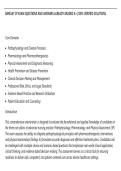
BARKLEY 3P EXAM QUESTIONS AND ANSWERS ALREADY GRADED A+| 100% VERIFIED SOLUTIONS
Core Domains
Pathophysiology and Disease Processes
Pharmacology and Pharmacotherapeutics
Physical Assessment and Diagnostic Reasoning
Health Promotion and Disease Prevention
Clinical Decision-Making and Management
Professional Role, Ethics, and Legal Standards
Evidence-Based Practice and Research Utilization
Patient Education and Counseling
Introduction
This comprehensive examination is designed to evaluate the foundational and applied knowledge of candidates in
the three core pillars of advanced nursing practice: Pathophysiology, Pharmacology, and Physical Assessment (3P).
The exam assesses the ability to integrate pathophysiological principles with pharmacotherapeutic interventions
and physical examination findings to formulate accurate diagnoses and effective treatment plans. Candidates will
be challenged with multiple-choice and scenario-based questions that emphasize real-world clinical application,
critical thinking, and evidence-based decision-making. This assessment serves as a critical tool for ensuring
readiness to deliver safe, competent, and patient-centered care across diverse healthcare settings.
,SECTION ONE: QUESTIONS 1–100
1. A 55-year-old female presents with fatigue, weight gain, constipation, and cold intolerance. On
examination, you note bradycardia and dry, coarse skin. Which of the following laboratory findings would
most likely confirm your suspected diagnosis?
A. Elevated free T4 and decreased TSH
B. Decreased free T4 and elevated TSH
C. Elevated free T4 and elevated TSH
D. Decreased free T4 and decreased TSH
🟢B
🔴 RATIONALE: The patient's presentation is classic for hypothyroidism. In primary hypothyroidism, the thyroid
gland fails to produce sufficient thyroid hormone, leading to decreased free T4. This triggers the pituitary to
increase TSH production, resulting in elevated TSH. Therefore, decreased free T4 and elevated TSH are the
hallmark laboratory findings.
2. A 68-year-old male with a history of hypertension and type 2 diabetes mellitus is being evaluated for a
new onset of shortness of breath and bilateral lower extremity edema. His blood pressure is 158/94 mmHg,
and heart rate is 88 bpm. An ECG shows left ventricular hypertrophy. Which of the following is the most
,appropriate initial pharmacologic therapy for managing his hypertension in the context of heart failure with
reduced ejection fraction (HFrEF)?
A. Metoprolol succinate
B. Hydrochlorothiazide
C. Amlodipine
D. Doxazosin
🟢A
🔴 RATIONALE: Beta-blockers, specifically carvedilol, metoprolol succinate, and bisoprolol, are first-line
therapies for HFrEF and have been shown to reduce mortality and morbidity. Hydrochlorothiazide is a thiazide
diuretic not typically used as a first-line agent in HFrEF. Amlodipine and doxazosin are not recommended as
first-line therapy in HFrEF due to lack of mortality benefit.
3. A 45-year-old male presents with a two-week history of a cough, low-grade fever, and night sweats. He
reports a 10-pound unintentional weight loss over the past month. He has a history of HIV, with a CD4 count
of 180 cells/mm³. A chest X-ray reveals a cavitary lesion in the right upper lobe. Which of the following is the
most appropriate initial diagnostic test?
A. Sputum culture and sensitivity
B. Interferon-gamma release assay (IGRA)
C. Acid-fast bacilli (AFB) smear and culture
D. Tuberculin skin test (TST)
, 🟢C
🔴 RATIONALE: Given the patient's symptoms, risk factors (HIV), and chest X-ray findings, tuberculosis (TB) is
the primary concern. The initial diagnostic test for active TB is an AFB smear and culture of sputum. While IGRA
and TST can indicate infection, they cannot distinguish between latent and active disease. A sputum culture and
sensitivity, while important, is not the first step; an AFB smear provides a rapid preliminary result.
4. A 65-year-old male with a 40-pack-year smoking history presents with a chronic cough, hemoptysis, and
weight loss. A chest X-ray reveals a mass in the right upper lobe. Which of the following is the most
important initial diagnostic step?
A. Positron emission tomography (PET) scan
B. Bronchoscopy with biopsy
C. Sputum cytology
D. Computed tomography (CT) scan of the chest
🟢B
🔴 RATIONALE: The patient has a high suspicion for lung cancer. The gold standard for diagnosis is a tissue
biopsy. Bronchoscopy with biopsy allows for direct visualization and tissue sampling. A CT scan and PET scan
are important for staging, but neither provides a definitive diagnosis. Sputum cytology has a low sensitivity.
Core Domains
Pathophysiology and Disease Processes
Pharmacology and Pharmacotherapeutics
Physical Assessment and Diagnostic Reasoning
Health Promotion and Disease Prevention
Clinical Decision-Making and Management
Professional Role, Ethics, and Legal Standards
Evidence-Based Practice and Research Utilization
Patient Education and Counseling
Introduction
This comprehensive examination is designed to evaluate the foundational and applied knowledge of candidates in
the three core pillars of advanced nursing practice: Pathophysiology, Pharmacology, and Physical Assessment (3P).
The exam assesses the ability to integrate pathophysiological principles with pharmacotherapeutic interventions
and physical examination findings to formulate accurate diagnoses and effective treatment plans. Candidates will
be challenged with multiple-choice and scenario-based questions that emphasize real-world clinical application,
critical thinking, and evidence-based decision-making. This assessment serves as a critical tool for ensuring
readiness to deliver safe, competent, and patient-centered care across diverse healthcare settings.
,SECTION ONE: QUESTIONS 1–100
1. A 55-year-old female presents with fatigue, weight gain, constipation, and cold intolerance. On
examination, you note bradycardia and dry, coarse skin. Which of the following laboratory findings would
most likely confirm your suspected diagnosis?
A. Elevated free T4 and decreased TSH
B. Decreased free T4 and elevated TSH
C. Elevated free T4 and elevated TSH
D. Decreased free T4 and decreased TSH
🟢B
🔴 RATIONALE: The patient's presentation is classic for hypothyroidism. In primary hypothyroidism, the thyroid
gland fails to produce sufficient thyroid hormone, leading to decreased free T4. This triggers the pituitary to
increase TSH production, resulting in elevated TSH. Therefore, decreased free T4 and elevated TSH are the
hallmark laboratory findings.
2. A 68-year-old male with a history of hypertension and type 2 diabetes mellitus is being evaluated for a
new onset of shortness of breath and bilateral lower extremity edema. His blood pressure is 158/94 mmHg,
and heart rate is 88 bpm. An ECG shows left ventricular hypertrophy. Which of the following is the most
,appropriate initial pharmacologic therapy for managing his hypertension in the context of heart failure with
reduced ejection fraction (HFrEF)?
A. Metoprolol succinate
B. Hydrochlorothiazide
C. Amlodipine
D. Doxazosin
🟢A
🔴 RATIONALE: Beta-blockers, specifically carvedilol, metoprolol succinate, and bisoprolol, are first-line
therapies for HFrEF and have been shown to reduce mortality and morbidity. Hydrochlorothiazide is a thiazide
diuretic not typically used as a first-line agent in HFrEF. Amlodipine and doxazosin are not recommended as
first-line therapy in HFrEF due to lack of mortality benefit.
3. A 45-year-old male presents with a two-week history of a cough, low-grade fever, and night sweats. He
reports a 10-pound unintentional weight loss over the past month. He has a history of HIV, with a CD4 count
of 180 cells/mm³. A chest X-ray reveals a cavitary lesion in the right upper lobe. Which of the following is the
most appropriate initial diagnostic test?
A. Sputum culture and sensitivity
B. Interferon-gamma release assay (IGRA)
C. Acid-fast bacilli (AFB) smear and culture
D. Tuberculin skin test (TST)
, 🟢C
🔴 RATIONALE: Given the patient's symptoms, risk factors (HIV), and chest X-ray findings, tuberculosis (TB) is
the primary concern. The initial diagnostic test for active TB is an AFB smear and culture of sputum. While IGRA
and TST can indicate infection, they cannot distinguish between latent and active disease. A sputum culture and
sensitivity, while important, is not the first step; an AFB smear provides a rapid preliminary result.
4. A 65-year-old male with a 40-pack-year smoking history presents with a chronic cough, hemoptysis, and
weight loss. A chest X-ray reveals a mass in the right upper lobe. Which of the following is the most
important initial diagnostic step?
A. Positron emission tomography (PET) scan
B. Bronchoscopy with biopsy
C. Sputum cytology
D. Computed tomography (CT) scan of the chest
🟢B
🔴 RATIONALE: The patient has a high suspicion for lung cancer. The gold standard for diagnosis is a tissue
biopsy. Bronchoscopy with biopsy allows for direct visualization and tissue sampling. A CT scan and PET scan
are important for staging, but neither provides a definitive diagnosis. Sputum cytology has a low sensitivity.


