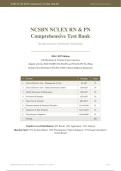
NCSBN NCLEX RN/PN Comprehensive Test Bank 2026-2027 100% Verified Correct Answers
NCSBN NCLEX RN & PN
Comprehensive Test Bank
Nursing Licensure Examination Preparation
Edition
200 Questions & Verified Correct Answers
Aligned with the 2026 NCSBN NCLEX-RN and NCLEX-PN Test Plans
Includes Next Generation NCLEX (NGN) Clinical Judgment Integration
# Section Q Range Count
1 Safe & Effective Care - Management of Care Q1-Q35 35
2 Safe & Effective Care - Safety & Infection Control Q36-Q55 20
3 Health Promotion & Maintenance Q56-Q75 20
4 Psychosocial Integrity Q76-Q95 20
5 Basic Care & Comfort Q96-Q115 20
6 Pharmacological & Parenteral Therapies Q116-Q140 25
7 Reduction of Risk Potential Q141-Q165 25
8 Physiological Adaptation Q166-Q200 35
TOTAL 200
Cognitive Level Distribution: 20% Recall · 50% Application · 30% Analysis
Question Style: 75% Scenario-Based · 20% Prioritization / Clinical Judgment · 5% Dosage Calculation /
Direct Recall
NCSBN NCLEX Test Plan 2026-2027 | 200 Questions | Q1-200 Page 1
,NCSBN NCLEX RN/PN Comprehensive Test Bank 2026-2027 100% Verified Correct Answers
Table of Contents
Section 1: Safe and Effective Care Environment - Management of Care Q1–Q35
Section 2: Safe and Effective Care Environment - Safety and Infection Control Q36–Q55
Section 3: Health Promotion and Maintenance Q56–Q75
Section 4: Psychosocial Integrity Q76–Q95
Section 5: Basic Care and Comfort Q96–Q115
Section 6: Pharmacological and Parenteral Therapies Q116–Q140
Section 7: Reduction of Risk Potential Q141–Q165
Section 8: Physiological Adaptation Q166–Q200
Each question is followed by four options (A–D), the verified correct answer, and a comprehensive NCLEX-aligned
rationale explaining why the correct option is right and why each distractor is wrong.
NCSBN NCLEX Test Plan 2026-2027 | 200 Questions | Q1-200 Page 2
,NCSBN NCLEX RN/PN Comprehensive Test Bank 2026-2027 100% Verified Correct Answers
Section 1: Safe and Effective Care Environment - Management of
Care
Advocacy, Delegation, Ethics, Legal Issues, Client Rights, and Continuity of Care. Questions emphasize the nursing
process (ADPIE), clinical judgment, scope-of-practice decisions (RN vs. LPN vs. UAP), and legal/ethical frameworks
including informed consent, advance directives, HIPAA, and mandatory reporting.
Management of Care · Prioritization (ABC)
Q1. A registered nurse (RN) on a medical-surgical unit is assigned four clients. Which client should
the RN assess first using the ABC priority-setting framework?
A. A client 8 hours postoperative colon resection who has not yet ambulated and reports abdominal distention.
B. A client with chronic obstructive pulmonary disease (COPD) whose pulse oximetry dropped from
92% to 86% on room air. [CORRECT]
C. A client receiving IV heparin for deep vein thrombosis whose activated partial thromboplastin time (aPTT)
is 78 seconds.
D. A client with type 2 diabetes mellitus whose morning capillary glucose is 142 mg/dL and is awaiting
breakfast.
Correct Answer: B — A client with chronic obstructive pulmonary disease (COPD) whose pulse oximetry
dropped from 92% to 86% on room air.
Rationale: The ABC framework (Airway, Breathing, Circulation) directs the RN to prioritize the COPD client whose
SpO2 fell to 86%, because acute hypoxemia threatens airway and breathing and can rapidly progress to respiratory
failure, cardiac dysrhythmias, or cardiopulmonary arrest. The postoperative client requires assessment and ambulation
but is hemodynamically stable. An aPTT of 78 seconds is slightly prolonged but not immediately life-threatening; the
nurse should verify the heparin rate and notify the provider per protocol. A glucose of 142 mg/dL in a type 2 diabetic
awaiting breakfast is within typical preprandial targets and does not require urgent intervention. Using Maslow's
hierarchy, oxygenation is a physiological need that supersedes the others.
Management of Care · Delegation (Scope of Practice)
Q2. An RN delegates care for four clients to a licensed practical nurse (LPN) and an unlicensed
assistive personnel (UAP). Which task is most appropriate to assign to the LPN?
A. Ambulating a client 2 days post-total knee arthroplasty for the first time with a continuous passive motion
device.
B. Administering oral morphine 10 mg to a client with terminal cancer and reassessing pain 45 minutes later.
C. Performing initial admission assessment of a client transferred from the emergency department with chest
pain.
D. Reinforcing teaching for a newly diagnosed heart failure client regarding a 2-gram sodium diet.
[CORRECT]
Correct Answer: D — Reinforcing teaching for a newly diagnosed heart failure client regarding a 2-gram
sodium diet.
Rationale: Reinforcing existing teaching (not initial teaching) is within the LPN scope of practice. The LPN may
administer oral medications but reassessment of a controlled substance's analgesic effect and complex pain management
often require RN judgment; state nurse practice acts vary, but Option B is less clearly within LPN scope than Option D.
Initial admission assessments (Option C) require RN-level synthesis and clinical judgment per the ANA Code of Ethics
and most state practice acts. First-time postoperative ambulation after joint replacement (Option A) requires RN
assessment of stability, weight-bearing status, and hemodynamic tolerance before delegation, making it inappropriate to
delegate directly to an LPN without RN evaluation first.
NCSBN NCLEX Test Plan 2026-2027 | 200 Questions | Q1-200 Page 3
, NCSBN NCLEX RN/PN Comprehensive Test Bank 2026-2027 100% Verified Correct Answers
Management of Care · Informed Consent
Q3. A client scheduled for an emergent appendectomy repeatedly asks the nurse, "Is this really
necessary? Can't I just take antibiotics?" The surgeon has explained the risks, benefits, and
alternatives, and the client has signed the consent form. What is the nurse's most appropriate action?
A. Notify the surgeon that the client is questioning the procedure and may be revoking consent.
B. Document the client's questions and proceed, because consent was already signed.
C. Re-explain the risks and benefits using simpler language and verify the client's understanding.
[CORRECT]
D. Reassure the client that the procedure is routine and encourage them to relax.
Correct Answer: C — Re-explain the risks and benefits using simpler language and verify the client's
understanding.
Rationale: Informed consent is an ongoing process, not a single signature. When the client voices uncertainty after
signing, the nurse must verify understanding by re-explaining at the client's level and clarifying misconceptions; if
uncertainty persists, the surgeon must be notified. Option A bypasses the nurse's role in assessing comprehension first.
Option B ignores the client's right to revoke or question consent, which is a violation of client autonomy. Option D is
non-therapeutic, dismisses the client's concerns, and could constitute coercion. The nurse's role in informed consent is to
witness the signature and assess that consent is truly informed; only the provider performs the actual consent discussion.
Management of Care · Ethics & Advance Directives
Q4. A 78-year-old client with advanced dementia is admitted with dehydration. The client has no
advance directive and is unable to verbalize preferences. The adult daughter wants a percutaneous
endoscopic gastrostomy (PEG) tube placed; the son states his mother "would never want that." What
is the nurse's best action?
A. Follow the daughter's wishes because she is the closest next of kin present.
B. Contact the facility's ethics committee and social work for a structured family meeting.
[CORRECT]
C. Document the conflict and defer the decision until the client regains decision-making capacity.
D. Place the PEG tube as ordered by the provider, because no advance directive exists.
Correct Answer: B — Contact the facility's ethics committee and social work for a structured family
meeting.
Rationale: When family members disagree about life-sustaining treatment for a client lacking capacity and an advance
directive, the nurse should escalate to the ethics committee and social work to facilitate a structured surrogate
decision-making process consistent with the Patient Self-Determination Act and substituted-judgment standard. Option
A is incorrect because proximity of kin does not override a structured ethical process; many states require consensus or
hierarchy under the Uniform Health-Care Decisions Act. Option C is inappropriate because the client is unlikely to
regain capacity in advanced dementia, and deferral could cause further harm from untreated dehydration. Option D
prematurely overrides the son's input, violating the principle of autonomy through surrogate decision-making. Nurses
advocate for the client's known values, not for a single relative's preference.
Management of Care · Client Rights & Mandatory Reporting
Q5. A client tells the nurse, "I think my roommate's wife is stealing from his wallet when she visits."
The roommate is alert and oriented. Which action should the nurse take first?
A. Report the suspicion to adult protective services (APS) immediately.
B. Confront the wife directly and ask her to return any items she took.
C. Interview the roommate privately to assess the situation and gather facts. [CORRECT]
D. Document the report and notify the charge nurse and provider.
Correct Answer: C — Interview the roommate privately to assess the situation and gather facts.
NCSBN NCLEX Test Plan 2026-2027 | 200 Questions | Q1-200 Page 4
NCSBN NCLEX RN & PN
Comprehensive Test Bank
Nursing Licensure Examination Preparation
Edition
200 Questions & Verified Correct Answers
Aligned with the 2026 NCSBN NCLEX-RN and NCLEX-PN Test Plans
Includes Next Generation NCLEX (NGN) Clinical Judgment Integration
# Section Q Range Count
1 Safe & Effective Care - Management of Care Q1-Q35 35
2 Safe & Effective Care - Safety & Infection Control Q36-Q55 20
3 Health Promotion & Maintenance Q56-Q75 20
4 Psychosocial Integrity Q76-Q95 20
5 Basic Care & Comfort Q96-Q115 20
6 Pharmacological & Parenteral Therapies Q116-Q140 25
7 Reduction of Risk Potential Q141-Q165 25
8 Physiological Adaptation Q166-Q200 35
TOTAL 200
Cognitive Level Distribution: 20% Recall · 50% Application · 30% Analysis
Question Style: 75% Scenario-Based · 20% Prioritization / Clinical Judgment · 5% Dosage Calculation /
Direct Recall
NCSBN NCLEX Test Plan 2026-2027 | 200 Questions | Q1-200 Page 1
,NCSBN NCLEX RN/PN Comprehensive Test Bank 2026-2027 100% Verified Correct Answers
Table of Contents
Section 1: Safe and Effective Care Environment - Management of Care Q1–Q35
Section 2: Safe and Effective Care Environment - Safety and Infection Control Q36–Q55
Section 3: Health Promotion and Maintenance Q56–Q75
Section 4: Psychosocial Integrity Q76–Q95
Section 5: Basic Care and Comfort Q96–Q115
Section 6: Pharmacological and Parenteral Therapies Q116–Q140
Section 7: Reduction of Risk Potential Q141–Q165
Section 8: Physiological Adaptation Q166–Q200
Each question is followed by four options (A–D), the verified correct answer, and a comprehensive NCLEX-aligned
rationale explaining why the correct option is right and why each distractor is wrong.
NCSBN NCLEX Test Plan 2026-2027 | 200 Questions | Q1-200 Page 2
,NCSBN NCLEX RN/PN Comprehensive Test Bank 2026-2027 100% Verified Correct Answers
Section 1: Safe and Effective Care Environment - Management of
Care
Advocacy, Delegation, Ethics, Legal Issues, Client Rights, and Continuity of Care. Questions emphasize the nursing
process (ADPIE), clinical judgment, scope-of-practice decisions (RN vs. LPN vs. UAP), and legal/ethical frameworks
including informed consent, advance directives, HIPAA, and mandatory reporting.
Management of Care · Prioritization (ABC)
Q1. A registered nurse (RN) on a medical-surgical unit is assigned four clients. Which client should
the RN assess first using the ABC priority-setting framework?
A. A client 8 hours postoperative colon resection who has not yet ambulated and reports abdominal distention.
B. A client with chronic obstructive pulmonary disease (COPD) whose pulse oximetry dropped from
92% to 86% on room air. [CORRECT]
C. A client receiving IV heparin for deep vein thrombosis whose activated partial thromboplastin time (aPTT)
is 78 seconds.
D. A client with type 2 diabetes mellitus whose morning capillary glucose is 142 mg/dL and is awaiting
breakfast.
Correct Answer: B — A client with chronic obstructive pulmonary disease (COPD) whose pulse oximetry
dropped from 92% to 86% on room air.
Rationale: The ABC framework (Airway, Breathing, Circulation) directs the RN to prioritize the COPD client whose
SpO2 fell to 86%, because acute hypoxemia threatens airway and breathing and can rapidly progress to respiratory
failure, cardiac dysrhythmias, or cardiopulmonary arrest. The postoperative client requires assessment and ambulation
but is hemodynamically stable. An aPTT of 78 seconds is slightly prolonged but not immediately life-threatening; the
nurse should verify the heparin rate and notify the provider per protocol. A glucose of 142 mg/dL in a type 2 diabetic
awaiting breakfast is within typical preprandial targets and does not require urgent intervention. Using Maslow's
hierarchy, oxygenation is a physiological need that supersedes the others.
Management of Care · Delegation (Scope of Practice)
Q2. An RN delegates care for four clients to a licensed practical nurse (LPN) and an unlicensed
assistive personnel (UAP). Which task is most appropriate to assign to the LPN?
A. Ambulating a client 2 days post-total knee arthroplasty for the first time with a continuous passive motion
device.
B. Administering oral morphine 10 mg to a client with terminal cancer and reassessing pain 45 minutes later.
C. Performing initial admission assessment of a client transferred from the emergency department with chest
pain.
D. Reinforcing teaching for a newly diagnosed heart failure client regarding a 2-gram sodium diet.
[CORRECT]
Correct Answer: D — Reinforcing teaching for a newly diagnosed heart failure client regarding a 2-gram
sodium diet.
Rationale: Reinforcing existing teaching (not initial teaching) is within the LPN scope of practice. The LPN may
administer oral medications but reassessment of a controlled substance's analgesic effect and complex pain management
often require RN judgment; state nurse practice acts vary, but Option B is less clearly within LPN scope than Option D.
Initial admission assessments (Option C) require RN-level synthesis and clinical judgment per the ANA Code of Ethics
and most state practice acts. First-time postoperative ambulation after joint replacement (Option A) requires RN
assessment of stability, weight-bearing status, and hemodynamic tolerance before delegation, making it inappropriate to
delegate directly to an LPN without RN evaluation first.
NCSBN NCLEX Test Plan 2026-2027 | 200 Questions | Q1-200 Page 3
, NCSBN NCLEX RN/PN Comprehensive Test Bank 2026-2027 100% Verified Correct Answers
Management of Care · Informed Consent
Q3. A client scheduled for an emergent appendectomy repeatedly asks the nurse, "Is this really
necessary? Can't I just take antibiotics?" The surgeon has explained the risks, benefits, and
alternatives, and the client has signed the consent form. What is the nurse's most appropriate action?
A. Notify the surgeon that the client is questioning the procedure and may be revoking consent.
B. Document the client's questions and proceed, because consent was already signed.
C. Re-explain the risks and benefits using simpler language and verify the client's understanding.
[CORRECT]
D. Reassure the client that the procedure is routine and encourage them to relax.
Correct Answer: C — Re-explain the risks and benefits using simpler language and verify the client's
understanding.
Rationale: Informed consent is an ongoing process, not a single signature. When the client voices uncertainty after
signing, the nurse must verify understanding by re-explaining at the client's level and clarifying misconceptions; if
uncertainty persists, the surgeon must be notified. Option A bypasses the nurse's role in assessing comprehension first.
Option B ignores the client's right to revoke or question consent, which is a violation of client autonomy. Option D is
non-therapeutic, dismisses the client's concerns, and could constitute coercion. The nurse's role in informed consent is to
witness the signature and assess that consent is truly informed; only the provider performs the actual consent discussion.
Management of Care · Ethics & Advance Directives
Q4. A 78-year-old client with advanced dementia is admitted with dehydration. The client has no
advance directive and is unable to verbalize preferences. The adult daughter wants a percutaneous
endoscopic gastrostomy (PEG) tube placed; the son states his mother "would never want that." What
is the nurse's best action?
A. Follow the daughter's wishes because she is the closest next of kin present.
B. Contact the facility's ethics committee and social work for a structured family meeting.
[CORRECT]
C. Document the conflict and defer the decision until the client regains decision-making capacity.
D. Place the PEG tube as ordered by the provider, because no advance directive exists.
Correct Answer: B — Contact the facility's ethics committee and social work for a structured family
meeting.
Rationale: When family members disagree about life-sustaining treatment for a client lacking capacity and an advance
directive, the nurse should escalate to the ethics committee and social work to facilitate a structured surrogate
decision-making process consistent with the Patient Self-Determination Act and substituted-judgment standard. Option
A is incorrect because proximity of kin does not override a structured ethical process; many states require consensus or
hierarchy under the Uniform Health-Care Decisions Act. Option C is inappropriate because the client is unlikely to
regain capacity in advanced dementia, and deferral could cause further harm from untreated dehydration. Option D
prematurely overrides the son's input, violating the principle of autonomy through surrogate decision-making. Nurses
advocate for the client's known values, not for a single relative's preference.
Management of Care · Client Rights & Mandatory Reporting
Q5. A client tells the nurse, "I think my roommate's wife is stealing from his wallet when she visits."
The roommate is alert and oriented. Which action should the nurse take first?
A. Report the suspicion to adult protective services (APS) immediately.
B. Confront the wife directly and ask her to return any items she took.
C. Interview the roommate privately to assess the situation and gather facts. [CORRECT]
D. Document the report and notify the charge nurse and provider.
Correct Answer: C — Interview the roommate privately to assess the situation and gather facts.
NCSBN NCLEX Test Plan 2026-2027 | 200 Questions | Q1-200 Page 4