
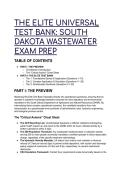
THE ELITE UNIVERSAL
TEST BANK: SOUTH
DAKOTA WASTEWATER
EXAM PREP
TABLE OF CONTENTS
● PART I: THE PREVIEW
○ The Mentor's Introduction
○ The "Critical Axioms" Cheat Sheet
● PART II: THE ELITE TEST BANK
○ Tier 1: Foundational Syntax & Application (Questions 1–10)
○ Tier 2: Complex Application & Simulation (Questions 11–20)
○ Tier 3: Grandmaster Synthesis (Questions 21–30)
PART I: THE PREVIEW
Mastering this Elite Test Bank translates directly into operational supremacy, ensuring that an
operator’s academic knowledge flawlessly executes the strict regulatory and environmental
mandates of the South Dakota Department of Agriculture and Natural Resources (DANR). By
internalizing these complex operational scenarios, the candidate transitions from rote
memorization to a grandmaster-level synthesis of administrative rules, hydraulic engineering,
and biological process control.
The "Critical Axioms" Cheat Sheet
● The 24/5 Reporting Law: Unanticipated bypasses or effluent violations endangering
public health require an oral report to the DANR within 24 hours, followed strictly by a
written submission within 5 days.
● The 500-Population Threshold: Any wastewater treatment plant or collection system
serving 500 or more people universally mandates a certified operator in direct responsible
charge, regardless of the specific treatment methodology.
● The Hydraulic Velocity Mandate: Lift station force mains must maintain a minimum
velocity of 2 feet per second (fps) to prevent solids deposition, with suction and discharge
piping capped at maximums of 5 fps and 8 fps, respectively, to prevent mechanical
destruction.
● CEU Escalation Framework: Contact hour requirements scale dynamically based on the
, highest class of certification held within an operator's portfolio, not the average of all
certificates.
Certification Portfolio Profile Required Contact Hours (Every 3 Years)
Operator holds a single Class I or II certificate 10 Contact Hours
Operator holds multiple certificates (All Class I 15 Contact Hours
or II)
Operator holds a single Class III or IV certificate 20 Contact Hours
Operator holds multiple certificates (At least 30 Contact Hours
one Class III or IV)
● Bypass Prohibition: A bypass is strictly prohibited and enforceable unless it prevents
loss of life, personal injury, or severe property damage. Severe property damage is
explicitly defined as physical inoperability of the facilities, never economic loss or
temporary efficiency reductions.
PART II: THE ELITE TEST BANK
Tier 1: Foundational Syntax & Application
Q1: A municipal wastewater treatment facility in South Dakota experiences an unanticipated
bypass that exceeds the permitted effluent limitation. Based on the principles of the
Administrative Rules of South Dakota (ARSD) 74:52, which action is the FIRST mandatory
reporting requirement? A) Submit a written report via NetDMR within 24 hours detailing the
bypass volume and environmental impact. B) Provide an oral report to the South Dakota
Department of Agriculture and Natural Resources within 24 hours. C) Submit a formal
modification request to the Water Management Board within 5 days of the occurrence. D)
Document the bypass in the daily operational log and report it during the next monthly
Discharge Monitoring Report (DMR).
● Answer/Respuesta/Réponse: B (Provide an oral report to the South Dakota Department
of Agriculture and Natural Resources within 24 hours.)
● Distractor Analysis:
○ A is incorrect: The regulations explicitly require an oral report within 24 hours for
noncompliance endangering public health or the environment. The written report is
a secondary mandate not due until the five-day mark.
○ C is incorrect: A permit modification request is an entirely separate, prolonged
administrative procedure utilized for changing facility parameters, and it provides no
legal cover for an acute, unauthorized bypass event.
○ D is incorrect: Relegating an unanticipated bypass to standard monthly DMR
reporting violates the 24-hour emergency notification mandate, exposing the facility
to severe enforcement actions and regulatory fines.
The Mentor's Analysis: Emergency environmental events demand instantaneous regulatory
visibility. When facing an unanticipated bypass, the immediate priority is verbal notification to the
governing body to trigger impact assessments. By utilizing 24-Hour Oral Notification, you
bypass the common trap of delaying critical environmental data for administrative convenience
or fear of reprisal. Professional/Academic Intuition: Never defer acute environmental
violations to routine reporting schedules; immediate oral communication is a
non-negotiable legal shield.
Q2: A municipality is expanding its infrastructure and building a new wastewater collection
, system. Under South Dakota operator certification regulations, at what specific capacity metric
does the system legally require supervision by a certified wastewater collection operator? A)
When the system serves 250 or more residential connections, regardless of the commercial
contribution. B) When the system experiences an average daily flow of 50,000 gallons over a
continuous thirty-day period. C) When the system serves 500 or more people or a population
equivalent of 500 people. D) When the system incorporates three or more mechanical lift
stations within the collection grid.
● Answer/Respuesta/Réponse: C (When the system serves 500 or more people or a
population equivalent of 500 people.)
● Distractor Analysis:
○ A is incorrect: Residential connections are a common design metric for localized
engineering sizing, but South Dakota law strictly measures regulatory oversight
thresholds by population equivalents to account for dense commercial or industrial
contributors.
○ B is incorrect: While flow rates dictate hydraulic design parameters and surface
water discharge permit categories, the operator certification mandate is legally
bound to the 500-population threshold, regardless of specific daily flow variations.
○ D is incorrect: The mechanical complexity of a collection system (such as the
inclusion of multiple lift stations) dictates engineering construction standards, but it
does not alter the baseline population trigger for requiring a certified operator.
The Mentor's Analysis: Regulatory oversight scales with potential public health impact, which
is universally measured by population density in wastewater law. When facing system
expansion, the immediate priority is calculating the population equivalent. By utilizing the
500-Population Threshold, you bypass the common trap of correlating operator requirements
solely with hydraulic flow metrics or mechanical complexity. Professional/Academic Intuition:
Population equivalents govern legal compliance and certification; flow rates merely
govern hydraulic engineering.
Q3: An operator holds a single Class III Wastewater Treatment certificate. According to the
South Dakota DANR continuing education mandates, what is the exact requirement to maintain
this certification in good standing? A) 10 contact hours every three years, validated by a
state-approved training sponsor. B) 15 contact hours every three years, distributed evenly
across biological and mechanical topics. C) 20 contact hours every three years. D) 30 contact
hours every three years.
● Answer/Respuesta/Réponse: C (20 contact hours every three years.)
● Distractor Analysis:
○ A is incorrect: Ten contact hours is the baseline requirement reserved exclusively
for operators holding a single Class I or Class II certificate.
○ B is incorrect: Fifteen contact hours applies specifically to operators holding multiple
certificates where all held certificates are at the Class I or Class II level.
○ D is incorrect: Thirty contact hours is the maximum regulatory burden, required only
when an operator holds multiple certificates and at least one of them is a Class III
or Class IV.
The Mentor's Analysis: Professional competency maintenance is directly proportional to the
complexity of the certified discipline. When facing certification renewal, the immediate priority is
matching the highest held class to its specific continuing education tier. By utilizing the Class III
Baseline Requirement, you bypass the common trap of misapplying the cumulative
multi-certificate sliding scale to a single-certificate holder. Professional/Academic Intuition:
The regulatory burden of continuing education scales precisely with the operational risk
TEST BANK: SOUTH
DAKOTA WASTEWATER
EXAM PREP
TABLE OF CONTENTS
● PART I: THE PREVIEW
○ The Mentor's Introduction
○ The "Critical Axioms" Cheat Sheet
● PART II: THE ELITE TEST BANK
○ Tier 1: Foundational Syntax & Application (Questions 1–10)
○ Tier 2: Complex Application & Simulation (Questions 11–20)
○ Tier 3: Grandmaster Synthesis (Questions 21–30)
PART I: THE PREVIEW
Mastering this Elite Test Bank translates directly into operational supremacy, ensuring that an
operator’s academic knowledge flawlessly executes the strict regulatory and environmental
mandates of the South Dakota Department of Agriculture and Natural Resources (DANR). By
internalizing these complex operational scenarios, the candidate transitions from rote
memorization to a grandmaster-level synthesis of administrative rules, hydraulic engineering,
and biological process control.
The "Critical Axioms" Cheat Sheet
● The 24/5 Reporting Law: Unanticipated bypasses or effluent violations endangering
public health require an oral report to the DANR within 24 hours, followed strictly by a
written submission within 5 days.
● The 500-Population Threshold: Any wastewater treatment plant or collection system
serving 500 or more people universally mandates a certified operator in direct responsible
charge, regardless of the specific treatment methodology.
● The Hydraulic Velocity Mandate: Lift station force mains must maintain a minimum
velocity of 2 feet per second (fps) to prevent solids deposition, with suction and discharge
piping capped at maximums of 5 fps and 8 fps, respectively, to prevent mechanical
destruction.
● CEU Escalation Framework: Contact hour requirements scale dynamically based on the
, highest class of certification held within an operator's portfolio, not the average of all
certificates.
Certification Portfolio Profile Required Contact Hours (Every 3 Years)
Operator holds a single Class I or II certificate 10 Contact Hours
Operator holds multiple certificates (All Class I 15 Contact Hours
or II)
Operator holds a single Class III or IV certificate 20 Contact Hours
Operator holds multiple certificates (At least 30 Contact Hours
one Class III or IV)
● Bypass Prohibition: A bypass is strictly prohibited and enforceable unless it prevents
loss of life, personal injury, or severe property damage. Severe property damage is
explicitly defined as physical inoperability of the facilities, never economic loss or
temporary efficiency reductions.
PART II: THE ELITE TEST BANK
Tier 1: Foundational Syntax & Application
Q1: A municipal wastewater treatment facility in South Dakota experiences an unanticipated
bypass that exceeds the permitted effluent limitation. Based on the principles of the
Administrative Rules of South Dakota (ARSD) 74:52, which action is the FIRST mandatory
reporting requirement? A) Submit a written report via NetDMR within 24 hours detailing the
bypass volume and environmental impact. B) Provide an oral report to the South Dakota
Department of Agriculture and Natural Resources within 24 hours. C) Submit a formal
modification request to the Water Management Board within 5 days of the occurrence. D)
Document the bypass in the daily operational log and report it during the next monthly
Discharge Monitoring Report (DMR).
● Answer/Respuesta/Réponse: B (Provide an oral report to the South Dakota Department
of Agriculture and Natural Resources within 24 hours.)
● Distractor Analysis:
○ A is incorrect: The regulations explicitly require an oral report within 24 hours for
noncompliance endangering public health or the environment. The written report is
a secondary mandate not due until the five-day mark.
○ C is incorrect: A permit modification request is an entirely separate, prolonged
administrative procedure utilized for changing facility parameters, and it provides no
legal cover for an acute, unauthorized bypass event.
○ D is incorrect: Relegating an unanticipated bypass to standard monthly DMR
reporting violates the 24-hour emergency notification mandate, exposing the facility
to severe enforcement actions and regulatory fines.
The Mentor's Analysis: Emergency environmental events demand instantaneous regulatory
visibility. When facing an unanticipated bypass, the immediate priority is verbal notification to the
governing body to trigger impact assessments. By utilizing 24-Hour Oral Notification, you
bypass the common trap of delaying critical environmental data for administrative convenience
or fear of reprisal. Professional/Academic Intuition: Never defer acute environmental
violations to routine reporting schedules; immediate oral communication is a
non-negotiable legal shield.
Q2: A municipality is expanding its infrastructure and building a new wastewater collection
, system. Under South Dakota operator certification regulations, at what specific capacity metric
does the system legally require supervision by a certified wastewater collection operator? A)
When the system serves 250 or more residential connections, regardless of the commercial
contribution. B) When the system experiences an average daily flow of 50,000 gallons over a
continuous thirty-day period. C) When the system serves 500 or more people or a population
equivalent of 500 people. D) When the system incorporates three or more mechanical lift
stations within the collection grid.
● Answer/Respuesta/Réponse: C (When the system serves 500 or more people or a
population equivalent of 500 people.)
● Distractor Analysis:
○ A is incorrect: Residential connections are a common design metric for localized
engineering sizing, but South Dakota law strictly measures regulatory oversight
thresholds by population equivalents to account for dense commercial or industrial
contributors.
○ B is incorrect: While flow rates dictate hydraulic design parameters and surface
water discharge permit categories, the operator certification mandate is legally
bound to the 500-population threshold, regardless of specific daily flow variations.
○ D is incorrect: The mechanical complexity of a collection system (such as the
inclusion of multiple lift stations) dictates engineering construction standards, but it
does not alter the baseline population trigger for requiring a certified operator.
The Mentor's Analysis: Regulatory oversight scales with potential public health impact, which
is universally measured by population density in wastewater law. When facing system
expansion, the immediate priority is calculating the population equivalent. By utilizing the
500-Population Threshold, you bypass the common trap of correlating operator requirements
solely with hydraulic flow metrics or mechanical complexity. Professional/Academic Intuition:
Population equivalents govern legal compliance and certification; flow rates merely
govern hydraulic engineering.
Q3: An operator holds a single Class III Wastewater Treatment certificate. According to the
South Dakota DANR continuing education mandates, what is the exact requirement to maintain
this certification in good standing? A) 10 contact hours every three years, validated by a
state-approved training sponsor. B) 15 contact hours every three years, distributed evenly
across biological and mechanical topics. C) 20 contact hours every three years. D) 30 contact
hours every three years.
● Answer/Respuesta/Réponse: C (20 contact hours every three years.)
● Distractor Analysis:
○ A is incorrect: Ten contact hours is the baseline requirement reserved exclusively
for operators holding a single Class I or Class II certificate.
○ B is incorrect: Fifteen contact hours applies specifically to operators holding multiple
certificates where all held certificates are at the Class I or Class II level.
○ D is incorrect: Thirty contact hours is the maximum regulatory burden, required only
when an operator holds multiple certificates and at least one of them is a Class III
or Class IV.
The Mentor's Analysis: Professional competency maintenance is directly proportional to the
complexity of the certified discipline. When facing certification renewal, the immediate priority is
matching the highest held class to its specific continuing education tier. By utilizing the Class III
Baseline Requirement, you bypass the common trap of misapplying the cumulative
multi-certificate sliding scale to a single-certificate holder. Professional/Academic Intuition:
The regulatory burden of continuing education scales precisely with the operational risk


