

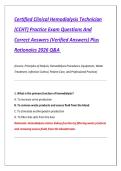
Certified Clinical Hemodialysis Technician
(CCHT) Practice Exam Questions And
Correct Answers (Verified Answers) Plus
Rationales 2026 Q&A
(Covers: Principles of Dialysis, Hemodialysis Procedures, Equipment, Water
Treatment, Infection Control, Patient Care, and Professional Practice)
1. What is the primary function of hemodialysis?
A. To increase urine production
B. To remove waste products and excess fluid from the blood
C. To stimulate erythropoietin production
D. To filter bile salts from the liver
Rationale: Hemodialysis mimics kidney function by filtering waste products
and removing excess fluids from the bloodstream.
,2. Which of the following best describes uremia?
A. A buildup of bile in the bloodstream
B. A buildup of waste products in the blood due to kidney failure
C. Low red blood cell count
D. Excess fluid retention in the lungs
Rationale: Uremia results from inadequate clearance of waste products by
the kidneys.
3. What is the primary purpose of the dialyzer?
A. To pump blood
B. To monitor pressure
C. To act as an artificial kidney to filter waste
D. To store dialysate
Rationale: The dialyzer contains semi-permeable membranes that allow
diffusion of solutes and fluid removal.
4. The dialysate contains electrolytes designed to:
A. Replace all patient blood electrolytes
B. Maintain normal serum electrolyte balance during dialysis
C. Reduce serum glucose levels
D. Promote urine output
Rationale: Dialysate composition is adjusted to help restore and maintain
proper electrolyte levels.
,5. What type of membrane allows small molecules to pass but not large
ones?
A. Impermeable membrane
B. Semi-permeable membrane
C. Osmotic membrane
D. Diffusion barrier
Rationale: The semi-permeable membrane allows selective transfer of
solutes and fluids.
6. The main force behind diffusion during dialysis is:
A. Gravity
B. Concentration gradient
C. Blood pressure
D. Osmosis
Rationale: Diffusion occurs as solutes move from an area of higher to lower
concentration.
7. Which of the following determines ultrafiltration during dialysis?
A. Solute concentration difference
B. Dialysate composition
C. Transmembrane pressure
, D. Membrane thickness m
Rationale: Ultrafiltration is controlled by transmembrane pressure
m m m m m m
m differences across the dialyzer membrane.
m m m m
8. The normal blood flow rate during hemodialysis ranges between:
m m m m m m m m
A. 50–100 mL/min m
B. 300–500 mL/min m
C. 600–900 mL/min m
D. 1000–1500 mL/min m
Rationale: Optimal clearance requires a blood flow rate typically
m m m m m m m m
between 300 and 500 mL/min.
m m m m m
9. The dialysate flow rate is commonly set at:
m m m m m m m
A. 50 mL/min
m
B. 500 mL/min
m
C. 1500 mL/min m
D. 2500 mL/min m
Rationale: A dialysate flow rate of around 500 mL/min optimizes solute
m m m m m m m m m m
m exchange efficiency.m
10. A patient’s dry weight refers to:
m m m m m
A. Their weight before starting dialysis
m m m m
(CCHT) Practice Exam Questions And
Correct Answers (Verified Answers) Plus
Rationales 2026 Q&A
(Covers: Principles of Dialysis, Hemodialysis Procedures, Equipment, Water
Treatment, Infection Control, Patient Care, and Professional Practice)
1. What is the primary function of hemodialysis?
A. To increase urine production
B. To remove waste products and excess fluid from the blood
C. To stimulate erythropoietin production
D. To filter bile salts from the liver
Rationale: Hemodialysis mimics kidney function by filtering waste products
and removing excess fluids from the bloodstream.
,2. Which of the following best describes uremia?
A. A buildup of bile in the bloodstream
B. A buildup of waste products in the blood due to kidney failure
C. Low red blood cell count
D. Excess fluid retention in the lungs
Rationale: Uremia results from inadequate clearance of waste products by
the kidneys.
3. What is the primary purpose of the dialyzer?
A. To pump blood
B. To monitor pressure
C. To act as an artificial kidney to filter waste
D. To store dialysate
Rationale: The dialyzer contains semi-permeable membranes that allow
diffusion of solutes and fluid removal.
4. The dialysate contains electrolytes designed to:
A. Replace all patient blood electrolytes
B. Maintain normal serum electrolyte balance during dialysis
C. Reduce serum glucose levels
D. Promote urine output
Rationale: Dialysate composition is adjusted to help restore and maintain
proper electrolyte levels.
,5. What type of membrane allows small molecules to pass but not large
ones?
A. Impermeable membrane
B. Semi-permeable membrane
C. Osmotic membrane
D. Diffusion barrier
Rationale: The semi-permeable membrane allows selective transfer of
solutes and fluids.
6. The main force behind diffusion during dialysis is:
A. Gravity
B. Concentration gradient
C. Blood pressure
D. Osmosis
Rationale: Diffusion occurs as solutes move from an area of higher to lower
concentration.
7. Which of the following determines ultrafiltration during dialysis?
A. Solute concentration difference
B. Dialysate composition
C. Transmembrane pressure
, D. Membrane thickness m
Rationale: Ultrafiltration is controlled by transmembrane pressure
m m m m m m
m differences across the dialyzer membrane.
m m m m
8. The normal blood flow rate during hemodialysis ranges between:
m m m m m m m m
A. 50–100 mL/min m
B. 300–500 mL/min m
C. 600–900 mL/min m
D. 1000–1500 mL/min m
Rationale: Optimal clearance requires a blood flow rate typically
m m m m m m m m
between 300 and 500 mL/min.
m m m m m
9. The dialysate flow rate is commonly set at:
m m m m m m m
A. 50 mL/min
m
B. 500 mL/min
m
C. 1500 mL/min m
D. 2500 mL/min m
Rationale: A dialysate flow rate of around 500 mL/min optimizes solute
m m m m m m m m m m
m exchange efficiency.m
10. A patient’s dry weight refers to:
m m m m m
A. Their weight before starting dialysis
m m m m


