
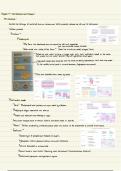
Chapter 4 -
cell membrane and transport
cell membrane :
·
Controls the exchange of materials , Such as nutrients and Waste products , between the cell and it's .
environment
·
Contain proteins
Structure
Phospholipids
Help form the membranes that surround the cell and
organelles .
·
ball like structures called micelles ,
When form"
·
mixed with water , either Sheet like structures called ,
bilayers (7nm)
>
Spread
-
out over water to form a
single layer with their hydrophilic heads in the water
Tails project out the water because they are hydrophobic (non-polar)
,
·
tails from the water
> Hydrophilic heads face outwards into the water , shielding hydrophobic
In the middle ,
the tail points in towards eachother
, (hydrophobic environment) .
>
Tails shielded from water, by
-
also heads .
fluid mosaic model
-"fluid" : Phospholipids and proteins can move about
by diffusion .
Phospholipid
-
associated
bilayer with Olive oil
Phospholipid
-
molecules move sideways in
layers
Some protein molecules move or remain fixed to structures inside or outside.
"Mosaic"
-
:
Pattern produced by scattered proteins When the Surface of the membrane is viewed from above.
features
·
Double layer of phospholipid molecules (bilayer) ,
Hydrophobic interior aqueous medium Surrounds membrane
,
Tails
·
are saturated or unsaturated
·
Proteins found in inner
/outer/Spanning whole membrane (transmembrane proteins
Proteins have hydrophobic and
hydrophilic regions
, Proteins Stay in the membrane because
Hydrophobic regions, made from
hydrophobic amino acids and next to
, hydrophobic fatty acid tails and are repelled by the
watery environment .
Hydrophilic regions, made from
hydrophilic amino acids
,
are repelled by the
hydrophobic interior of the membrane ,
facing into the
ageous
environment
,
inside/outside the cell
,
or
lining hydrophilic pores which pass through the membrane .
fluidity factors -
The
·
unsaturated the phospholipid tails , the looser
more
they fit so
fluidity increases .
The longer
·
the tail
,
the less fluid .
The lower the
temperature ,
the less fluidity .
Many proteins and lipids have short,
branching carbohydrate chains
, forming glyco
proteins and lipids .
Carbohydrate chains face outside the membrane .
cell membrane and transport
cell membrane :
·
Controls the exchange of materials , Such as nutrients and Waste products , between the cell and it's .
environment
·
Contain proteins
Structure
Phospholipids
Help form the membranes that surround the cell and
organelles .
·
ball like structures called micelles ,
When form"
·
mixed with water , either Sheet like structures called ,
bilayers (7nm)
>
Spread
-
out over water to form a
single layer with their hydrophilic heads in the water
Tails project out the water because they are hydrophobic (non-polar)
,
·
tails from the water
> Hydrophilic heads face outwards into the water , shielding hydrophobic
In the middle ,
the tail points in towards eachother
, (hydrophobic environment) .
>
Tails shielded from water, by
-
also heads .
fluid mosaic model
-"fluid" : Phospholipids and proteins can move about
by diffusion .
Phospholipid
-
associated
bilayer with Olive oil
Phospholipid
-
molecules move sideways in
layers
Some protein molecules move or remain fixed to structures inside or outside.
"Mosaic"
-
:
Pattern produced by scattered proteins When the Surface of the membrane is viewed from above.
features
·
Double layer of phospholipid molecules (bilayer) ,
Hydrophobic interior aqueous medium Surrounds membrane
,
Tails
·
are saturated or unsaturated
·
Proteins found in inner
/outer/Spanning whole membrane (transmembrane proteins
Proteins have hydrophobic and
hydrophilic regions
, Proteins Stay in the membrane because
Hydrophobic regions, made from
hydrophobic amino acids and next to
, hydrophobic fatty acid tails and are repelled by the
watery environment .
Hydrophilic regions, made from
hydrophilic amino acids
,
are repelled by the
hydrophobic interior of the membrane ,
facing into the
ageous
environment
,
inside/outside the cell
,
or
lining hydrophilic pores which pass through the membrane .
fluidity factors -
The
·
unsaturated the phospholipid tails , the looser
more
they fit so
fluidity increases .
The longer
·
the tail
,
the less fluid .
The lower the
temperature ,
the less fluidity .
Many proteins and lipids have short,
branching carbohydrate chains
, forming glyco
proteins and lipids .
Carbohydrate chains face outside the membrane .


