

NSG221 Mental Health Nursing HESI | 2026/2027 Update Herzing University | Grade A Verified Answers
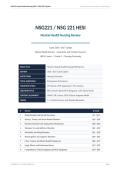
NSG221 / NSG 221 HESI
Mental Health Nursing Review
Latest Update
Mental Health Review | Questions and Verified Answers
100% Correct | Grade A | Herzing University
EXAM TITLE NSG221 Mental Health Nursing HESI Review
EDITION Latest Update
INSTITUTION Herzing University
TOTAL QUESTIONS 85 Questions (9 Sections)
COGNITIVE LEVELS 25% Recall | 50% Application | 25% Analysis
QUESTION STYLE 80% Scenario-Based NGN Integration | 20% Direct Recall
CONTENT ALIGNMENT DSM-5-TR Criteria | NGN Clinical Judgment Model
GRADE A - Verified Answers with Detailed Rationales
# Section Q Range
1 Mood Disorders and Suicide Prevention Q1 - Q15
2 Anxiety, Trauma, and Stress-Related Disorders Q16 - Q28
3 Psychotic Disorders and Antipsychotic Medications Q29 - Q40
4 Substance Use and Addictive Disorders Q41 - Q50
5 Personality and Eating Disorders Q51 - Q58
6 Neurocognitive and Cognitive Disorders Q59 - Q65
7 Crisis, Trauma, and Mental Health Emergencies Q66 - Q72
8 Legal, Ethical, and Professional Issues Q73 - Q78
9 Comprehensive Clinical Judgment and NGN Integration Q79 - Q85
Confidential - For Educational Use Page 1
,NSG221 Mental Health Nursing HESI | 2026/2027 Update Herzing University | Grade A Verified Answers
Instructions: This examination consists of 85 multiple-choice and Next-Generation NCLEX (NGN) enhanced
questions covering comprehensive mental health nursing concepts aligned with the DSM-5-TR (2022) and current
mental health practice standards (2026-2027). Each question has one best answer unless marked as an extended
multiple-response item. Rationales are provided after each question with detailed clinical reasoning including
DSM-5-TR criteria, psychopharmacology, therapeutic communication principles, safety considerations, and clinical
judgment. Topics covered include mood disorders, anxiety and trauma, psychotic disorders, substance use disorders,
personality and eating disorders, neurocognitive disorders, crisis intervention, legal/ethical issues, and NGN clinical
judgment integration. Herzing University NSG221 HESI preparation focus: prioritization, pharmacology, safety,
therapeutic communication, and NGN item formats.
Section 1: Mood Disorders and Suicide Prevention
Major Depressive Disorder | Bipolar Disorder | Suicidality | Antidepressants (SSRIs, SNRIs, TCAs, MAOIs)
NGN Case Study - Clinical Judgment: Recognize Cues
Q1: A 47-year-old female is brought to the outpatient mental health clinic by her sister, who reports the patient
has not left her house in 3 weeks. She has stopped attending her book club, has missed two weeks of work, and
tells the nurse, "I just don't see the point anymore." She has lost 12 pounds in 1 month without trying, awakens
at 3:00 AM daily and cannot return to sleep, and reports feeling "heavy" in her limbs. Which DSM-5-TR criteria
cluster is the nurse prioritizing when analyzing these cues?
A. Mood disturbance plus appetite change, sleep disturbance, psychomotor changes, fatigue, and suicidal
ideation - meeting 6 of 9 criteria for MDD [CORRECT]
B. Anxiety-driven avoidance with autonomic hyperarousal and persistent worry
C. Manic episode with decreased need for sleep and psychomotor agitation
D. Brief psychotic disorder with disorganized speech and catatonic features
Correct Answer: A
Rationale:
DSM-5-TR criteria for Major Depressive Disorder require at least 5 of 9 symptoms (including depressed mood or
anhedonia) persisting >= 2 weeks. This patient demonstrates depressed mood, anhedonia (social withdrawal, stopped
activities), significant weight loss, terminal insomnia (early morning awakening), psychomotor retardation ("heavy"
limbs), and passive suicidal ideation - meeting 6 criteria. Anxiety disorders require persistent worry as the primary
symptom (B). Mania presents with elevated mood and decreased need for sleep rather than terminal insomnia (C). Brief
psychotic disorder requires active psychotic symptoms (D). The nurse's clinical judgment focuses on clustering cues to
identify MDD severity.
NGN Bow-tie Item - Pharmacological Priority
Q2: A patient with MDD is started on sertraline (Zoloft) 50 mg daily. Drag the correct nursing actions to the
"Implement" side and contraindicated actions to the "Avoid" side. Which assessment finding 2 weeks after
initiation requires IMMEDIATE physician notification?
A. Mild headache, loose stools, and transient insomnia during week 1 - expected side effects of SSRI initiation
Confidential - For Educational Use Page 2
,NSG221 Mental Health Nursing HESI | 2026/2027 Update Herzing University | Grade A Verified Answers
B. Sustained blood pressure of 148/96 mmHg with diaphoresis, confusion, myoclonus, and hyperreflexia
at week 2 [CORRECT]
C. Patient reports "I'm feeling a little more energized but still down" at week 2
D. Weight gain of 2 pounds and decreased libido reported at the 4-week follow-up
Correct Answer: B
Rationale:
Serotonin syndrome is a life-threatening complication of SSRI therapy characterized by the triad of mental status changes
(confusion), autonomic instability (hypertension, diaphoresis), and neuromuscular hyperactivity (myoclonus,
hyperreflexia) - requiring immediate discontinuation and physician notification. Choice A represents expected transient
SSRI side effects that typically resolve within 1-2 weeks. Choice C reflects therapeutic onset (SSRIs take 4-6 weeks for
full effect). Choice D shows long-term SSRI adverse effects managed through monitoring, dose adjustment, or
augmentation. The 2-week timing coincides with peak SSRI effect accumulation, making serotonin syndrome the priority.
Q3: A patient with MDD has been taking phenelzine (Nardil), an MAOI, for 6 weeks with good response. The
patient asks the nurse, "Can I still eat my favorite Italian sub with salami and aged cheese?" What is the nurse's
BEST response?
A. "Yes, after 6 weeks of therapy your body has adjusted to the medication and dietary restrictions can be
relaxed."
B. "No, foods containing tyramine such as aged cheeses, cured meats, fermented foods, and certain beers
must be avoided throughout therapy and for 2 weeks after discontinuation." [CORRECT]
C. "You can have small amounts of aged cheese occasionally as long as you monitor your blood pressure."
D. "Only red wine needs to be avoided; aged cheese and salami are safe in moderation."
Correct Answer: B
Rationale:
MAOIs inhibit monoamine oxidase, the enzyme that breaks down tyramine in the gut. Tyramine-rich foods (aged cheeses,
cured/smoked meats, fermented foods, fava beans, tap beer, Marmite) can trigger a hypertensive crisis that can be fatal.
This restriction must continue throughout therapy AND for 14 days after stopping the MAOI (because MAO enzyme
regeneration takes that long). The body never "adjusts" to allow tyramine (A). There is no safe threshold for tyramine
intake on MAOIs (C, D). Patient education must include a complete tyramine-restricted diet list and recognition of
hypertensive crisis symptoms (occipital headache, palpitations, neck stiffness, sweating).
NGN Trend Item - Lithium Monitoring
Q4: A patient with bipolar I disorder is started on lithium carbonate 600 mg twice daily. Review the following
lithium levels drawn over 4 weeks: Week 1: 0.4 mEq/L; Week 2: 0.6 mEq/L; Week 3: 0.9 mEq/L; Week 4: 1.4
mEq/L. Which interpretation by the nurse is CORRECT?
A. All levels are within the therapeutic maintenance range of 0.6-1.5 mEq/L; continue current dose.
B. The trend shows appropriate upward titration; week 4 level indicates toxicity and the dose should be
held pending physician notification. [CORRECT]
C. The patient is non-adherent because the level is fluctuating.
D. Week 4 level is therapeutic for acute mania (1.0-1.5 mEq/L); no action is needed.
Correct Answer: B
Confidential - For Educational Use Page 3
, NSG221 Mental Health Nursing HESI | 2026/2027 Update Herzing University | Grade A Verified Answers
Rationale:
Lithium therapeutic range for acute mania is 0.8-1.2 mEq/L; maintenance range is 0.6-1.0 mEq/L (some references use
0.6-1.2). Levels >1.5 mEq/L indicate toxicity; levels >2.0 mEq/L are severe and life-threatening. A level of 1.4 mEq/L
with a rising trend signals impending toxicity. Early signs of lithium toxicity include mild GI upset, fine hand tremor,
polyuria, and lethargy; moderate toxicity (1.5-2.0) causes coarse tremor, ataxia, confusion, and muscle fasciculations;
severe toxicity causes seizures, arrhythmias, and renal failure. The dose must be held and the physician notified
immediately. Choice A is wrong because 1.4 exceeds maintenance range. Choice C is wrong because fluctuations reflect
titration, not non-adherence. Choice D ignores the toxic range.
Q5: A 22-year-old college student is brought to the ED after a suicide attempt. The patient took an overdose of a
tricyclic antidepressant (amitriptyline) 2 hours ago. Which finding is the MOST critical to monitor for in the next
24 hours?
A. Urinary retention and dry mouth secondary to anticholinergic effects
B. Prolonged QT interval on ECG, widening QRS complex, and life-threatening ventricular arrhythmias
[CORRECT]
C. Weight gain and sedation from histamine blockade
D. Orthostatic hypotension occurring only with rapid position changes
Correct Answer: B
Rationale:
TCA overdose is lethal due to sodium channel blockade in cardiac tissue, producing a prolonged QRS duration (>100 ms),
QTc prolongation, and life-threatening ventricular arrhythmias including torsades de pointes and ventricular fibrillation.
The classic triad of TCA overdose includes CNS depression, cardiovascular toxicity, and anticholinergic toxidrome.
Sodium bicarbonate is the antidote given for QRS widening >100 ms or ventricular dysrhythmias. While A, C, and D are
all side effects of TCAs (anticholinergic, antihistamine, alpha-1 blockade respectively), they are not the lethal concerns in
overdose. Cardiovascular monitoring in an ICU setting is mandatory for at least 24 hours post-ingestion.
NGN Scenario - Therapeutic Communication
Q6: A 38-year-old patient hospitalized for MDD with suicidal ideation tells the nurse during evening rounds, "I've
been thinking about how everyone would be better off without me. I have a plan, but I don't want to talk about
it." Which nursing response is the MOST therapeutic?
A. "You shouldn't think that way. Your family loves you very much."
B. "I'm concerned about what you're saying. Tell me more about your plan, and let's work together to
keep you safe." [CORRECT]
C. "We'll keep you on one-to-one observation tonight so you can't act on it."
D. "Why would you think such things when you have so much to live for?"
Correct Answer: B
Rationale:
Therapeutic communication requires directly addressing suicidal ideation without judgment. Choice B uses validation,
expresses concern, invites disclosure of the plan (essential for risk assessment), and collaboratively frames safety - all core
therapeutic techniques. Choice A dismisses the patient's feelings and uses false reassurance. Choice C, while implementing
a safety measure, avoids the therapeutic conversation about the plan and is non-collaborative. Choice D uses the
non-therapeutic "why" question and minimizes the patient's pain. Best practice: assess plan, means, timeframe, and intent
Confidential - For Educational Use Page 4
NSG221 / NSG 221 HESI
Mental Health Nursing Review
Latest Update
Mental Health Review | Questions and Verified Answers
100% Correct | Grade A | Herzing University
EXAM TITLE NSG221 Mental Health Nursing HESI Review
EDITION Latest Update
INSTITUTION Herzing University
TOTAL QUESTIONS 85 Questions (9 Sections)
COGNITIVE LEVELS 25% Recall | 50% Application | 25% Analysis
QUESTION STYLE 80% Scenario-Based NGN Integration | 20% Direct Recall
CONTENT ALIGNMENT DSM-5-TR Criteria | NGN Clinical Judgment Model
GRADE A - Verified Answers with Detailed Rationales
# Section Q Range
1 Mood Disorders and Suicide Prevention Q1 - Q15
2 Anxiety, Trauma, and Stress-Related Disorders Q16 - Q28
3 Psychotic Disorders and Antipsychotic Medications Q29 - Q40
4 Substance Use and Addictive Disorders Q41 - Q50
5 Personality and Eating Disorders Q51 - Q58
6 Neurocognitive and Cognitive Disorders Q59 - Q65
7 Crisis, Trauma, and Mental Health Emergencies Q66 - Q72
8 Legal, Ethical, and Professional Issues Q73 - Q78
9 Comprehensive Clinical Judgment and NGN Integration Q79 - Q85
Confidential - For Educational Use Page 1
,NSG221 Mental Health Nursing HESI | 2026/2027 Update Herzing University | Grade A Verified Answers
Instructions: This examination consists of 85 multiple-choice and Next-Generation NCLEX (NGN) enhanced
questions covering comprehensive mental health nursing concepts aligned with the DSM-5-TR (2022) and current
mental health practice standards (2026-2027). Each question has one best answer unless marked as an extended
multiple-response item. Rationales are provided after each question with detailed clinical reasoning including
DSM-5-TR criteria, psychopharmacology, therapeutic communication principles, safety considerations, and clinical
judgment. Topics covered include mood disorders, anxiety and trauma, psychotic disorders, substance use disorders,
personality and eating disorders, neurocognitive disorders, crisis intervention, legal/ethical issues, and NGN clinical
judgment integration. Herzing University NSG221 HESI preparation focus: prioritization, pharmacology, safety,
therapeutic communication, and NGN item formats.
Section 1: Mood Disorders and Suicide Prevention
Major Depressive Disorder | Bipolar Disorder | Suicidality | Antidepressants (SSRIs, SNRIs, TCAs, MAOIs)
NGN Case Study - Clinical Judgment: Recognize Cues
Q1: A 47-year-old female is brought to the outpatient mental health clinic by her sister, who reports the patient
has not left her house in 3 weeks. She has stopped attending her book club, has missed two weeks of work, and
tells the nurse, "I just don't see the point anymore." She has lost 12 pounds in 1 month without trying, awakens
at 3:00 AM daily and cannot return to sleep, and reports feeling "heavy" in her limbs. Which DSM-5-TR criteria
cluster is the nurse prioritizing when analyzing these cues?
A. Mood disturbance plus appetite change, sleep disturbance, psychomotor changes, fatigue, and suicidal
ideation - meeting 6 of 9 criteria for MDD [CORRECT]
B. Anxiety-driven avoidance with autonomic hyperarousal and persistent worry
C. Manic episode with decreased need for sleep and psychomotor agitation
D. Brief psychotic disorder with disorganized speech and catatonic features
Correct Answer: A
Rationale:
DSM-5-TR criteria for Major Depressive Disorder require at least 5 of 9 symptoms (including depressed mood or
anhedonia) persisting >= 2 weeks. This patient demonstrates depressed mood, anhedonia (social withdrawal, stopped
activities), significant weight loss, terminal insomnia (early morning awakening), psychomotor retardation ("heavy"
limbs), and passive suicidal ideation - meeting 6 criteria. Anxiety disorders require persistent worry as the primary
symptom (B). Mania presents with elevated mood and decreased need for sleep rather than terminal insomnia (C). Brief
psychotic disorder requires active psychotic symptoms (D). The nurse's clinical judgment focuses on clustering cues to
identify MDD severity.
NGN Bow-tie Item - Pharmacological Priority
Q2: A patient with MDD is started on sertraline (Zoloft) 50 mg daily. Drag the correct nursing actions to the
"Implement" side and contraindicated actions to the "Avoid" side. Which assessment finding 2 weeks after
initiation requires IMMEDIATE physician notification?
A. Mild headache, loose stools, and transient insomnia during week 1 - expected side effects of SSRI initiation
Confidential - For Educational Use Page 2
,NSG221 Mental Health Nursing HESI | 2026/2027 Update Herzing University | Grade A Verified Answers
B. Sustained blood pressure of 148/96 mmHg with diaphoresis, confusion, myoclonus, and hyperreflexia
at week 2 [CORRECT]
C. Patient reports "I'm feeling a little more energized but still down" at week 2
D. Weight gain of 2 pounds and decreased libido reported at the 4-week follow-up
Correct Answer: B
Rationale:
Serotonin syndrome is a life-threatening complication of SSRI therapy characterized by the triad of mental status changes
(confusion), autonomic instability (hypertension, diaphoresis), and neuromuscular hyperactivity (myoclonus,
hyperreflexia) - requiring immediate discontinuation and physician notification. Choice A represents expected transient
SSRI side effects that typically resolve within 1-2 weeks. Choice C reflects therapeutic onset (SSRIs take 4-6 weeks for
full effect). Choice D shows long-term SSRI adverse effects managed through monitoring, dose adjustment, or
augmentation. The 2-week timing coincides with peak SSRI effect accumulation, making serotonin syndrome the priority.
Q3: A patient with MDD has been taking phenelzine (Nardil), an MAOI, for 6 weeks with good response. The
patient asks the nurse, "Can I still eat my favorite Italian sub with salami and aged cheese?" What is the nurse's
BEST response?
A. "Yes, after 6 weeks of therapy your body has adjusted to the medication and dietary restrictions can be
relaxed."
B. "No, foods containing tyramine such as aged cheeses, cured meats, fermented foods, and certain beers
must be avoided throughout therapy and for 2 weeks after discontinuation." [CORRECT]
C. "You can have small amounts of aged cheese occasionally as long as you monitor your blood pressure."
D. "Only red wine needs to be avoided; aged cheese and salami are safe in moderation."
Correct Answer: B
Rationale:
MAOIs inhibit monoamine oxidase, the enzyme that breaks down tyramine in the gut. Tyramine-rich foods (aged cheeses,
cured/smoked meats, fermented foods, fava beans, tap beer, Marmite) can trigger a hypertensive crisis that can be fatal.
This restriction must continue throughout therapy AND for 14 days after stopping the MAOI (because MAO enzyme
regeneration takes that long). The body never "adjusts" to allow tyramine (A). There is no safe threshold for tyramine
intake on MAOIs (C, D). Patient education must include a complete tyramine-restricted diet list and recognition of
hypertensive crisis symptoms (occipital headache, palpitations, neck stiffness, sweating).
NGN Trend Item - Lithium Monitoring
Q4: A patient with bipolar I disorder is started on lithium carbonate 600 mg twice daily. Review the following
lithium levels drawn over 4 weeks: Week 1: 0.4 mEq/L; Week 2: 0.6 mEq/L; Week 3: 0.9 mEq/L; Week 4: 1.4
mEq/L. Which interpretation by the nurse is CORRECT?
A. All levels are within the therapeutic maintenance range of 0.6-1.5 mEq/L; continue current dose.
B. The trend shows appropriate upward titration; week 4 level indicates toxicity and the dose should be
held pending physician notification. [CORRECT]
C. The patient is non-adherent because the level is fluctuating.
D. Week 4 level is therapeutic for acute mania (1.0-1.5 mEq/L); no action is needed.
Correct Answer: B
Confidential - For Educational Use Page 3
, NSG221 Mental Health Nursing HESI | 2026/2027 Update Herzing University | Grade A Verified Answers
Rationale:
Lithium therapeutic range for acute mania is 0.8-1.2 mEq/L; maintenance range is 0.6-1.0 mEq/L (some references use
0.6-1.2). Levels >1.5 mEq/L indicate toxicity; levels >2.0 mEq/L are severe and life-threatening. A level of 1.4 mEq/L
with a rising trend signals impending toxicity. Early signs of lithium toxicity include mild GI upset, fine hand tremor,
polyuria, and lethargy; moderate toxicity (1.5-2.0) causes coarse tremor, ataxia, confusion, and muscle fasciculations;
severe toxicity causes seizures, arrhythmias, and renal failure. The dose must be held and the physician notified
immediately. Choice A is wrong because 1.4 exceeds maintenance range. Choice C is wrong because fluctuations reflect
titration, not non-adherence. Choice D ignores the toxic range.
Q5: A 22-year-old college student is brought to the ED after a suicide attempt. The patient took an overdose of a
tricyclic antidepressant (amitriptyline) 2 hours ago. Which finding is the MOST critical to monitor for in the next
24 hours?
A. Urinary retention and dry mouth secondary to anticholinergic effects
B. Prolonged QT interval on ECG, widening QRS complex, and life-threatening ventricular arrhythmias
[CORRECT]
C. Weight gain and sedation from histamine blockade
D. Orthostatic hypotension occurring only with rapid position changes
Correct Answer: B
Rationale:
TCA overdose is lethal due to sodium channel blockade in cardiac tissue, producing a prolonged QRS duration (>100 ms),
QTc prolongation, and life-threatening ventricular arrhythmias including torsades de pointes and ventricular fibrillation.
The classic triad of TCA overdose includes CNS depression, cardiovascular toxicity, and anticholinergic toxidrome.
Sodium bicarbonate is the antidote given for QRS widening >100 ms or ventricular dysrhythmias. While A, C, and D are
all side effects of TCAs (anticholinergic, antihistamine, alpha-1 blockade respectively), they are not the lethal concerns in
overdose. Cardiovascular monitoring in an ICU setting is mandatory for at least 24 hours post-ingestion.
NGN Scenario - Therapeutic Communication
Q6: A 38-year-old patient hospitalized for MDD with suicidal ideation tells the nurse during evening rounds, "I've
been thinking about how everyone would be better off without me. I have a plan, but I don't want to talk about
it." Which nursing response is the MOST therapeutic?
A. "You shouldn't think that way. Your family loves you very much."
B. "I'm concerned about what you're saying. Tell me more about your plan, and let's work together to
keep you safe." [CORRECT]
C. "We'll keep you on one-to-one observation tonight so you can't act on it."
D. "Why would you think such things when you have so much to live for?"
Correct Answer: B
Rationale:
Therapeutic communication requires directly addressing suicidal ideation without judgment. Choice B uses validation,
expresses concern, invites disclosure of the plan (essential for risk assessment), and collaboratively frames safety - all core
therapeutic techniques. Choice A dismisses the patient's feelings and uses false reassurance. Choice C, while implementing
a safety measure, avoids the therapeutic conversation about the plan and is non-collaborative. Choice D uses the
non-therapeutic "why" question and minimizes the patient's pain. Best practice: assess plan, means, timeframe, and intent
Confidential - For Educational Use Page 4


