

Written by students who passed Immediately available after payment Read online or as PDF Wrong document? Swap it for free 4.6 TrustPilot
logo-home
Document preview thumbnail
Preview 4 out of 473 pages
Exam (elaborations)

Test Bank for Clinical Chemistry: Principles, Techniques, and Correlations by Michael L. Bishop, M.D. Fody, Edward P., & 3 Others (All Chapters inclusive) |Comprehensive 1005 Multiple Choice Questions Review with Answers and Rationales

Document preview thumbnail
Preview 4 out of 473 pages

Ace Your Clinical Chemistry Exams with the Definitive Test Bank! Are you preparing for a challenging Clinical Chemistry course or a crucial certification exam (ASCP, AMT, or State Board)? This comprehensive Test Bank for Clinical Chemistry: Principles, Techniques, and Correlations, 9th Edition by Bishop, Fody, and colleagues is the ultimate resource to help you master the subject and achieve top grades. Test Bank for Clinical Chemistry: Principles, Techniques, and Correlations by Michael L. Bishop, M.D. Fody, Edward P., & 3 Others (All Chapters inclusive) |Comprehensive 1005 Multiple Choice Questions Review with Answers and Rationales TABLE OF CONTENTS Part Chapter Title Questions Part 1 Basic Principles and Practice in Clinical Chemistry Ch 1 Basic Principles and Practices of Clinical Chemistry 1–40 Ch 2 Laboratory Safety and Regulations 41–70 Ch 3 Quality Management in the Clinical Laboratory 71–105 Ch 4 Analytic Techniques 106–145 Ch 5 Clinical Chemistry Automation 146–175 Part 2 Analytic Procedures and Clinical Correlation Ch 6 Proteins and Heme Derivatives 176–215 Ch 7 Nonprotein Nitrogen Compounds 216–245 Ch 8 Enzymes 246–290 Ch 9 Carbohydrates 291–330 Ch 10 Lipids and Lipoproteins 331–370 Ch 11 Electrolytes 371–410 Ch 12 Blood Gases, pH, and Buffer Systems 411–445 Part 3 Endocrinology and Clinical Correlation Ch 13 Basic Endocrinology 446–475 Ch 14 Thyroid Function 476–510 Ch 15 Hypothalamic and Pituitary Function 511–545 Ch 16 Adrenal Function 546–580 Ch 17 Gonadal Function 581–610 Ch 18 Parathyroid Function and Calcium Homeostasis 611–640 Part 4 Organ Systems and Clinical Correlation Ch 19 Liver Function 641–680 Ch 20 Cardiac Function 681–715 Ch 21 Renal Function 716–750 Ch 22 Pancreatic and Gastrointestinal Function 751–785 Part 5 Specialty Areas of Clinical Chemistry Ch 23 Body Fluid Analysis 786–815 Ch 24 Pregnancy and Prenatal Testing 816–835 Ch 25 Therapeutic Drug Monitoring 836–865 Ch 26 Toxicology 866–895 Ch 27 Trace Elements, Toxic Elements, and Vitamins 896–925 Ch 28 Tumor Markers 926–955 Ch 29 Point-of-Care Testing 956–975 Ch 30 Newborn and Pediatric Clinical Chemistry 976–995 Ch 31 Geriatric Clinical Chemistry 996–1005 ________________________________________ PART 1: BASIC PRINCIPLES AND PRACTICE IN CLINICAL CHEMISTRY ________________________________________ CHAPTER 1: BASIC PRINCIPLES AND PRACTICES OF CLINICAL CHEMISTRY ________________________________________ 1. One nanogram is equivalent to how many grams? A) 10⁻⁶ B) 10⁻⁹ C) 10⁻¹² D) 10⁻¹⁵ Correct Answer: B Rationale: The prefix "nano" denotes 10⁻⁹. Therefore, one nanogram (ng) equals 10⁻⁹ grams. A microgram is 10⁻⁶ g, a picogram is 10⁻¹² g, and a femtogram is 10⁻¹⁵ g. DIF: 1 REF: Chapter 1, Units of Measure KEY: Clinical Chemistry | Basic Principles | Units of Measure MSC: Remembering ________________________________________ 2. How many milliliters of 0.5 N NaOH are required to make 100 milliliters of 0.2 N NaOH? A) 20 mL B) 40 mL C) 60 mL D) 80 mL Correct Answer: B Rationale: Using the dilution formula C₁V₁ = C₂V₂, where C₁ = 0.5 N, C₂ = 0.2 N, and V₂ = 100 mL: (0.5)(V₁) = (0.2)(100); V₁ = 20/0.5 = 40 mL. DIF: 2 REF: Chapter 1, Solution Preparation KEY: Clinical Chemistry | Basic Principles | Dilution Calculations MSC: Applying ________________________________________ 3. What is the molarity of a solution containing 100 g of NaCl made up to 500 mL with distilled water? (Molecular weight of NaCl ≈ 58 g/mol) A) 1.72 M B) 3.45 M C) 0.86 M D) 6.90 M Correct Answer: B Rationale: Moles of NaCl = 100 g ÷ 58 g/mol = 1.724 mol. Molarity = moles ÷ volume in liters = 1.724 mol ÷ 0.5 L = 3.448 M ≈ 3.45 M. DIF: 3 REF: Chapter 1, Molarity Calculations KEY: Clinical Chemistry | Basic Principles | Molarity MSC: Applying ________________________________________ 4. Which of the following is the correct relationship between absorbance and transmittance? A) A = log(1/T) B) A = -log T C) Both A and B D) A = T × 100 Correct Answer: C Rationale: Absorbance (A) is defined as the negative logarithm of transmittance (T): A = -log T. This is equivalent to A = log(1/T). Both expressions are correct and mathematically identical. DIF: 2 REF: Chapter 1, Spectrophotometry KEY: Clinical Chemistry | Basic Principles | Absorbance | Transmittance MSC: Understanding ________________________________________ 5. The Beer-Lambert law states that absorbance is directly proportional to: A) Concentration only B) Path length only C) Both concentration and path length D) Neither concentration nor path length Correct Answer: C Rationale: The Beer-Lambert law is expressed as A = εbc, where A is absorbance, ε is the molar absorptivity, b is the path length, and c is the concentration. Absorbance is directly proportional to both the concentration of the absorbing species and the path length of the light through the sample. DIF: 1 REF: Chapter 1, Spectrophotometry KEY: Clinical Chemistry | Basic Principles | Beer-Lambert Law MSC: Remembering

Content preview

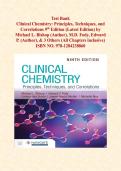
Test Bank
Clinical Chemistry: Principles, Techniques, and
Correlations 9th Edition (Latest Edition) by
Michael L. Bishop (Author), M.D. Fody, Edward
P. (Author), & 3 Others (All Chapters inclusive)
ISBN NO. 978-1284238860

,Test Bank for Clinical Chemistry: Principles,
Techniques, and Correlations by Michael L.
Bishop, M.D. Fody, Edward P., & 3 Others (All
Chapters inclusive) |Comprehensive 1005
Multiple Choice Questions Review with Answers
and Rationales

TABLE OF CONTENTS

Part Chapter Title Questions

Part Basic Principles and Practice in Clinical
1 Chemistry

Basic Principles and Practices of Clinical
Ch 1 1–40
Chemistry

Ch 2 Laboratory Safety and Regulations 41–70

Quality Management in the Clinical
Ch 3 71–105
Laboratory

Ch 4 Analytic Techniques 106–145

Ch 5 Clinical Chemistry Automation 146–175

Part Analytic Procedures and Clinical
2 Correlation

Ch 6 Proteins and Heme Derivatives 176–215

Ch 7 Nonprotein Nitrogen Compounds 216–245

,Part Chapter Title Questions

Ch 8 Enzymes 246–290

Ch 9 Carbohydrates 291–330

Ch 10 Lipids and Lipoproteins 331–370

Ch 11 Electrolytes 371–410

Ch 12 Blood Gases, pH, and Buffer Systems 411–445

Part
3 Endocrinology and Clinical Correlation


Ch 13 Basic Endocrinology 446–475

Ch 14 Thyroid Function 476–510

Ch 15 Hypothalamic and Pituitary Function 511–545

Ch 16 Adrenal Function 546–580

Ch 17 Gonadal Function 581–610

Parathyroid Function and Calcium
Ch 18 611–640
Homeostasis

Part
4 Organ Systems and Clinical Correlation


Ch 19 Liver Function 641–680

Ch 20 Cardiac Function 681–715

Ch 21 Renal Function 716–750

Ch 22 Pancreatic and Gastrointestinal Function 751–785

, Part Chapter Title Questions

Part
5 Specialty Areas of Clinical Chemistry


Ch 23 Body Fluid Analysis 786–815

Ch 24 Pregnancy and Prenatal Testing 816–835

Ch 25 Therapeutic Drug Monitoring 836–865

Ch 26 Toxicology 866–895

Trace Elements, Toxic Elements, and
Ch 27 896–925
Vitamins

Ch 28 Tumor Markers 926–955

Ch 29 Point-of-Care Testing 956–975

Ch 30 Newborn and Pediatric Clinical Chemistry 976–995

Ch 31 Geriatric Clinical Chemistry 996–1005

Connected book
 image
Michael L. Bishop, Edward P. Fody, Carleen Van Siclen Clinical Chemistry: Principles, Techniques, and Correlations
Publisher: 2022 ISBN: 9781284238860 Edition: Unknown

Document information

Uploaded on
August 29, 2026
Number of pages
473
Written in
2026/2027
Type
Exam (elaborations)
Contains
Questions & answers
$17.49

Wrong document? Swap it for free Within 14 days of purchase and before downloading, you can choose a different document. You can simply spend the amount again.
Written by students who passed
Immediately available after payment
Read online or as PDF

Seller avatar
Reputation scores are based on the amount of documents a seller has sold for a fee and the reviews they have received for those documents. There are three levels: Bronze, Silver and Gold. The better the reputation, the more your can rely on the quality of the sellers work.
TutorGeoff
3.8
(15)
Sold
68
Followers
2
Items
755
Last sold
14 hours ago


Why students choose Stuvia

Created by fellow students, verified by reviews

Quality you can trust: written by students who passed their exams and reviewed by others who've used these revision notes.

Didn't get what you expected? Choose another document

No problem! You can straightaway pick a different document that better suits what you're after.

Pay as you like, start learning straight away

No subscription, no commitments. Pay the way you're used to via credit card and download your PDF document instantly.

Student with book image

“Bought, downloaded, and smashed it. It really can be that simple.”

Alisha Student

Working on your references?

Create accurate citations in APA, MLA and Harvard with our free citation generator.

Working on your references?

Frequently asked questions
