

Page 1 of 246
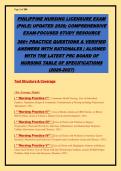
PHILIPPINE NURSING LICENSURE EXAM
(PNLE) UPDATED 2026; COMPREHENSIVE
EXAM-FOCUSED STUDY RESOURCE
380+ PRACTICE QUESTIONS & VERIFIED
ANSWERS WITH RATIONALES | ALIGNED
WITH THE LATEST PRC BOARD OF
NURSING TABLE OF SPECIFICATIONS
(2026-2027)
Test Structure & Coverage
| Test | Coverage | Weight |
| **Nursing Practice I** | Community Health Nursing; Care of Individuals,
Families, Population Groups & Community; Fundamentals of Nursing including Professional
Adjustments | 20% |
| **Nursing Practice II** | Care of Mother, Adolescent (Well Clients), At Risk or
With Problems (Acute & Chronic); Human Growth and Development | 20% |
| **Nursing Practice III** | Care of Clients with Problems in Surgery,
Oxygenation, Fluid and Electrolytes, Infectious, Inflammatory and Immunologic Response,
Cellular Aberrations (Acute and Chronic) | 20% |
| **Nursing Practice IV** | Care of Clients with Problems in Nutrition, Gastro-
Intestinal, Metabolism and Endocrine, Perception and Coordination (Acute and Chronic) | 20% |
| **Nursing Practice V** | Care of Clients with Maladaptive Patterns of Behavior
(Acute and Chronic); Care of Clients with Life-Threatening Condition, Acutely Ill/Multi-Organ
Problems, High Acuity and Emergency Situation | 20% |
,Page 2 of 246
# NURSING PRACTICE I
## Community Health Nursing & Fundamentals
### SECTION A: COMMUNITY HEALTH NURSING CONCEPTS
**Question 1**
A community health nurse is planning a primary prevention program for a rural barangay. Which
of the following activities BEST exemplifies primary prevention?
A. Conducting blood pressure screening for adults over 40 years old
B. Providing immunizations to infants and children at the health center
C. Facilitating a support group for clients with diabetes mellitus
D. Referring a client with tuberculosis to a directly observed therapy (DOT) program
**Correct Answer: B**
**Rationale:** Primary prevention aims to prevent disease before it occurs. Immunizations are a
classic example of primary prevention as they protect individuals from developing infectious
diseases. Option A (screening) is secondary prevention (early detection). Option C (support
groups) and Option D (referral for treatment) are tertiary prevention (management of established
disease).
---
**Question 2**
The nurse is applying the epidemiologic triad to understand the transmission of dengue fever in a
community. Which component of the triad would be classified as the **agent**?
,Page 3 of 246
A. The Aedes aegypti mosquito
B. The dengue virus
C. A child who has been bitten by an infected mosquito
D. The standing water where mosquitoes breed
**Correct Answer: B**
**Rationale:** The epidemiologic triad consists of agent, host, and environment. The **agent**
is the cause of the disease — in this case, the dengue virus. The Aedes aegypti mosquito is the
**vector** (mode of transmission). The child is the **host**, and standing water is an
**environmental** factor that facilitates transmission.
---
**Question 3**
A community health nurse is using the family nursing process. During which phase does the
nurse validate collected data with the family and identify health problems?
A. Assessment
B. Planning
C. Implementation
D. Evaluation
**Correct Answer: A**
**Rationale:** The assessment phase involves collecting, validating, and organizing data about
the family's health status, and identifying existing or potential health problems. Validation with
, Page 4 of 246
the family is a critical component of accurate assessment. Planning involves setting goals,
implementation involves carrying out interventions, and evaluation measures outcomes.
---
**Question 4**
The nurse is conducting a community diagnosis. Which of the following is a **secondary level
of prevention** activity?
A. Health education on proper nutrition for pregnant women
B. Mass immunization campaign for measles
C. Tuberculosis screening using chest X-ray
D. Rehabilitation program for stroke survivors
**Correct Answer: C**
**Rationale:** Secondary prevention focuses on early detection and prompt treatment of
disease. Screening (such as TB screening with chest X-ray) is a secondary prevention activity.
Primary prevention includes health education and immunizations. Tertiary prevention includes
rehabilitation and management of chronic conditions.
---
**Question 5**
According to the Philippine Health Care Delivery System, which level of health care facility is
the **first contact** between the community and the health care system?
A. Tertiary hospital
B. Secondary hospital
PHILIPPINE NURSING LICENSURE EXAM
(PNLE) UPDATED 2026; COMPREHENSIVE
EXAM-FOCUSED STUDY RESOURCE
380+ PRACTICE QUESTIONS & VERIFIED
ANSWERS WITH RATIONALES | ALIGNED
WITH THE LATEST PRC BOARD OF
NURSING TABLE OF SPECIFICATIONS
(2026-2027)
Test Structure & Coverage
| Test | Coverage | Weight |
| **Nursing Practice I** | Community Health Nursing; Care of Individuals,
Families, Population Groups & Community; Fundamentals of Nursing including Professional
Adjustments | 20% |
| **Nursing Practice II** | Care of Mother, Adolescent (Well Clients), At Risk or
With Problems (Acute & Chronic); Human Growth and Development | 20% |
| **Nursing Practice III** | Care of Clients with Problems in Surgery,
Oxygenation, Fluid and Electrolytes, Infectious, Inflammatory and Immunologic Response,
Cellular Aberrations (Acute and Chronic) | 20% |
| **Nursing Practice IV** | Care of Clients with Problems in Nutrition, Gastro-
Intestinal, Metabolism and Endocrine, Perception and Coordination (Acute and Chronic) | 20% |
| **Nursing Practice V** | Care of Clients with Maladaptive Patterns of Behavior
(Acute and Chronic); Care of Clients with Life-Threatening Condition, Acutely Ill/Multi-Organ
Problems, High Acuity and Emergency Situation | 20% |
,Page 2 of 246
# NURSING PRACTICE I
## Community Health Nursing & Fundamentals
### SECTION A: COMMUNITY HEALTH NURSING CONCEPTS
**Question 1**
A community health nurse is planning a primary prevention program for a rural barangay. Which
of the following activities BEST exemplifies primary prevention?
A. Conducting blood pressure screening for adults over 40 years old
B. Providing immunizations to infants and children at the health center
C. Facilitating a support group for clients with diabetes mellitus
D. Referring a client with tuberculosis to a directly observed therapy (DOT) program
**Correct Answer: B**
**Rationale:** Primary prevention aims to prevent disease before it occurs. Immunizations are a
classic example of primary prevention as they protect individuals from developing infectious
diseases. Option A (screening) is secondary prevention (early detection). Option C (support
groups) and Option D (referral for treatment) are tertiary prevention (management of established
disease).
---
**Question 2**
The nurse is applying the epidemiologic triad to understand the transmission of dengue fever in a
community. Which component of the triad would be classified as the **agent**?
,Page 3 of 246
A. The Aedes aegypti mosquito
B. The dengue virus
C. A child who has been bitten by an infected mosquito
D. The standing water where mosquitoes breed
**Correct Answer: B**
**Rationale:** The epidemiologic triad consists of agent, host, and environment. The **agent**
is the cause of the disease — in this case, the dengue virus. The Aedes aegypti mosquito is the
**vector** (mode of transmission). The child is the **host**, and standing water is an
**environmental** factor that facilitates transmission.
---
**Question 3**
A community health nurse is using the family nursing process. During which phase does the
nurse validate collected data with the family and identify health problems?
A. Assessment
B. Planning
C. Implementation
D. Evaluation
**Correct Answer: A**
**Rationale:** The assessment phase involves collecting, validating, and organizing data about
the family's health status, and identifying existing or potential health problems. Validation with
, Page 4 of 246
the family is a critical component of accurate assessment. Planning involves setting goals,
implementation involves carrying out interventions, and evaluation measures outcomes.
---
**Question 4**
The nurse is conducting a community diagnosis. Which of the following is a **secondary level
of prevention** activity?
A. Health education on proper nutrition for pregnant women
B. Mass immunization campaign for measles
C. Tuberculosis screening using chest X-ray
D. Rehabilitation program for stroke survivors
**Correct Answer: C**
**Rationale:** Secondary prevention focuses on early detection and prompt treatment of
disease. Screening (such as TB screening with chest X-ray) is a secondary prevention activity.
Primary prevention includes health education and immunizations. Tertiary prevention includes
rehabilitation and management of chronic conditions.
---
**Question 5**
According to the Philippine Health Care Delivery System, which level of health care facility is
the **first contact** between the community and the health care system?
A. Tertiary hospital
B. Secondary hospital


