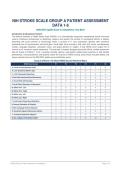
NIH STROKE SCALE GROUP A PATIENT ASSESSMENT
DATA 1-6
2026-2027 Update Exam & Competency Test Bank
Introduction & Educational Context:
The National Institutes of Health Stroke Scale (NIHSS) is an internationally recognized, standardized clinical instrument
used by healthcare professionals to objectively measure and quantify the severity of neurological deficits in patients
presenting with acute ischemic or hemorrhagic stroke. It consists of 11 core examination domains (with sub-items)
evaluating level of consciousness, horizontal gaze, visual fields, facial symmetry, limb motor drift, ataxia, somatosensory
function, language integration, articulation clarity, and spatial attention or neglect. A total NIHSS score ranges from 0
(normal) to 42 (maximum severe impairment). This test bank is expertly designed around the official, verified assessment
data for Group A (Patients 1 to 6). It provides clinically rigorous, case-based multiple-choice questions to help medical
professionals, nurse practitioners, and students master the nuances of NIHSS scoring, avoid clinical evaluation pitfalls, and
secure a perfect score on the 2026-2027 update and re-certification exams.
Group A (Patients 1-6) Official NIHSS Scores Reference Matrix
NIHSS Item Domain P1 P2 P3 P4 P5 P6
1a. Level of Consciousness (LOC) 0 0 0 0 0 0
1b. LOC Questions (Month, Age) 0 2 0 0 1 0
1c. LOC Commands (Eyes/Grip) 0 0 0 0 0 0
2. Best Gaze (Horizontal Eye Movements) 0 0 0 0 0 0
3. Visual Fields (Hemianopia) 0 0 0 0 2 0
4. Facial Palsy (Symmetry of Movement) 1 1 1 1 2 0
5a. Motor Arm - Left 3 0 0 0 4 0
5b. Motor Arm - Right 0 0 0 0 0 0
6a. Motor Leg - Left 1 0 2 0 1 0
6b. Motor Leg - Right 0 0 2 0 0 1
7. Limb Ataxia (Finger-Nose/Heel-Shin) 1 0 0 0 1 0
8. Sensory (Sensation to Pinprick) 1 1 1 1 1 1
9. Best Language (Cortical Aphasia) 0 2 0 0 1 0
10. Dysarthria (Speech Mechanical Clarity) 0 1 1 0 0 0
11. Extinction/Inattention (Neglect) 1 0 0 0 1 0
TOTAL CUMULATIVE NIHSS SCORE 8 7 7 2 14 2
NIHSS Group A Patient Assessment Competency Page 1 of 5
, NIH STROKE SCALE GROUP A PATIENT ASSESSMENT DATA 1-6 2026-2027 UPDATE EXAM & TEST BANK
Part I: Level of Consciousness & Cranial Nerve Integrity
Question 1: Item 1b (LOC Questions) assesses orientation by asking the patient their current age and the
current month. Patient 2 and Patient 5 show different scoring on this item (Patient 2 scores 2; Patient 5
scores 1). Which clinical observation correctly explains their scoring?
A. Patient 2 answered one question correctly, while Patient 5 answered neither correctly.
B. Patient 2 was completely unresponsive and could not be assessed, resulting in an automatic score of 2.
C. Patient 2 answered neither question correctly (or could not answer due to severe aphasia), whereas Patient 5
answered exactly one question correctly.
D. Patient 5 answered both questions correctly but was penalized for slurred speech (dysarthria).
ANSWER ✔: C — Patient 2 answered neither question correctly, whereas Patient 5 answered exactly one
question correctly.
Explanation: On NIHSS Item 1b, a score of 0 indicates both answers are correct; a score of 1 indicates one correct
answer; and a score of 2 indicates neither answer is correct. Patient 2 scored a 2, which matches their clinical
presentation of severe aphasia (Item 9 score of 2) preventing them from giving any correct answers. Patient 5 scored a 1,
indicating they successfully answered only one of the two orientation questions. Option A swaps their scores. Option B is
incorrect because Patient 2 is alert (Item 1a score of 0) and not unresponsive. Option D is incorrect because dysarthria
(slurred speech) is scored separately under Item 10 and does not penalize Item 1b if the intended answer is clear.
Question 2: Item 1c (LOC Commands) requires the patient to perform two tasks: opening/closing their eyes
and gripping/releasing their non-paretic hand. All six patients in Group A scored 0 on Item 1c. What does a
score of 0 indicate about their clinical performance?
A. The patients performed neither command correctly, demonstrating severe cognitive deficits.
B. The patients successfully performed both commands correctly, showing intact basic command-following.
C. The commands were omitted from the assessments because all six patients were in deep stupor.
D. The patients followed only one command correctly, showing mild executive dysfunction.
ANSWER ✔: B — The patients successfully performed both commands correctly, showing intact basic
command-following.
Explanation: For NIHSS Item 1c, a score of 0 is a normal finding, indicating that the patient successfully performed both
commands correctly. A score of 1 is given if the patient performs only one command correctly, and a score of 2 is
assigned if neither command is performed correctly. Since all six patients scored 0, they all had intact ability to follow
these basic motor commands. Options A, C, and D represent incorrect score interpretations or clinical statuses
(especially since all patients had alert scores of 0 on Item 1a).
Question 3: Item 2 (Best Gaze) evaluates horizontal extraocular movements. All six patients in Group A
scored 0 on Item 2. Which of the following is true regarding how the clinician must assess and score this
item?
A. Gaze is scored as 0 only if the patient has a forced ocular deviation that can be overcome by oculocephalic reflex.
B. Gaze is assessed using visual pursuit or tracking of the clinician's finger/face; a score of 0 indicates completely
normal horizontal eye movements.
C. If a patient is aphasic, they must automatically receive a score of 1 on horizontal gaze.
D. Normal vertical eye movements can substitute for horizontal eye movements when assessing this item.
ANSWER ✔: B — Gaze is assessed using visual pursuit or tracking of the clinician's finger/face; a score of 0
indicates completely normal horizontal eye movements.
Explanation: Item 2 specifically tests horizontal eye movements. A score of 0 indicates normal horizontal ocular motility.
A score of 1 represents partial gaze palsy (where gaze is abnormal but not completely locked), and a score of 2
represents forced deviation or total gaze paresis that cannot be overcome. Since all six patients scored 0, they all had
completely normal horizontal eye movements. Option A is incorrect because forced deviation is scored as 2. Option C is
incorrect because aphasia does not prevent gaze assessment (visual tracking can be performed without language).
Option D is incorrect because vertical eye movements are not assessed in this item.
NIHSS Group A Patient Assessment Competency Page 2 of 5
DATA 1-6
2026-2027 Update Exam & Competency Test Bank
Introduction & Educational Context:
The National Institutes of Health Stroke Scale (NIHSS) is an internationally recognized, standardized clinical instrument
used by healthcare professionals to objectively measure and quantify the severity of neurological deficits in patients
presenting with acute ischemic or hemorrhagic stroke. It consists of 11 core examination domains (with sub-items)
evaluating level of consciousness, horizontal gaze, visual fields, facial symmetry, limb motor drift, ataxia, somatosensory
function, language integration, articulation clarity, and spatial attention or neglect. A total NIHSS score ranges from 0
(normal) to 42 (maximum severe impairment). This test bank is expertly designed around the official, verified assessment
data for Group A (Patients 1 to 6). It provides clinically rigorous, case-based multiple-choice questions to help medical
professionals, nurse practitioners, and students master the nuances of NIHSS scoring, avoid clinical evaluation pitfalls, and
secure a perfect score on the 2026-2027 update and re-certification exams.
Group A (Patients 1-6) Official NIHSS Scores Reference Matrix
NIHSS Item Domain P1 P2 P3 P4 P5 P6
1a. Level of Consciousness (LOC) 0 0 0 0 0 0
1b. LOC Questions (Month, Age) 0 2 0 0 1 0
1c. LOC Commands (Eyes/Grip) 0 0 0 0 0 0
2. Best Gaze (Horizontal Eye Movements) 0 0 0 0 0 0
3. Visual Fields (Hemianopia) 0 0 0 0 2 0
4. Facial Palsy (Symmetry of Movement) 1 1 1 1 2 0
5a. Motor Arm - Left 3 0 0 0 4 0
5b. Motor Arm - Right 0 0 0 0 0 0
6a. Motor Leg - Left 1 0 2 0 1 0
6b. Motor Leg - Right 0 0 2 0 0 1
7. Limb Ataxia (Finger-Nose/Heel-Shin) 1 0 0 0 1 0
8. Sensory (Sensation to Pinprick) 1 1 1 1 1 1
9. Best Language (Cortical Aphasia) 0 2 0 0 1 0
10. Dysarthria (Speech Mechanical Clarity) 0 1 1 0 0 0
11. Extinction/Inattention (Neglect) 1 0 0 0 1 0
TOTAL CUMULATIVE NIHSS SCORE 8 7 7 2 14 2
NIHSS Group A Patient Assessment Competency Page 1 of 5
, NIH STROKE SCALE GROUP A PATIENT ASSESSMENT DATA 1-6 2026-2027 UPDATE EXAM & TEST BANK
Part I: Level of Consciousness & Cranial Nerve Integrity
Question 1: Item 1b (LOC Questions) assesses orientation by asking the patient their current age and the
current month. Patient 2 and Patient 5 show different scoring on this item (Patient 2 scores 2; Patient 5
scores 1). Which clinical observation correctly explains their scoring?
A. Patient 2 answered one question correctly, while Patient 5 answered neither correctly.
B. Patient 2 was completely unresponsive and could not be assessed, resulting in an automatic score of 2.
C. Patient 2 answered neither question correctly (or could not answer due to severe aphasia), whereas Patient 5
answered exactly one question correctly.
D. Patient 5 answered both questions correctly but was penalized for slurred speech (dysarthria).
ANSWER ✔: C — Patient 2 answered neither question correctly, whereas Patient 5 answered exactly one
question correctly.
Explanation: On NIHSS Item 1b, a score of 0 indicates both answers are correct; a score of 1 indicates one correct
answer; and a score of 2 indicates neither answer is correct. Patient 2 scored a 2, which matches their clinical
presentation of severe aphasia (Item 9 score of 2) preventing them from giving any correct answers. Patient 5 scored a 1,
indicating they successfully answered only one of the two orientation questions. Option A swaps their scores. Option B is
incorrect because Patient 2 is alert (Item 1a score of 0) and not unresponsive. Option D is incorrect because dysarthria
(slurred speech) is scored separately under Item 10 and does not penalize Item 1b if the intended answer is clear.
Question 2: Item 1c (LOC Commands) requires the patient to perform two tasks: opening/closing their eyes
and gripping/releasing their non-paretic hand. All six patients in Group A scored 0 on Item 1c. What does a
score of 0 indicate about their clinical performance?
A. The patients performed neither command correctly, demonstrating severe cognitive deficits.
B. The patients successfully performed both commands correctly, showing intact basic command-following.
C. The commands were omitted from the assessments because all six patients were in deep stupor.
D. The patients followed only one command correctly, showing mild executive dysfunction.
ANSWER ✔: B — The patients successfully performed both commands correctly, showing intact basic
command-following.
Explanation: For NIHSS Item 1c, a score of 0 is a normal finding, indicating that the patient successfully performed both
commands correctly. A score of 1 is given if the patient performs only one command correctly, and a score of 2 is
assigned if neither command is performed correctly. Since all six patients scored 0, they all had intact ability to follow
these basic motor commands. Options A, C, and D represent incorrect score interpretations or clinical statuses
(especially since all patients had alert scores of 0 on Item 1a).
Question 3: Item 2 (Best Gaze) evaluates horizontal extraocular movements. All six patients in Group A
scored 0 on Item 2. Which of the following is true regarding how the clinician must assess and score this
item?
A. Gaze is scored as 0 only if the patient has a forced ocular deviation that can be overcome by oculocephalic reflex.
B. Gaze is assessed using visual pursuit or tracking of the clinician's finger/face; a score of 0 indicates completely
normal horizontal eye movements.
C. If a patient is aphasic, they must automatically receive a score of 1 on horizontal gaze.
D. Normal vertical eye movements can substitute for horizontal eye movements when assessing this item.
ANSWER ✔: B — Gaze is assessed using visual pursuit or tracking of the clinician's finger/face; a score of 0
indicates completely normal horizontal eye movements.
Explanation: Item 2 specifically tests horizontal eye movements. A score of 0 indicates normal horizontal ocular motility.
A score of 1 represents partial gaze palsy (where gaze is abnormal but not completely locked), and a score of 2
represents forced deviation or total gaze paresis that cannot be overcome. Since all six patients scored 0, they all had
completely normal horizontal eye movements. Option A is incorrect because forced deviation is scored as 2. Option C is
incorrect because aphasia does not prevent gaze assessment (visual tracking can be performed without language).
Option D is incorrect because vertical eye movements are not assessed in this item.
NIHSS Group A Patient Assessment Competency Page 2 of 5