UNIT I LECTURE NOTES: INTRODUCTION TO
ANATOMY AND PHYSIOLOGY
2026-2027 COMPREHENSIVE UPDATE EXAM & COMPETENCY TEST BANK
Educational Context & Study Blueprint:
This standardized clinical and academic test bank is programmatically mapped to the verified lecture notes
of Unit I: Introduction to Anatomy and Physiology. It serves as a rigorous, comprehensive testing
instrument designed to evaluate student understanding, enhance long-term retention, and clarify commonly
confused anatomical and physiological pathways. Each question is structured to mimic professional
healthcare certification models, requiring a deep synthesis of the scientific material rather than mere rote
memorization.
Test Bank Coverage & Weighting:
Questions are systematically distributed across the major sections of the Unit I curriculum, representing
their respective importance in foundational medical science: • Introduction & Levels of Organization:
Gross vs. microscopic anatomy, cytology, histology, and the hierarchy of structural complexity (from
chemical to organism levels). • Overview of the 11 Organ Systems: Detailed tracking of physical organs,
vascular pathways, and specific endocrine, respiratory, digestive, and urinary networks. • Homeostasis &
Cellular Communication: Dynamic hormonal axes (insulin and glucagon), negative feedback loops, and
rapid positive feedback systems (blood clotting). • Anatomical Language & Geometry: Directional
terminology, regional terminology, anatomical planes, body cavities, and serous membranes (parietal vs.
visceral). • Foundational Biochemistry: Elements, radioisotopes, electrolytes, pH scale dynamics, protein
denaturation, enzyme catalysts, and ATP energy utilization. • Cell Biology & Histology: Membrane
transport (osmosis, active pumps), organelles, and specialized tissue classifications (epithelial, connective,
muscle, nervous) and repair.
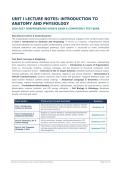
Exam Section Primary Key Concepts Evaluated Questions
Structural hierarchy, gross vs. microscopic anatomy, red bone
Part I: Introductory
marrow hematopoiesis, endocrine glands, pulmonary capillary Questions 1-8
Anatomy & Systems
gas exchange exceptions.
Negative vs. positive feedback, insulin/glucagon glycogenesis,
Part II: Homeostasis &
regional terminology (peroneal, patellar), planes, cavities, Questions 9-15
Anatomical Geometry
serous membranes.
Part III: Chemistry, pH, & pH log calculations, isotopes, synthesis/decomposition, ATP
Questions 16-26
Cellular Biology synthesis, membrane selectivity, cilia vs. microvilli functions.
Tonicity/lysis, active transport pumps, ciliated columnar tissue,
Part IV: Cell Transport,
cartilage avascularity healing limits, inflammation, bedsores, Questions 27-35
Histology, & Skin
thermoregulation.
Anatomy & Physiology Unit I Lecture Notes Test Bank Page 1 of 15
, UNIT I LECTURE NOTES COMPETENCY EXAM 2026-2027 UPDATE
CHAPTER 1: INTRODUCTION TO ANATOMY & PHYSIOLOGY
Question 1: A cell biologist is investigating how the extremely thin, single-layered walls of
pulmonary capillaries enhance the passive diffusion of oxygen from alveoli into the blood. This
investigation, which explores how specific body parts are constructed to perform their physical
functions, directly integrates which two fields of study?
A. Microscopic anatomy and gross pathology
B. Anatomy and physiology
C. Cytology and systematic ecology
D. Histology and genetic engineering
ANSWER ✔: B — Anatomy and physiology
Explanation: Anatomy is the study of body structures (parts of the body), whereas physiology is the study of body
functions (how body parts work) [1, 2]. Anatomy and physiology are intimately related because structural
characteristics determine functional capabilities [2]. The thinness of the simple squamous tissue that makes up
capillary walls is an anatomical feature that directly allows for the physiological function of gas diffusion [2].
Microscopic anatomy covers structures requiring magnification (like cells or tissues), but does not itself describe
physiological functions [1].
Question 2: A clinical cytologist is examining a tissue sample under a microscope and notes that
it consists of groups of associated cells surrounded by extracellular material. Which hierarchical
level of structural organization is being observed, and what are the four primary types of this
level in the human body?
A. Cellular level; comprised of water, lipids, proteins, and nucleic acids
B. Tissue level; comprised of epithelial, connective, muscle, and neural/nervous tissues
C. Organ level; comprised of the skin, skeletal muscles, heart, and brain
D. System level; comprised of cardiovascular, endocrine, lymphatic, and respiratory systems
ANSWER ✔: B — Tissue level; comprised of epithelial, connective, muscle, and neural/nervous
tissues
Explanation: By definition, a tissue consists of a group of associated cells and the surrounding extracellular material
[2, 3]. Tissues are known as the 'fabrics of the body' and compose structural features [3, 88]. The four primary types of
tissue in the body are epithelial tissue, connective tissue, muscle tissue, and neural/nervous tissue [3, 89]. The cellular
level is the smallest living unit but does not describe multicellular groupings [3]. Organs consist of two or more tissues
[4], and systems consist of groups of organs [4].
Anatomy & Physiology Unit I: Introduction to Anatomy and Physiology Page 2 of 15
ANATOMY AND PHYSIOLOGY
2026-2027 COMPREHENSIVE UPDATE EXAM & COMPETENCY TEST BANK
Educational Context & Study Blueprint:
This standardized clinical and academic test bank is programmatically mapped to the verified lecture notes
of Unit I: Introduction to Anatomy and Physiology. It serves as a rigorous, comprehensive testing
instrument designed to evaluate student understanding, enhance long-term retention, and clarify commonly
confused anatomical and physiological pathways. Each question is structured to mimic professional
healthcare certification models, requiring a deep synthesis of the scientific material rather than mere rote
memorization.
Test Bank Coverage & Weighting:
Questions are systematically distributed across the major sections of the Unit I curriculum, representing
their respective importance in foundational medical science: • Introduction & Levels of Organization:
Gross vs. microscopic anatomy, cytology, histology, and the hierarchy of structural complexity (from
chemical to organism levels). • Overview of the 11 Organ Systems: Detailed tracking of physical organs,
vascular pathways, and specific endocrine, respiratory, digestive, and urinary networks. • Homeostasis &
Cellular Communication: Dynamic hormonal axes (insulin and glucagon), negative feedback loops, and
rapid positive feedback systems (blood clotting). • Anatomical Language & Geometry: Directional
terminology, regional terminology, anatomical planes, body cavities, and serous membranes (parietal vs.
visceral). • Foundational Biochemistry: Elements, radioisotopes, electrolytes, pH scale dynamics, protein
denaturation, enzyme catalysts, and ATP energy utilization. • Cell Biology & Histology: Membrane
transport (osmosis, active pumps), organelles, and specialized tissue classifications (epithelial, connective,
muscle, nervous) and repair.
Exam Section Primary Key Concepts Evaluated Questions
Structural hierarchy, gross vs. microscopic anatomy, red bone
Part I: Introductory
marrow hematopoiesis, endocrine glands, pulmonary capillary Questions 1-8
Anatomy & Systems
gas exchange exceptions.
Negative vs. positive feedback, insulin/glucagon glycogenesis,
Part II: Homeostasis &
regional terminology (peroneal, patellar), planes, cavities, Questions 9-15
Anatomical Geometry
serous membranes.
Part III: Chemistry, pH, & pH log calculations, isotopes, synthesis/decomposition, ATP
Questions 16-26
Cellular Biology synthesis, membrane selectivity, cilia vs. microvilli functions.
Tonicity/lysis, active transport pumps, ciliated columnar tissue,
Part IV: Cell Transport,
cartilage avascularity healing limits, inflammation, bedsores, Questions 27-35
Histology, & Skin
thermoregulation.
Anatomy & Physiology Unit I Lecture Notes Test Bank Page 1 of 15
, UNIT I LECTURE NOTES COMPETENCY EXAM 2026-2027 UPDATE
CHAPTER 1: INTRODUCTION TO ANATOMY & PHYSIOLOGY
Question 1: A cell biologist is investigating how the extremely thin, single-layered walls of
pulmonary capillaries enhance the passive diffusion of oxygen from alveoli into the blood. This
investigation, which explores how specific body parts are constructed to perform their physical
functions, directly integrates which two fields of study?
A. Microscopic anatomy and gross pathology
B. Anatomy and physiology
C. Cytology and systematic ecology
D. Histology and genetic engineering
ANSWER ✔: B — Anatomy and physiology
Explanation: Anatomy is the study of body structures (parts of the body), whereas physiology is the study of body
functions (how body parts work) [1, 2]. Anatomy and physiology are intimately related because structural
characteristics determine functional capabilities [2]. The thinness of the simple squamous tissue that makes up
capillary walls is an anatomical feature that directly allows for the physiological function of gas diffusion [2].
Microscopic anatomy covers structures requiring magnification (like cells or tissues), but does not itself describe
physiological functions [1].
Question 2: A clinical cytologist is examining a tissue sample under a microscope and notes that
it consists of groups of associated cells surrounded by extracellular material. Which hierarchical
level of structural organization is being observed, and what are the four primary types of this
level in the human body?
A. Cellular level; comprised of water, lipids, proteins, and nucleic acids
B. Tissue level; comprised of epithelial, connective, muscle, and neural/nervous tissues
C. Organ level; comprised of the skin, skeletal muscles, heart, and brain
D. System level; comprised of cardiovascular, endocrine, lymphatic, and respiratory systems
ANSWER ✔: B — Tissue level; comprised of epithelial, connective, muscle, and neural/nervous
tissues
Explanation: By definition, a tissue consists of a group of associated cells and the surrounding extracellular material
[2, 3]. Tissues are known as the 'fabrics of the body' and compose structural features [3, 88]. The four primary types of
tissue in the body are epithelial tissue, connective tissue, muscle tissue, and neural/nervous tissue [3, 89]. The cellular
level is the smallest living unit but does not describe multicellular groupings [3]. Organs consist of two or more tissues
[4], and systems consist of groups of organs [4].
Anatomy & Physiology Unit I: Introduction to Anatomy and Physiology Page 2 of 15