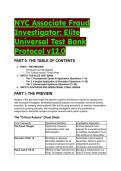
NYC Associate Fraud
Investigator: Elite
Universal Test Bank
Protocol v12.0
PART 0: THE TABLE OF CONTENTS
● PART I: THE PREVIEW
○ Introduction to Elite Mastery
○ The "Critical Axioms" Cheat Sheet
● PART II: THE ELITE TEST BANK
○ Tier 1: Foundational Syntax & Application (Questions 1–10)
○ Tier 2: Complex Application & Simulation (Questions 11–20)
○ Tier 3: Grandmaster Synthesis (Questions 21–30)
● PART III: SYNTHESIS AND OPERATIONAL CONCLUSIONS
PART I: THE PREVIEW
Mastery of this test bank forges the baseline cognitive architecture required to operate as an
elite municipal investigator, translating theoretical statutes into immediate, real-world forensic
execution. By stripping away academic filler and focusing exclusively on statutory interpretation,
forensic accounting principles, and unyielding investigative ethics, the practitioner is
weaponized to dismantle complex corruption networks within public systems.
The "Critical Axioms" Cheat Sheet
Core Framework Operational Definition Investigative Application
The Fraud Triangle Opportunity, Pressure All three elements must
(unshareable need), and intersect for occupational fraud
Rationalization. to manifest; investigators must
map evidence to these pillars.
Executive Order 16 Mandates an absolute, Supersedes internal agency
affirmative obligation for all hierarchies; failure to report is
municipal employees to report independent grounds for
corruption directly to the DOI. termination and prosecution.
Penal Law § 175.35 Offering a False Instrument for Elevates a misdemeanor to a
Filing, 1st Degree; requires an Class E Felony; intent includes
,Core Framework Operational Definition Investigative Application
intent to defraud. leading the government into
administrative disadvantage.
Article 200 Distinctions Bribery influences a future Dictates statutory charging
action; Rewarding Official based exclusively on the
Misconduct compensates for a temporal timeline of the illicit
past violation. agreement.
The Net Worth Method (Assets - Liabilities) - Prior NW The definitive forensic
= NW Increase + Living calculation for quantifying
Expenses = Total Income - hidden assets and proving illicit
Known Sources = Illicit Funds. income streams in court.
Benford's Law The first digit '1' appears Used to identify artificial
~30.1% of the time; '9' appears manipulation of financial data,
~4.6% of the time in natural such as invoice splitting or
datasets. phantom billing.
PART II: THE ELITE TEST BANK
Tier 1: Foundational Syntax & Application
Q1: During an initial training seminar on fraud theory, an investigator is tasked with categorizing
the psychological drivers of embezzlement. Based on the principles of the Cressey Fraud
Triangle, which combination of elements is the MOST ACCURATE representation of the
conditions required for an ordinary individual to commit occupational fraud? A) Motivation,
Justification, and Concealment B) Financial Incentive, Lack of Internal Controls, and Criminal
Intent C) Perceived Opportunity, Unshareable Financial Pressure, and Rationalization D) Greed,
Institutional Vulnerability, and Coercion
● Answer/Respuesta/Réponse: C (Perceived Opportunity, Unshareable Financial
Pressure, and Rationalization)
● Distractor Analysis:
○ A is incorrect: These terms represent the physical actions taken during a fraud
scheme (theft, concealment, conversion), not the psychological drivers theorized by
Donald Cressey.
○ B is incorrect: While a lack of internal controls creates opportunity, the terms
"financial incentive" and "criminal intent" fail to capture the specific nuance of an
unshareable pressure and the psychological requirement to rationalize the act.
○ D is incorrect: This is a highly plausible distractor based on generic criminal theory,
but it violates the strict definitional boundaries of the established occupational Fraud
Triangle framework.
The Mentor's Analysis: The fundamental architecture of occupational fraud relies on a specific
psychological state. When analyzing a suspect's motives, the immediate priority is mapping the
evidence to these three exact pillars. By utilizing Cressey's exact taxonomy, the practitioner
bypasses the common trap of relying on vague concepts like "greed." Professional/Academic
Intuition: The presence of an unshareable financial burden is the primary catalyst that
triggers the search for a systemic opportunity.
Q2: A mid-level manager at the NYC Department of Social Services discovers that a
subordinate is deliberately approving fraudulent public benefits for family members. Under
Mayoral Executive Order No. 16, what is the manager's IMMEDIATE affirmative obligation? A)
, Confront the subordinate to secure an administrative confession before reporting the incident.
B) Report the information directly and without undue delay to the Department of Investigation or
the agency's Inspector General. C) Notify the agency's internal human resources department to
initiate a formal termination proceeding. D) Document the findings in a sealed memo to the
agency commissioner for review at the end of the fiscal quarter.
● Answer/Respuesta/Réponse: B (Report the information directly and without undue
delay to the Department of Investigation or the agency's Inspector General.)
● Distractor Analysis:
○ A is incorrect: Confronting a suspect prematurely can result in the destruction of
evidence or tip off co-conspirators, violating the core tenets of investigative
neutrality and securing evidence.
○ C is incorrect: While HR handles standard personnel issues, EO 16 strictly
designates the DOI and the Inspector General as the sole initial recipients of
corruption and criminal allegations.
○ D is incorrect: Delaying the report violates the explicit EO 16 mandate of "without
undue delay," which is designed to prevent systemic cover-ups.
The Mentor's Analysis: Executive Order No. 16 was designed specifically to sever internal
bureaucratic reporting chains that historically allowed agencies to bury corruption. When facing
official misconduct, the immediate priority is protecting the integrity of the independent
investigation. By utilizing direct reporting to the DOI, the practitioner bypasses the common
novice error of keeping investigations "in-house." Professional/Academic Intuition:
Administrative hierarchy never supersedes the statutory mandate to report corruption
directly to the Inspector General.
Q3: A city contractor knowingly submits an invoice for $50,000 containing deliberately inflated
material costs to the municipal Comptroller's Office, seeking payment. Based on New York
Penal Law § 175.35 (Offering a False Instrument for Filing in the First Degree), what specific
element elevates this act from a Class A Misdemeanor to a Class E Felony? A) The monetary
value of the instrument exceeds $10,000. B) The document was submitted electronically rather
than via physical paper. C) The filing was accompanied by a specific intent to defraud the State
or municipal government. D) The individual submitting the document is an appointed public
servant.
● Answer/Respuesta/Réponse: C (The filing was accompanied by a specific intent to
defraud the State or municipal government.)
● Distractor Analysis:
○ A is incorrect: PL 175.35 is not tied to a monetary threshold; grand larceny statutes
govern monetary thresholds. The nature of the instrument and the intent dictate the
charge.
○ B is incorrect: The method of transmission (electronic vs. paper) is irrelevant to the
statutory definition of a "written instrument" under PL 175.00(3).
○ D is incorrect: The statute applies to any person, not exclusively public servants,
who file false instruments with public offices.
The Mentor's Analysis: The division between first and second-degree false instrument charges
hinges entirely on the perpetrator's ultimate goal. When facing fraudulent documentation, the
immediate priority is establishing the intent to lead the government into error or disadvantage.
By utilizing subpoenaed communications indicating intent, the practitioner bypasses the
common trap of merely proving the document was inaccurate. Professional/Academic
Intuition: A false statement is an error; a false statement engineered for systemic gain is
fraud.
Investigator: Elite
Universal Test Bank
Protocol v12.0
PART 0: THE TABLE OF CONTENTS
● PART I: THE PREVIEW
○ Introduction to Elite Mastery
○ The "Critical Axioms" Cheat Sheet
● PART II: THE ELITE TEST BANK
○ Tier 1: Foundational Syntax & Application (Questions 1–10)
○ Tier 2: Complex Application & Simulation (Questions 11–20)
○ Tier 3: Grandmaster Synthesis (Questions 21–30)
● PART III: SYNTHESIS AND OPERATIONAL CONCLUSIONS
PART I: THE PREVIEW
Mastery of this test bank forges the baseline cognitive architecture required to operate as an
elite municipal investigator, translating theoretical statutes into immediate, real-world forensic
execution. By stripping away academic filler and focusing exclusively on statutory interpretation,
forensic accounting principles, and unyielding investigative ethics, the practitioner is
weaponized to dismantle complex corruption networks within public systems.
The "Critical Axioms" Cheat Sheet
Core Framework Operational Definition Investigative Application
The Fraud Triangle Opportunity, Pressure All three elements must
(unshareable need), and intersect for occupational fraud
Rationalization. to manifest; investigators must
map evidence to these pillars.
Executive Order 16 Mandates an absolute, Supersedes internal agency
affirmative obligation for all hierarchies; failure to report is
municipal employees to report independent grounds for
corruption directly to the DOI. termination and prosecution.
Penal Law § 175.35 Offering a False Instrument for Elevates a misdemeanor to a
Filing, 1st Degree; requires an Class E Felony; intent includes
,Core Framework Operational Definition Investigative Application
intent to defraud. leading the government into
administrative disadvantage.
Article 200 Distinctions Bribery influences a future Dictates statutory charging
action; Rewarding Official based exclusively on the
Misconduct compensates for a temporal timeline of the illicit
past violation. agreement.
The Net Worth Method (Assets - Liabilities) - Prior NW The definitive forensic
= NW Increase + Living calculation for quantifying
Expenses = Total Income - hidden assets and proving illicit
Known Sources = Illicit Funds. income streams in court.
Benford's Law The first digit '1' appears Used to identify artificial
~30.1% of the time; '9' appears manipulation of financial data,
~4.6% of the time in natural such as invoice splitting or
datasets. phantom billing.
PART II: THE ELITE TEST BANK
Tier 1: Foundational Syntax & Application
Q1: During an initial training seminar on fraud theory, an investigator is tasked with categorizing
the psychological drivers of embezzlement. Based on the principles of the Cressey Fraud
Triangle, which combination of elements is the MOST ACCURATE representation of the
conditions required for an ordinary individual to commit occupational fraud? A) Motivation,
Justification, and Concealment B) Financial Incentive, Lack of Internal Controls, and Criminal
Intent C) Perceived Opportunity, Unshareable Financial Pressure, and Rationalization D) Greed,
Institutional Vulnerability, and Coercion
● Answer/Respuesta/Réponse: C (Perceived Opportunity, Unshareable Financial
Pressure, and Rationalization)
● Distractor Analysis:
○ A is incorrect: These terms represent the physical actions taken during a fraud
scheme (theft, concealment, conversion), not the psychological drivers theorized by
Donald Cressey.
○ B is incorrect: While a lack of internal controls creates opportunity, the terms
"financial incentive" and "criminal intent" fail to capture the specific nuance of an
unshareable pressure and the psychological requirement to rationalize the act.
○ D is incorrect: This is a highly plausible distractor based on generic criminal theory,
but it violates the strict definitional boundaries of the established occupational Fraud
Triangle framework.
The Mentor's Analysis: The fundamental architecture of occupational fraud relies on a specific
psychological state. When analyzing a suspect's motives, the immediate priority is mapping the
evidence to these three exact pillars. By utilizing Cressey's exact taxonomy, the practitioner
bypasses the common trap of relying on vague concepts like "greed." Professional/Academic
Intuition: The presence of an unshareable financial burden is the primary catalyst that
triggers the search for a systemic opportunity.
Q2: A mid-level manager at the NYC Department of Social Services discovers that a
subordinate is deliberately approving fraudulent public benefits for family members. Under
Mayoral Executive Order No. 16, what is the manager's IMMEDIATE affirmative obligation? A)
, Confront the subordinate to secure an administrative confession before reporting the incident.
B) Report the information directly and without undue delay to the Department of Investigation or
the agency's Inspector General. C) Notify the agency's internal human resources department to
initiate a formal termination proceeding. D) Document the findings in a sealed memo to the
agency commissioner for review at the end of the fiscal quarter.
● Answer/Respuesta/Réponse: B (Report the information directly and without undue
delay to the Department of Investigation or the agency's Inspector General.)
● Distractor Analysis:
○ A is incorrect: Confronting a suspect prematurely can result in the destruction of
evidence or tip off co-conspirators, violating the core tenets of investigative
neutrality and securing evidence.
○ C is incorrect: While HR handles standard personnel issues, EO 16 strictly
designates the DOI and the Inspector General as the sole initial recipients of
corruption and criminal allegations.
○ D is incorrect: Delaying the report violates the explicit EO 16 mandate of "without
undue delay," which is designed to prevent systemic cover-ups.
The Mentor's Analysis: Executive Order No. 16 was designed specifically to sever internal
bureaucratic reporting chains that historically allowed agencies to bury corruption. When facing
official misconduct, the immediate priority is protecting the integrity of the independent
investigation. By utilizing direct reporting to the DOI, the practitioner bypasses the common
novice error of keeping investigations "in-house." Professional/Academic Intuition:
Administrative hierarchy never supersedes the statutory mandate to report corruption
directly to the Inspector General.
Q3: A city contractor knowingly submits an invoice for $50,000 containing deliberately inflated
material costs to the municipal Comptroller's Office, seeking payment. Based on New York
Penal Law § 175.35 (Offering a False Instrument for Filing in the First Degree), what specific
element elevates this act from a Class A Misdemeanor to a Class E Felony? A) The monetary
value of the instrument exceeds $10,000. B) The document was submitted electronically rather
than via physical paper. C) The filing was accompanied by a specific intent to defraud the State
or municipal government. D) The individual submitting the document is an appointed public
servant.
● Answer/Respuesta/Réponse: C (The filing was accompanied by a specific intent to
defraud the State or municipal government.)
● Distractor Analysis:
○ A is incorrect: PL 175.35 is not tied to a monetary threshold; grand larceny statutes
govern monetary thresholds. The nature of the instrument and the intent dictate the
charge.
○ B is incorrect: The method of transmission (electronic vs. paper) is irrelevant to the
statutory definition of a "written instrument" under PL 175.00(3).
○ D is incorrect: The statute applies to any person, not exclusively public servants,
who file false instruments with public offices.
The Mentor's Analysis: The division between first and second-degree false instrument charges
hinges entirely on the perpetrator's ultimate goal. When facing fraudulent documentation, the
immediate priority is establishing the intent to lead the government into error or disadvantage.
By utilizing subpoenaed communications indicating intent, the practitioner bypasses the
common trap of merely proving the document was inaccurate. Professional/Academic
Intuition: A false statement is an error; a false statement engineered for systemic gain is
fraud.