
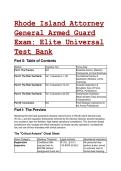
Rhode Island Attorney
General Armed Guard
Exam: Elite Universal
Test Bank
Part 0: Table of Contents
Section Cognitive Tier Focus Area
Part I: The Preview N/A Essential Axioms, Statutory
Frameworks, & Core Directives
Part II: The Elite Test Bank Tier 1 (Questions 1–18) Foundational Syntax &
Application (Statutes, Limits,
Licensing)
Part II: The Elite Test Bank Tier 2 (Questions 19–37) Complex Application &
Simulation (Use of Force,
ERPOs, Prohibitions)
Part II: The Elite Test Bank Tier 3 (Questions 38–55) Grandmaster Synthesis
(Multi-Variable Crisis Scenarios
& Adjudication)
Part III: Conclusion N/A Final Strategic Imperatives for
the Armed Professional
Part I: The Preview
Mastering this test bank guarantees absolute native fluency in Rhode Island General Laws
(R.I.G.L.) and the regulatory frameworks enforced by the Attorney General, directly translating
your academic rigor into flawless, high-stakes operational competence. This document forges
practitioners who navigate the lethal intersection of private security operations, constitutional
law, and use-of-force mandates with clinical precision.
The "Critical Axioms" Cheat Sheet
Axiom Category Statutory Threshold Legal Authority Operational Implication
Registration Conditional offer R.I.G.L. § 5-5.1; No personnel may
Imperative required prior to 110-RICR-20-00-2 perform duties, armed
BCI/FBI national or unarmed, prior to
background check and formal state licensing
,Axiom Category Statutory Threshold Legal Authority Operational Implication
employee registration. and agency affiliation.
Armed Authorization Army-L Target at 25 R.I.G.L. § 11-47-15 Civilians and guards
yards; Minimum Score must achieve a "slow
195/300. fire" score certified by
an NRA or Police
instructor.
Use of Force (Lethal) Duty to retreat in public; State v. Quarles; Lethal force is a last
Castle Doctrine R.I.G.L. § 11-8-8 resort. Retreat is
restricted strictly to the mandatory if completely
dwelling. safe, even against a
cohabitant inside the
home.
Hardware Bans 10-round maximum R.I.G.L. § 11-47.1-3; § Armed guards possess
magazine capacity; 11-47-20 no exemptions from
Silencers prohibited. state large-capacity
magazine or NFA
silencer bans.
Firearm Logistics 7-day waiting period for R.I.G.L. § 11-47-35; § A Blue Card is required
purchases; waived for 11-47-35.1 for all purchases. An
active LCCW holders. LCCW bypasses the
waiting period.
Part II: The Elite Test Bank
Tier 1: Foundational Syntax & Application
Q1: An applicant receives a conditional offer for an armed security position. Based on the
principles of R.I.G.L. § 5-5.1, which action is the FIRST legally required step before performing
any physical post duties? A) Acquiring a Blue Card to authorize employment B) Purchasing
individual liability insurance C) Completing employee registration and a national fingerprint
background check D) Patrolling unarmed during a probationary period
● Answer: C (Completing employee registration and a national fingerprint background
check)
● Distractor Analysis:
○ A is incorrect: The Blue Card exclusively authorizes handgun and ammunition
purchases, holding no bearing on employment authorization or armed deployment.
○ B is incorrect: The licensed security business entity, not the individual employee,
must hold the requisite liability insurance.
○ D is incorrect: Rhode Island strictly prohibits personnel from working any
assignments, including unarmed probationary shifts, before formal registration and
licensing are complete.
The Mentor's Analysis: Employment within the private security sector requires prior registration
and BCI/FBI clearance. When facing onboarding, the immediate priority is legal registration
under a licensed agency. By utilizing proper sequential compliance, the practitioner bypasses
the common novice error of illegal early deployment. Professional/Academic Intuition:
Registration and licensing precede deployment without exception.
Q2: A firm intends to operate as a private security guard business. Based on the principles of
, the Private Security Guard Act, which insurance parameter is the MOST ACCURATE
requirement for licensing? A) $1,000,000 comprehensive liability B) Bond waiver for
unarmed-only businesses C) $300,000 for bodily injury and $100,000 for property damage D)
Self-insurance through a verified corporate escrow
● Answer: C ($300,000 for bodily injury and $100,000 for property damage)
● Distractor Analysis:
○ A is incorrect: While a business may opt for higher coverage, this exceeds the
statutory minimum requirement established for state licensing.
○ B is incorrect: The state offers no bond waivers; all licensed security businesses
must maintain continuous active insurance.
○ D is incorrect: The policy must be held by a carrier explicitly licensed to operate
within the state, precluding self-insurance schemes.
The Mentor's Analysis: Corporate licensing mandates specific, non-negotiable financial
protections for the public. When facing business compliance, the immediate priority is securing
statutory insurance limits. By utilizing licensed state carriers, the practitioner bypasses the trap
of inadequate regulatory coverage. Professional/Academic Intuition: Statutory minimums of
300k/100k are absolute prerequisites for entity licensing.
Q3: An applicant seeks an Attorney General pistol permit. Based on the principles of R.I.G.L. §
11-47-15, which qualification metric is the MOST ACCURATE requirement? A) 165 out of 250
on a B-21 combat target B) 70% accuracy on a tactical movement course C) 195 out of 300 on
an Army-L target at 25 yards D) 250 out of 300 on a silhouette target at 15 yards
● Answer: C (195 out of 300 on an Army-L target at 25 yards)
● Distractor Analysis:
○ A is incorrect: This represents the historical qualification score strictly reserved for
sworn law enforcement officers under § 11-47-15.1, not private guards or civilians.
○ B is incorrect: Rhode Island statute mandates stationary, "slow fire" metrics for
standard civilian and security permits.
○ D is incorrect: The statute explicitly requires an Army-L target placed at 25 yards,
firing 30 consecutive rounds.
The Mentor's Analysis: Handgun qualification rests on precise statutory metrics rather than
dynamic tactical courses. When facing range qualification, the immediate priority is achieving
195/300 on the correct paper. By utilizing the Army-L standard, the practitioner bypasses the
trap of taking the incorrect law enforcement combat course. Professional/Academic Intuition:
The 195/300 Army-L metric is the universal baseline for standard armed authorization.
Q4: An individual purchases a handgun from a licensed dealer in Rhode Island. Based on the
principles of R.I.G.L. § 11-47-35, which document is IMMEDIATELY required to authorize this
purchase? A) An Attorney General LCCW permit B) A federal concealed carry endorsement C)
A Rhode Island Pistol/Revolver Safety Certificate (Blue Card) D) A local police chief
authorization letter
● Answer: C (A Rhode Island Pistol/Revolver Safety Certificate (Blue Card))
● Distractor Analysis:
○ A is incorrect: An LCCW permit dictates the legal carry of a firearm in public, but it
is not a prerequisite merely to purchase a handgun.
○ B is incorrect: No federal concealed carry endorsement exists for retail handgun
transactions.
○ D is incorrect: Local police departments issue carry permits, but the Department of
Environmental Management (DEM) administers the Blue Card required for
purchase.
General Armed Guard
Exam: Elite Universal
Test Bank
Part 0: Table of Contents
Section Cognitive Tier Focus Area
Part I: The Preview N/A Essential Axioms, Statutory
Frameworks, & Core Directives
Part II: The Elite Test Bank Tier 1 (Questions 1–18) Foundational Syntax &
Application (Statutes, Limits,
Licensing)
Part II: The Elite Test Bank Tier 2 (Questions 19–37) Complex Application &
Simulation (Use of Force,
ERPOs, Prohibitions)
Part II: The Elite Test Bank Tier 3 (Questions 38–55) Grandmaster Synthesis
(Multi-Variable Crisis Scenarios
& Adjudication)
Part III: Conclusion N/A Final Strategic Imperatives for
the Armed Professional
Part I: The Preview
Mastering this test bank guarantees absolute native fluency in Rhode Island General Laws
(R.I.G.L.) and the regulatory frameworks enforced by the Attorney General, directly translating
your academic rigor into flawless, high-stakes operational competence. This document forges
practitioners who navigate the lethal intersection of private security operations, constitutional
law, and use-of-force mandates with clinical precision.
The "Critical Axioms" Cheat Sheet
Axiom Category Statutory Threshold Legal Authority Operational Implication
Registration Conditional offer R.I.G.L. § 5-5.1; No personnel may
Imperative required prior to 110-RICR-20-00-2 perform duties, armed
BCI/FBI national or unarmed, prior to
background check and formal state licensing
,Axiom Category Statutory Threshold Legal Authority Operational Implication
employee registration. and agency affiliation.
Armed Authorization Army-L Target at 25 R.I.G.L. § 11-47-15 Civilians and guards
yards; Minimum Score must achieve a "slow
195/300. fire" score certified by
an NRA or Police
instructor.
Use of Force (Lethal) Duty to retreat in public; State v. Quarles; Lethal force is a last
Castle Doctrine R.I.G.L. § 11-8-8 resort. Retreat is
restricted strictly to the mandatory if completely
dwelling. safe, even against a
cohabitant inside the
home.
Hardware Bans 10-round maximum R.I.G.L. § 11-47.1-3; § Armed guards possess
magazine capacity; 11-47-20 no exemptions from
Silencers prohibited. state large-capacity
magazine or NFA
silencer bans.
Firearm Logistics 7-day waiting period for R.I.G.L. § 11-47-35; § A Blue Card is required
purchases; waived for 11-47-35.1 for all purchases. An
active LCCW holders. LCCW bypasses the
waiting period.
Part II: The Elite Test Bank
Tier 1: Foundational Syntax & Application
Q1: An applicant receives a conditional offer for an armed security position. Based on the
principles of R.I.G.L. § 5-5.1, which action is the FIRST legally required step before performing
any physical post duties? A) Acquiring a Blue Card to authorize employment B) Purchasing
individual liability insurance C) Completing employee registration and a national fingerprint
background check D) Patrolling unarmed during a probationary period
● Answer: C (Completing employee registration and a national fingerprint background
check)
● Distractor Analysis:
○ A is incorrect: The Blue Card exclusively authorizes handgun and ammunition
purchases, holding no bearing on employment authorization or armed deployment.
○ B is incorrect: The licensed security business entity, not the individual employee,
must hold the requisite liability insurance.
○ D is incorrect: Rhode Island strictly prohibits personnel from working any
assignments, including unarmed probationary shifts, before formal registration and
licensing are complete.
The Mentor's Analysis: Employment within the private security sector requires prior registration
and BCI/FBI clearance. When facing onboarding, the immediate priority is legal registration
under a licensed agency. By utilizing proper sequential compliance, the practitioner bypasses
the common novice error of illegal early deployment. Professional/Academic Intuition:
Registration and licensing precede deployment without exception.
Q2: A firm intends to operate as a private security guard business. Based on the principles of
, the Private Security Guard Act, which insurance parameter is the MOST ACCURATE
requirement for licensing? A) $1,000,000 comprehensive liability B) Bond waiver for
unarmed-only businesses C) $300,000 for bodily injury and $100,000 for property damage D)
Self-insurance through a verified corporate escrow
● Answer: C ($300,000 for bodily injury and $100,000 for property damage)
● Distractor Analysis:
○ A is incorrect: While a business may opt for higher coverage, this exceeds the
statutory minimum requirement established for state licensing.
○ B is incorrect: The state offers no bond waivers; all licensed security businesses
must maintain continuous active insurance.
○ D is incorrect: The policy must be held by a carrier explicitly licensed to operate
within the state, precluding self-insurance schemes.
The Mentor's Analysis: Corporate licensing mandates specific, non-negotiable financial
protections for the public. When facing business compliance, the immediate priority is securing
statutory insurance limits. By utilizing licensed state carriers, the practitioner bypasses the trap
of inadequate regulatory coverage. Professional/Academic Intuition: Statutory minimums of
300k/100k are absolute prerequisites for entity licensing.
Q3: An applicant seeks an Attorney General pistol permit. Based on the principles of R.I.G.L. §
11-47-15, which qualification metric is the MOST ACCURATE requirement? A) 165 out of 250
on a B-21 combat target B) 70% accuracy on a tactical movement course C) 195 out of 300 on
an Army-L target at 25 yards D) 250 out of 300 on a silhouette target at 15 yards
● Answer: C (195 out of 300 on an Army-L target at 25 yards)
● Distractor Analysis:
○ A is incorrect: This represents the historical qualification score strictly reserved for
sworn law enforcement officers under § 11-47-15.1, not private guards or civilians.
○ B is incorrect: Rhode Island statute mandates stationary, "slow fire" metrics for
standard civilian and security permits.
○ D is incorrect: The statute explicitly requires an Army-L target placed at 25 yards,
firing 30 consecutive rounds.
The Mentor's Analysis: Handgun qualification rests on precise statutory metrics rather than
dynamic tactical courses. When facing range qualification, the immediate priority is achieving
195/300 on the correct paper. By utilizing the Army-L standard, the practitioner bypasses the
trap of taking the incorrect law enforcement combat course. Professional/Academic Intuition:
The 195/300 Army-L metric is the universal baseline for standard armed authorization.
Q4: An individual purchases a handgun from a licensed dealer in Rhode Island. Based on the
principles of R.I.G.L. § 11-47-35, which document is IMMEDIATELY required to authorize this
purchase? A) An Attorney General LCCW permit B) A federal concealed carry endorsement C)
A Rhode Island Pistol/Revolver Safety Certificate (Blue Card) D) A local police chief
authorization letter
● Answer: C (A Rhode Island Pistol/Revolver Safety Certificate (Blue Card))
● Distractor Analysis:
○ A is incorrect: An LCCW permit dictates the legal carry of a firearm in public, but it
is not a prerequisite merely to purchase a handgun.
○ B is incorrect: No federal concealed carry endorsement exists for retail handgun
transactions.
○ D is incorrect: Local police departments issue carry permits, but the Department of
Environmental Management (DEM) administers the Blue Card required for
purchase.


