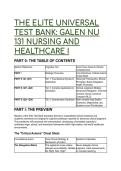
THE ELITE UNIVERSAL
TEST BANK: GALEN NU
131 NURSING AND
HEALTHCARE I
PART 0: THE TABLE OF CONTENTS
Section Reference Cognitive Tier Core Focus Areas & Clinical
Competencies
PART I Strategic Overview Core Directives, Critical Axioms
Cheat Sheet
PART II: Q1–Q10 Tier 1: Foundational Syntax & Historical Frameworks, Ethical
Application Principles, Basic Delegation,
Health Promotion
PART II: Q11–Q20 Tier 2: Complex Application & Clinical Judgment Models,
Simulation Advanced Delegation, Informed
Consent, Nurse Licensure
Compact (NLC)
PART II: Q21–Q30 Tier 3: Grandmaster Synthesis Multi-variable High-Stakes
Scenarios, Malpractice Law,
Systems-Level Prioritization
PART I: THE PREVIEW
Mastery of this Elite Test Bank translates directly to unparalleled clinical readiness and
academic dominance by forging the cognitive pathways required for advanced clinical judgment.
The practitioner will transcend rote memorization, developing a formidable capacity to
synthesize legal, ethical, and theoretical frameworks within high-stakes, real-world healthcare
environments.
The "Critical Axioms" Cheat Sheet
Foundational Axiom Core Clinical Strategy & Systemic Implication
Mechanism of Action
The Delegation Matrix The registered nurse retains Never delegate clinical
ultimate accountability. Validate judgment, initial assessments,
the Right Task, Right or complex teaching.
,Foundational Axiom Core Clinical Strategy & Systemic Implication
Mechanism of Action
Circumstance, Right Person,
Right Direction, and Right
Supervision.
Clinical Judgment Tanner's Model directly Observation must precede
Convergence parallels the NCSBN CJMM: interpretation; you cannot
Noticing equates to analyze what you have not yet
Recognizing Cues; Interpreting recognized.
equates to Analyzing
Cues/Prioritizing; Responding
equates to Taking Action.
The Sovereignty of Consent The provider explains the risks, Chemical sedation or coercion
benefits, and alternatives. The instantly voids the patient's
nurse acts strictly as a witness, legal capacity to sign binding
an advocate, and an evaluator documents.
of the patient's cognitive
capacity.
NLC Jurisdictional Law A nurse changing their Primary The nurse is perpetually bound
State of Residence (PSOR) to by the Nurse Practice Act
another compact state has 60 (NPA) of the state where the
days to apply for licensure in patient is located.
the new jurisdiction.
Nightingale's Construct Healing is correlated to the Sickness thrives in
manipulation of 13 canons, environmental stagnation; the
primarily pure air, pure water, environment actively
efficient drainage, cleanliness, participates in the healing
and light. process.
PART II: THE ELITE TEST BANK
Tier 1 - Foundational Syntax & Application
Q1: A public health nurse is designing a community wellness initiative focused on administering
immunizations and providing education on smoking cessation to healthy young adults. Based on
the principles of the Levels of Prevention framework, which action/conclusion is the MOST
ACCURATE categorization of this initiative? A) It represents secondary prevention because it
halts the progression of subclinical disease. B) It represents tertiary prevention because it
minimizes the long-term effects of environmental toxins. C) It represents primary prevention
because it intercepts disease occurrence before pathogenesis begins. D) It represents
primordial prevention because it exclusively targets national policy changes.
● Answer: C (It represents primary prevention because it intercepts disease occurrence
before pathogenesis begins.)
● Distractor Analysis:
○ A is incorrect: Secondary prevention strictly involves early detection and screening
(e.g., mammograms, blood pressure screenings) to halt disease early in its clinical
course.
○ B is incorrect: Tertiary prevention focuses on rehabilitation and managing existing,
, irreversible chronic diseases to optimize function (e.g., diabetic foot care,
post-stroke physical therapy).
○ D is incorrect: Primordial prevention targets broad social, economic, and
environmental conditions rather than individual or targeted community biological
interventions like vaccines.
The Mentor's Analysis: True primary prevention is entirely proactive, existing in the theoretical
space before a disease establishes a biological foothold within the host. When facing a
population without a specific pathology, the immediate priority is shielding the biological baseline
through immunization and behavioral modification. By utilizing Primary Prevention, you bypass
the common trap of waiting for symptomatology to justify clinical intervention, shifting the
paradigm from reactive sickness management to proactive health promotion.
Professional/Academic Intuition: Screening is always secondary; prevention of the initial
onset is always primary.
Q2: During the late 19th century, a pioneer in the nursing profession established the Henry
Street Settlement, drastically altering the landscape of community and public health nursing
among marginalized immigrant populations in New York. Based on the historical evolution of the
nursing profession, which action/conclusion regarding the identity of this pioneer is the MOST
ACCURATE? A) Florence Nightingale established this settlement to enforce her environmental
theory of ventilation and sanitation. B) Clara Barton founded the settlement as an extension of
the American Red Cross during domestic crises. C) Lillian Wald founded the Henry Street
Settlement, effectively creating the discipline of public health nursing. D) Mary Seacole utilized
the settlement to introduce herbal remedies to impoverished populations.
● Answer: C (Lillian Wald founded the Henry Street Settlement, effectively creating the
discipline of public health nursing.)
● Distractor Analysis:
○ A is incorrect: Florence Nightingale is the founder of modern nursing and the
Environmental Theory, operating primarily in Europe and during the Crimean War,
not in New York's immigrant settlements.
○ B is incorrect: Clara Barton is historically recognized exclusively for founding the
American Red Cross in 1881.
○ D is incorrect: Mary Seacole was a Jamaican-British nurse who provided
independent logistical and clinical care during the Crimean War; she did not found
the Henry Street Settlement.
The Mentor's Analysis: Understanding the lineage of nursing specialties grounds the
profession's identity and provides context for how public health frameworks evolved from
grassroots social reform. When facing severe community health deficits in urban environments,
the historical precedent was established by Lillian Wald's integration of social reform directly
with community-based clinical care. By utilizing Historical Context, you bypass the common trap
of attributing all systemic nursing advancements uniformly to Florence Nightingale.
Professional/Academic Intuition: Wald equates to community public health and social
reform; Nightingale equates to environmental sanitation and formal institutional
education.
Q3: A state legislature has recently updated the regulatory frameworks that govern nursing
practice, defining the exact boundaries of what a registered nurse can legally perform regarding
intravenous medications. Based on the principles of nursing jurisprudence, which
action/conclusion regarding the origin of this authority is the MOST ACCURATE? A) The scope
of practice is dictated by federal mandates issued by the American Nurses Association. B) The
parameters are established solely by the internal bylaws of the hospital where the nurse is
TEST BANK: GALEN NU
131 NURSING AND
HEALTHCARE I
PART 0: THE TABLE OF CONTENTS
Section Reference Cognitive Tier Core Focus Areas & Clinical
Competencies
PART I Strategic Overview Core Directives, Critical Axioms
Cheat Sheet
PART II: Q1–Q10 Tier 1: Foundational Syntax & Historical Frameworks, Ethical
Application Principles, Basic Delegation,
Health Promotion
PART II: Q11–Q20 Tier 2: Complex Application & Clinical Judgment Models,
Simulation Advanced Delegation, Informed
Consent, Nurse Licensure
Compact (NLC)
PART II: Q21–Q30 Tier 3: Grandmaster Synthesis Multi-variable High-Stakes
Scenarios, Malpractice Law,
Systems-Level Prioritization
PART I: THE PREVIEW
Mastery of this Elite Test Bank translates directly to unparalleled clinical readiness and
academic dominance by forging the cognitive pathways required for advanced clinical judgment.
The practitioner will transcend rote memorization, developing a formidable capacity to
synthesize legal, ethical, and theoretical frameworks within high-stakes, real-world healthcare
environments.
The "Critical Axioms" Cheat Sheet
Foundational Axiom Core Clinical Strategy & Systemic Implication
Mechanism of Action
The Delegation Matrix The registered nurse retains Never delegate clinical
ultimate accountability. Validate judgment, initial assessments,
the Right Task, Right or complex teaching.
,Foundational Axiom Core Clinical Strategy & Systemic Implication
Mechanism of Action
Circumstance, Right Person,
Right Direction, and Right
Supervision.
Clinical Judgment Tanner's Model directly Observation must precede
Convergence parallels the NCSBN CJMM: interpretation; you cannot
Noticing equates to analyze what you have not yet
Recognizing Cues; Interpreting recognized.
equates to Analyzing
Cues/Prioritizing; Responding
equates to Taking Action.
The Sovereignty of Consent The provider explains the risks, Chemical sedation or coercion
benefits, and alternatives. The instantly voids the patient's
nurse acts strictly as a witness, legal capacity to sign binding
an advocate, and an evaluator documents.
of the patient's cognitive
capacity.
NLC Jurisdictional Law A nurse changing their Primary The nurse is perpetually bound
State of Residence (PSOR) to by the Nurse Practice Act
another compact state has 60 (NPA) of the state where the
days to apply for licensure in patient is located.
the new jurisdiction.
Nightingale's Construct Healing is correlated to the Sickness thrives in
manipulation of 13 canons, environmental stagnation; the
primarily pure air, pure water, environment actively
efficient drainage, cleanliness, participates in the healing
and light. process.
PART II: THE ELITE TEST BANK
Tier 1 - Foundational Syntax & Application
Q1: A public health nurse is designing a community wellness initiative focused on administering
immunizations and providing education on smoking cessation to healthy young adults. Based on
the principles of the Levels of Prevention framework, which action/conclusion is the MOST
ACCURATE categorization of this initiative? A) It represents secondary prevention because it
halts the progression of subclinical disease. B) It represents tertiary prevention because it
minimizes the long-term effects of environmental toxins. C) It represents primary prevention
because it intercepts disease occurrence before pathogenesis begins. D) It represents
primordial prevention because it exclusively targets national policy changes.
● Answer: C (It represents primary prevention because it intercepts disease occurrence
before pathogenesis begins.)
● Distractor Analysis:
○ A is incorrect: Secondary prevention strictly involves early detection and screening
(e.g., mammograms, blood pressure screenings) to halt disease early in its clinical
course.
○ B is incorrect: Tertiary prevention focuses on rehabilitation and managing existing,
, irreversible chronic diseases to optimize function (e.g., diabetic foot care,
post-stroke physical therapy).
○ D is incorrect: Primordial prevention targets broad social, economic, and
environmental conditions rather than individual or targeted community biological
interventions like vaccines.
The Mentor's Analysis: True primary prevention is entirely proactive, existing in the theoretical
space before a disease establishes a biological foothold within the host. When facing a
population without a specific pathology, the immediate priority is shielding the biological baseline
through immunization and behavioral modification. By utilizing Primary Prevention, you bypass
the common trap of waiting for symptomatology to justify clinical intervention, shifting the
paradigm from reactive sickness management to proactive health promotion.
Professional/Academic Intuition: Screening is always secondary; prevention of the initial
onset is always primary.
Q2: During the late 19th century, a pioneer in the nursing profession established the Henry
Street Settlement, drastically altering the landscape of community and public health nursing
among marginalized immigrant populations in New York. Based on the historical evolution of the
nursing profession, which action/conclusion regarding the identity of this pioneer is the MOST
ACCURATE? A) Florence Nightingale established this settlement to enforce her environmental
theory of ventilation and sanitation. B) Clara Barton founded the settlement as an extension of
the American Red Cross during domestic crises. C) Lillian Wald founded the Henry Street
Settlement, effectively creating the discipline of public health nursing. D) Mary Seacole utilized
the settlement to introduce herbal remedies to impoverished populations.
● Answer: C (Lillian Wald founded the Henry Street Settlement, effectively creating the
discipline of public health nursing.)
● Distractor Analysis:
○ A is incorrect: Florence Nightingale is the founder of modern nursing and the
Environmental Theory, operating primarily in Europe and during the Crimean War,
not in New York's immigrant settlements.
○ B is incorrect: Clara Barton is historically recognized exclusively for founding the
American Red Cross in 1881.
○ D is incorrect: Mary Seacole was a Jamaican-British nurse who provided
independent logistical and clinical care during the Crimean War; she did not found
the Henry Street Settlement.
The Mentor's Analysis: Understanding the lineage of nursing specialties grounds the
profession's identity and provides context for how public health frameworks evolved from
grassroots social reform. When facing severe community health deficits in urban environments,
the historical precedent was established by Lillian Wald's integration of social reform directly
with community-based clinical care. By utilizing Historical Context, you bypass the common trap
of attributing all systemic nursing advancements uniformly to Florence Nightingale.
Professional/Academic Intuition: Wald equates to community public health and social
reform; Nightingale equates to environmental sanitation and formal institutional
education.
Q3: A state legislature has recently updated the regulatory frameworks that govern nursing
practice, defining the exact boundaries of what a registered nurse can legally perform regarding
intravenous medications. Based on the principles of nursing jurisprudence, which
action/conclusion regarding the origin of this authority is the MOST ACCURATE? A) The scope
of practice is dictated by federal mandates issued by the American Nurses Association. B) The
parameters are established solely by the internal bylaws of the hospital where the nurse is