
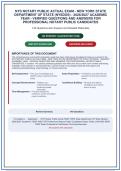
NYS NOTARY PUBLIC ACTUAL EXAM - NEW YORK STATE
DEPARTMENT OF STATE (NYSDOS) - 2026/2027 ACADEMIC
YEAR - VERIFIED QUESTIONS AND ANSWERS FOR
PROFESSIONAL NOTARY PUBLIC CANDIDATES
140 Questions with Answers and Detailed Rationales
100 PERCENT GUARANTEED PASS
INSTANT DOWNLOAD ANSWERS INCLUDED
IMPORTANCE OF THIS DOCUMENT
This comprehensive examination preparation guide has been meticulously developed to help you succeed in the
NYS NOTARY PUBLIC ACTUAL EXAM - NEW YORK STATE DEPARTMENT OF STATE (NYSDOS) - 2026/2027
ACADEMIC YEAR - VERIFIED QUESTIONS AND ANSWERS FOR PROFESSIONAL NOTARY PUBLIC
CANDIDATES. It contains 140 carefully selected questions that reflect the most current exam content and testing
strategies. Each question is accompanied by a correct answer and a detailed rationale that explains the
underlying pathophysiology, pharmacology, or clinical reasoning.
Self-Assessment – Test your knowledge and Exam Preparation – Familiarize yourself with the
identify areas requiring further question format and content
study areas
Concept Reinforcement – Deepen your Confidence Building – Develop test-taking
understanding through strategies and reduce
evidence-based exam anxiety
rationales
Time Management – Practice answering
questions under simulated
exam conditions
Review Summary 140 Questions
Foundations - Application - NYS Notary Public Actual NEW YORK State Department OF State Nysdos
2026/2027 Academic YEAR AND FOR Professional Notary Public Candidates Notary Public LAW AND NEW
YORK State Professional Certification Post-baccalaureate
All answers with rationales
,Table of Contents
Content Area Questions Key Topics
NYS Notary Public Actual 1-24 Notary, Asked, Signer, Notarize, Document
NEW YORK State Department
OF State Nysdos 2026/2027
Academic YEAR AND FOR
Professional Notary Public
Candidates Notary Public
LAW AND NEW YORK State
Professional Certification
Post-baccalaureate
Asked 25-48 Notary, Signer, Notarize, Document, NEW YORK
Signer 49-72 Notary, Asked, NEW YORK, Public, Notarize
Notarize 73-96 Notary, Asked, Signer, NEW YORK, Document
Document 97-120 Notary, Asked, Signer, Notarization, NEW YORK
NEW YORK 121-140 Notary, Asked, Notarize, Document, Signer
TOTAL 140 All questions include answers and detailed rationales
,Section A - NYS Notary Public Actual NEW YORK State
Department OF State Nysdos 2026/2027 Academic YEAR
AND FOR Professional Notary Public Candidates Notary
Public LAW AND NEW YORK State Professional
Certification Post-baccalaureate
Q1.
A notary is asked to notarize a deed for a close friend. The notary is also a party to the
transaction as a beneficiary of the trust that is conveying the property. Under NY law, what
is the notary's proper course of action?
A. Perform the notarization because the B. Perform the notarization if the notary
notary is not a named grantor or grantee. discloses their interest to all parties.
C. Refuse to perform the notarization D. Perform the notarization only if the friend
because the notary has a direct financial or signs in the notary's presence and presents
beneficial interest. valid ID.
Correct: C - Refuse to perform the notarization because the notary has a direct financial or
beneficial interest.
Rationale:NY law prohibits a notary from performing a notarial act if the notary is a party to
the instrument or has a direct financial or beneficial interest. The notary's status as a
beneficiary of the trust constitutes a direct interest, disqualifying them. Disclosure does not
cure the conflict. Even with proper ID, the act is voidable.
Q2.
A notary receives a document with a jurat that states: 'Subscribed and sworn to before me
this ____ day of ____, 20__.' The signer appears and signs the document in the notary's
presence, but does not verbally swear or affirm that the contents are true. The notary
proceeds to complete the jurat. What is the legal consequence?
A. The jurat is valid because the act of B. The jurat is invalid because the signer
signing in the notary's presence implies an must make an oral declaration under oath or
oath. affirmation.
C. The jurat is valid if the notary administers D. The jurat is invalid only if the document is
the oath after the signer signs. challenged in court.
Correct: B - The jurat is invalid because the signer must make an oral declaration under
oath or affirmation.
Page 3
, Section A - NYS Notary Public Actual NEW YORK State Department OF State Nysdos 2026/2027 Academic YEAR AND FOR Professional
Notary Public Candidates Notary Public LAW AND NEW YORK State Professional Certification Post-baccalaureate
Rationale: A jurat requires that the signer make an oath or affirmation that the statements in
the document are true. This must be an oral or written declaration; mere signing is
insufficient. The notary must administer the oath before or after signing, but the signer must
actually swear or affirm. Failure to do so renders the jurat defective.
Q3.
Under New York law, which of the following statements best describes the evidentiary
presumption afforded to a notary's certificate of acknowledgment?
A. It is conclusive evidence of the facts B. It is prima facie evidence of the facts
recited, and cannot be rebutted. recited, but may be rebutted by clear and
convincing evidence.
C. It is not admissible as evidence unless D. It is presumed valid only if the notary's
the notary testifies in person. seal is embossed.
Correct: B - It is prima facie evidence of the facts recited, but may be rebutted by clear and
convincing evidence.
Rationale:In New York, a notary's certificate of acknowledgment is presumed valid and
serves as prima facie evidence of the facts stated, such as the signer's identity and voluntary
signing. However, this presumption is rebuttable; a party challenging the certificate must
present clear and convincing evidence to overcome it. It is not conclusive, does not require
notary testimony, and a seal is not required for validity.
Q4.
A notary is asked to perform a remote online notarization (RON) for a signer located in
California. The notary is commissioned in New York. Under current NY regulations, which
condition must be satisfied?
A. The signer must be physically present in B. The notary must have a separate
New York State at the time of notarization. commission in the state where the signer is
located.
C. The notary may perform the RON if the D. RON is not permitted for out-of-state
signer appears via audio-visual technology signers under any circumstances.
and the notary complies with all NY RON
requirements.
Correct: C - The notary may perform the RON if the signer appears via audio-visual
technology and the notary complies with all NY RON requirements.
Rationale:New York's RON law (Executive Law §135-c) permits notaries to perform
notarizations for signers located outside New York, provided the notary is commissioned in
New York and uses approved audio-visual technology. The signer need not be physically in
New York. The notary must follow all statutory requirements, including identity verification and
electronic recordkeeping.
Page 4


