
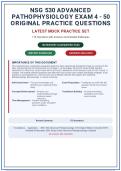
,Table of Contents
Content Area Questions Key Topics
NSG 530 Advanced 1-29 Chronic, Mechanism, Disease, Explains, Serum
Pathophysiology 4 50
Original Wilkes University
WITH Detailed & Rationales
2026 Study Guide Advanced
Pathophysiology Graduate
Chronic 30-58 Mechanism, Disease, Explains, Failure, Laboratory
Disease 59-87 Mechanism, Develops, Syndrome, Chronic, Acute
Develops 88-116 Mechanism, Chronic, Explains, Disease, Development
Explains 117-145 Mechanism, Chronic, Develops, Acute, Pathophysiological
Acute 146-170 Chronic, Mechanism, Disease, Develops, Heart Failure
TOTAL 170 All questions include answers and detailed rationales
,Section A - NSG 530 Advanced Pathophysiology 4 50
Original Wilkes University WITH Detailed & Rationales 2026
Study Guide Advanced Pathophysiology Graduate
Q1.
A patient with a chronic inflammatory condition has persistent elevation of IL-6. Which
downstream effect is most likely contributing to the anemia of chronic disease?
A. Decreased erythropoietin receptor B. Increased hepcidin leading to iron
sensitivity sequestration
C. Impaired B-cell maturation D. Suppressed thrombopoietin production
Correct: B - Increased hepcidin leading to iron sequestration
Rationale:IL-6 stimulates hepatic hepcidin synthesis, which degrades ferroportin and traps
iron in macrophages, limiting erythropoiesis despite adequate iron stores. Erythropoietin
receptor sensitivity is not directly affected by IL-6. B-cell maturation and thrombopoietin are
not the primary mechanisms of anemia of chronic disease.
Q2.
A patient with chronic heart failure is started on sacubitril/valsartan. Which mechanism
best explains the drug's benefit in reducing myocardial remodeling?
A. Inhibition of neprilysin increases B. Combined AT1 blockade and neprilysin
natriuretic peptides, promoting diuresis and inhibition reduces aldosterone secretion
vasodilation
C. Neprilysin inhibition alone prevents D. Valsartan blocks angiotensin II while
breakdown of bradykinin, reducing preload neprilysin inhibition prevents degradation of
angiotensin II
Correct: A - Inhibition of neprilysin increases natriuretic peptides, promoting diuresis and
vasodilation
Rationale:Sacubitril inhibits neprilysin, increasing levels of natriuretic peptides that enhance
diuresis, vasodilation, and reduce sympathetic tone, counteracting remodeling. Valsartan
blocks AT1, but aldosterone reduction is not the primary mechanism. Bradykinin breakdown is
also inhibited but not the main benefit. Neprilysin inhibition does not prevent angiotensin II
degradation; it actually increases it, hence the need for ARB.
Q3.
In a patient with type 2 diabetes, which of the following best explains the transition from
compensatory hyperinsulinemia to overt hyperglycemia?
Page 3
, Section A - NSG 530 Advanced Pathophysiology 4 50 Original Wilkes University WITH Detailed & Rationales 2026 Study Guide Advanced
Pathophysiology Graduate
A. Progressive beta-cell failure due to B. Increased hepatic gluconeogenesis due
amyloid deposition and glucotoxicity to glucagon resistance
C. Downregulation of insulin receptors on D. Enhanced renal glucose reabsorption
skeletal muscle only leading to hyperglycemia
Correct: A - Progressive beta-cell failure due to amyloid deposition and glucotoxicity
Rationale:Chronic insulin resistance is compensated by increased insulin secretion, but over
time beta-cell dysfunction develops due to amyloid deposition, glucotoxicity, and lipotoxicity,
leading to relative insulin deficiency and hyperglycemia. Hepatic gluconeogenesis is
increased but is a consequence of insulin resistance, not the primary transition. Insulin
receptor downregulation occurs but is not the sole factor. Renal glucose reabsorption is
adaptive but not the cause of transition.
Q4.
A patient with chronic kidney disease stage 4 has a serum phosphorus of 6.2 mg/dL.
Which compensatory mechanism is most likely contributing to the patient's secondary
hyperparathyroidism?
A. Decreased calcitriol production leading to B. Increased FGF23 secretion that directly
reduced intestinal calcium absorption stimulates PTH release
C. Hypercalcemia-induced suppression of D. Skeletal resistance to PTH due to
calcium-sensing receptors downregulation of PTH receptors
Correct: A - Decreased calcitriol production leading to reduced intestinal calcium
absorption
Rationale:In CKD, hyperphosphatemia suppresses renal 1-alpha hydroxylase, reducing
calcitriol. Low calcitriol decreases intestinal calcium absorption, leading to hypocalcemia,
which stimulates PTH secretion. FGF23 is elevated but it suppresses PTH, not stimulates.
Hypercalcemia is not present; typically hypocalcemia. Skeletal resistance to PTH occurs but
is not the primary driver of increased PTH.
Q5.
A patient with sepsis develops acute respiratory distress syndrome (ARDS). Which
pathophysiological mechanism is most directly responsible for the refractory hypoxemia?
A. Alveolar flooding with proteinaceous fluid B. Bronchoconstriction due to release of
due to endothelial and epithelial injury histamine from mast cells
C. Pulmonary embolism from microthrombi D. Reduced surfactant production by type II
leading to ventilation-perfusion mismatch pneumocytes due to hypercapnia
Correct: A - Alveolar flooding with proteinaceous fluid due to endothelial and epithelial
injury
Page 4


