
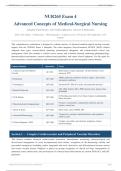
NUR265 Exam 4 — Advanced Concepts of Medical-Surgical Nursing Update
NUR265 Exam 4
Advanced Concepts of Medical-Surgical Nursing
Complete Exam Review with Verified Questions, Answers & Rationales
Update | 90 Questions | NGN-Integrated | Cognitive Levels: 25% Recall / 50% Application / 25%
Analysis
This comprehensive examination is designed to evaluate mastery of advanced medical-surgical nursing concepts
aligned with the NUR265 Exam 4 blueprint. The exam integrates Next-Generation NCLEX (NGN) clinical
judgment item types, scenario-based reasoning, prioritization, delegation, and evidence-based critical care
management. Each item includes a verified correct answer and a detailed rationale addressing pathophysiology,
pharmacological mechanisms, current evidence-based guidelines, and expert clinical judgment. Use this guide for
self-assessment, focused remediation, and examination preparation across nine integrated content domains.
Content Domain Questions Focus
1. Cardiovascular & Peripheral Heart failure, cardiac tamponade, valvular disorders, aortic
Q1–Q16
Vascular aneurysm, PVD
ARDS, pulmonary embolism, thoracic surgery, chest trauma,
2. Respiratory Q17–Q28
mechanical ventilation
3. Neurological Q29–Q42 Increased ICP, TBI, SCI, stroke, neuromuscular disorders
AKI, CKD, dialysis, DKA, HHS, thyroid storm, adrenal crisis,
4. Renal & Endocrine Q43–Q56
SIADH/DI
GI bleeding, pancreatitis, liver failure, hepatic encephalopathy,
5. GI & Hepatic Q57–Q68
biliary disorders
Fractures, osteomyelitis, compartment syndrome, pressure
6. Musculoskeletal & Integumentary Q69–Q76
injuries, wound care
7. Shock & Sepsis Q77–Q82 Shock states, sepsis, MODS, DIC
Vasopressors, inotropes, antidysrhythmics, anticoagulation,
8. Advanced Pharmacology Q83–Q86
sedatives, pain
Complex case studies, prioritization, delegation, clinical
9. Clinical Judgment / NGN Q87–Q90
decision-making
Section 1 — Complex Cardiovascular and Peripheral Vascular Disorders
This domain evaluates advanced cardiovascular assessment, hemodynamic monitoring, pharmacological and
device-based management of acute decompensated heart failure, recognition of life-threatening valvular and
pericardial emergencies (including cardiac tamponade and aortic dissection), and differentiation between arterial
and venous vascular disease. Emphasis is placed on prompt recognition of clinical red flags, interpretation of
pulmonary artery catheter data, and prioritization of evidence-based interventions per current AHA/ACC and ESC
guidelines.
Complete Guide with Verified Answers & Rationales Page 1
,NUR265 Exam 4 — Advanced Concepts of Medical-Surgical Nursing Update
Q1. A 68-year-old male with a history of HFrEF (EF 28%) presents to the ED with progressive dyspnea,
orthopnea, and bilateral crackles two-thirds up. Vital signs: BP 168/96, HR 102 and irregular, RR 28, SpO2
88% on room air. Which intervention should the nurse implement FIRST?
A. Administer a 1-liter normal saline bolus to improve perfusion
B. Administer IV furosemide 40 mg IV push as ordered
C. Begin IV nitroprusside titrated for blood pressure control
D. Initiate non-rebreather mask at 15 L/min and place in high-Fowler's position [CORRECT]
Correct Answer: D
Rationale: Acute decompensated heart failure with pulmonary edema is a respiratory emergency — the ABCDE prioritization
framework requires stabilization of oxygenation first. Placing the patient in high-Fowler's position and applying a
non-rebreather mask decreases preload via venous pooling and immediately improves oxygenation while IV furosemide is being
prepared. Furosemide (B) is essential but takes 10–20 minutes for diuresis to begin and does not address immediate hypoxemia.
Fluid bolus (A) is contraindicated and would worsen pulmonary edema. Nitroprusside (C) is a secondary vasodilator requiring
arterial line monitoring and is not the first action in an unstable, hypoxic patient.
Q2. A 72-year-old female is admitted with HFpEF (EF 60%). Which pharmacological regimen best aligns
with current evidence-based management of HF with preserved ejection fraction?
A. High-dose ACE inhibitor + beta blocker + spironolactone titrated to target doses
B. Diuretic for volume control, blood pressure and heart rate control, and treatment of comorbidities
[CORRECT]
C. Hydralazine-nitrate combination as first-line therapy
D. Digoxin monotherapy to improve diastolic filling
Correct Answer: B
Rationale: Unlike HFrEF, no therapy has been shown to reduce mortality in HFpEF. Management focuses on symptom relief
with diuretics, aggressive blood pressure control, rate control of atrial fibrillation, and treatment of comorbidities (diabetes,
obesity, CAD). The EMPEROR-Preserved and PARAGON-HF trials showed only modest benefit of SGLT2 inhibitors and
ARNI respectively; they are not yet universal standard of care. Aggressive ACE inhibitor titration (A) and hydralazine-nitrates
(C) are HFrEF regimens. Digoxin (D) does not improve diastolic function and carries toxicity risk in elderly patients with renal
impairment.
Q3. A 64-year-old male with HFrEF (EF 25%), LBBB with QRS 150 ms, NYHA Class III symptoms despite
optimal medical therapy for 3+ months is being evaluated for advanced device therapy. Which intervention
is most appropriate?
A. Implantable cardioverter-defibrillator (ICD) only
B. Cardiac resynchronization therapy-defibrillator (CRT-D) [CORRECT]
C. Permanent pacemaker for sinus node dysfunction
D. Subcutaneous ICD without pacing capabilities
Correct Answer: B
Rationale: Per current AHA/ACC/HFSA guidelines, patients with HFrEF (EF ≤35%), NYHA Class II–IV symptoms despite
optimal medical therapy for ≥3 months, and LBBB with QRS ≥150 ms have a Class I indication for cardiac resynchronization
therapy (CRT). CRT-D combines biventricular pacing for dyssynchrony correction with defibrillation capability for sudden
cardiac death prevention. ICD alone (A) does not address the conduction delay and would not improve HF symptoms. A
permanent pacemaker (C) does not provide biventricular synchronization. Subcutaneous ICD (D) cannot pace and is
inappropriate for patients requiring CRT.
Q4. A 56-year-old male post-cardiac catheterization develops hypotension (BP 84/50), jugular venous
distention with muffled heart sounds, and a HR of 122. Which clinical triad is described, and what is the
Complete Guide with Verified Answers & Rationales Page 2
,NUR265 Exam 4 — Advanced Concepts of Medical-Surgical Nursing Update
priority intervention?
A. Beck's triad — emergent pericardiocentesis [CORRECT]
B. Cushing's triad — emergent mannitol administration
C. Kussmaul's sign — Trendelenburg positioning
D. Virchow's triad — anticoagulation therapy
Correct Answer: A
Rationale: Beck's triad (hypotension, JVD, muffled heart sounds) is pathognomonic for cardiac tamponade, a life-threatening
condition caused by fluid accumulation in the pericardial space compressing the heart. The priority intervention is emergent
pericardiocentesis to drain the pericardial fluid and relieve cardiac compression. Cushing's triad (B) reflects increased ICP.
Kussmaul's sign (C) is JVD with inspiration seen in constrictive pericarditis or right heart failure. Virchow's triad (D) describes
thrombosis risk factors and is unrelated to this presentation.
Q5. A patient with suspected cardiac tamponade has a blood pressure of 96/70 with an inspiratory drop of
18 mmHg in systolic pressure. The nurse correctly documents this finding as which abnormality, and
explains the underlying mechanism?
A. Pulsus alternans — alternating ventricular contractility
B. Pulsus paradoxus — impaired LV filling during inspiration due to pericardial constraint [CORRECT]
C. Pulsus bisferiens — combined aortic stenosis and regurgitation
D. Pulsus bigeminus — premature ventricular contractions in pairs
Correct Answer: B
Rationale: Pulsus paradoxus is an inspiratory drop in systolic blood pressure exceeding 10 mmHg. In cardiac tamponade, the
pericardial fluid prevents the normal intrathoracic pressure changes during inspiration from enhancing right heart filling, instead
compressing the right ventricle and shifting the interventricular septum leftward, which impairs LV filling and reduces stroke
volume. A drop of ≥10–12 mmHg is significant; this patient's 18 mmHg drop is highly concerning. Pulsus alternans, bisferiens,
and bigeminus relate to different pathologies (severe LV failure, hypertrophic cardiomyopathy, and PVCs respectively) and are
unrelated to tamponade physiology.
Q6. The critical care nurse is preparing for emergent pericardiocentesis in a patient with cardiac
tamponade. Which action is MOST critical to ensure patient safety during the procedure?
A. Position the patient supine with arms above the head
B. Ensure continuous cardiac monitoring and resuscitation equipment availability [CORRECT]
C. Administer a 500 mL fluid bolus immediately before the procedure
D. Place the patient in left lateral decubitus position
Correct Answer: B
Rationale: Continuous ECG monitoring with a lead attached to the pericardiocentesis needle allows immediate detection of
needle contact with the myocardium (ST elevation or PVCs), which would require needle withdrawal. Resuscitation equipment
including defibrillator and advanced airway must be immediately available. The patient should be positioned supine with the
head of bed elevated 30–45 degrees (not arms above head) to allow fluid to pool dependently. Aggressive fluid bolus (C) may
transiently help but is not the most critical safety action. Left lateral decubitus (D) is incorrect positioning.
Q7. A 72-year-old male with a history of bicuspid aortic valve presents with new-onset exertional chest pain,
two episodes of syncope, and progressive dyspnea on exertion. On auscultation, a crescendo-decrescendo
systolic murmur is heard at the right second intercostal space radiating to the carotids. Which assessment
finding is most consistent with severe aortic stenosis?
A. Bounding carotid pulses with a rapid rise and fall
B. Delayed carotid upstroke (pulsus parvus et tardus) [CORRECT]
Complete Guide with Verified Answers & Rationales Page 3
, NUR265 Exam 4 — Advanced Concepts of Medical-Surgical Nursing Update
C. Bisferiens pulse indicating combined stenosis and regurgitation
D. Pulsus alternans indicating left ventricular failure
Correct Answer: B
Rationale: The classic hemodynamic hallmark of severe aortic stenosis is pulsus parvus et tardus — a carotid pulse that is weak
(parvus) and delayed (tardus) due to the fixed obstruction to LV outflow. The classic clinical triad of severe AS is angina,
syncope, and heart failure — the three symptoms that prompt urgent valve evaluation. Bounding pulses (A) suggest aortic
regurgitation. Bisferiens pulse (C) indicates combined AS/AR or hypertrophic cardiomyopathy. Pulsus alternans (D) reflects
end-stage LV failure, not isolated AS.
Q8. A 65-year-old female with mitral regurgitation secondary to mitral valve prolapse is being assessed.
Which characteristic murmur and additional finding would the nurse expect to auscultate?
A. Holosystolic murmur at the apex radiating to the axilla; S3 commonly present [CORRECT]
B. Crescendo-decrescendo murmur at the right upper sternal border; S4 present
C. Diastolic blowing murmur at the left sternal border; bounding pulses
D. Mid-systolic click without murmur; normal S1 and S2
Correct Answer: A
Rationale: Chronic mitral regurgitation produces a high-pitched, holosystolic (pansystolic) murmur best heard at the cardiac
apex with radiation to the axilla due to the regurgitant jet impinging on the posterior left atrial wall. An S3 is commonly present
due to volume overload of the LV in diastole. The murmur of mitral valve prolapse itself may include a mid-systolic click, but
in MR with significant regurgitation, the holosystolic murmur predominates. Crescendo-decrescendo murmurs (B) suggest
aortic stenosis. Diastolic blowing murmurs (C) suggest aortic regurgitation. A mid-systolic click alone (D) indicates MVP
without significant regurgitation.
Q9. A 58-year-old patient who underwent mechanical mitral valve replacement 3 days ago is being prepared
for discharge. The patient's INR is 2.4 (target 2.5–3.5 for mechanical mitral valve). Which discharge
instruction is MOST important?
A. Stop warfarin if bleeding gums occur and call clinic in 1 week
B. Maintain consistent vitamin K intake; notify all providers of anticoagulation status before procedures
[CORRECT]
C. Take NSAIDs instead of acetaminophen for headache to avoid interfering with warfarin
D. Continue warfarin for 6 months, then transition to aspirin 81 mg daily
Correct Answer: B
Rationale: Mechanical mitral valves require lifelong anticoagulation with warfarin (target INR 2.5–3.5) due to high
thromboembolic risk. Patients must maintain a consistent vitamin K intake (not eliminate it) to keep INR stable, inform all
providers of anticoagulation before any procedure, and use barrier precautions. Bleeding gums (A) require evaluation but
warfarin should not be stopped without provider direction. NSAIDs (C) are contraindicated due to additive bleeding risk and GI
ulceration; acetaminophen is preferred. Anticoagulation is lifelong (D), not 6 months.
Q10. A 72-year-old male with a known 5.2 cm abdominal aortic aneurysm (AAA) presents with sudden
severe, tearing abdominal and back pain, diaphoresis, and a palpable pulsatile mass. Current BP 86/52.
What is the priority nursing action?
A. Administer morphine 4 mg IV for pain control
B. Obtain a stat CT angiogram of the abdomen
C. Insert two large-bore IVs, initiate fluid resuscitation, and notify the surgical team STAT [CORRECT]
D. Place the patient in Trendelenburg position and apply compression to the abdomen
Correct Answer: C
Complete Guide with Verified Answers & Rationales Page 4
NUR265 Exam 4
Advanced Concepts of Medical-Surgical Nursing
Complete Exam Review with Verified Questions, Answers & Rationales
Update | 90 Questions | NGN-Integrated | Cognitive Levels: 25% Recall / 50% Application / 25%
Analysis
This comprehensive examination is designed to evaluate mastery of advanced medical-surgical nursing concepts
aligned with the NUR265 Exam 4 blueprint. The exam integrates Next-Generation NCLEX (NGN) clinical
judgment item types, scenario-based reasoning, prioritization, delegation, and evidence-based critical care
management. Each item includes a verified correct answer and a detailed rationale addressing pathophysiology,
pharmacological mechanisms, current evidence-based guidelines, and expert clinical judgment. Use this guide for
self-assessment, focused remediation, and examination preparation across nine integrated content domains.
Content Domain Questions Focus
1. Cardiovascular & Peripheral Heart failure, cardiac tamponade, valvular disorders, aortic
Q1–Q16
Vascular aneurysm, PVD
ARDS, pulmonary embolism, thoracic surgery, chest trauma,
2. Respiratory Q17–Q28
mechanical ventilation
3. Neurological Q29–Q42 Increased ICP, TBI, SCI, stroke, neuromuscular disorders
AKI, CKD, dialysis, DKA, HHS, thyroid storm, adrenal crisis,
4. Renal & Endocrine Q43–Q56
SIADH/DI
GI bleeding, pancreatitis, liver failure, hepatic encephalopathy,
5. GI & Hepatic Q57–Q68
biliary disorders
Fractures, osteomyelitis, compartment syndrome, pressure
6. Musculoskeletal & Integumentary Q69–Q76
injuries, wound care
7. Shock & Sepsis Q77–Q82 Shock states, sepsis, MODS, DIC
Vasopressors, inotropes, antidysrhythmics, anticoagulation,
8. Advanced Pharmacology Q83–Q86
sedatives, pain
Complex case studies, prioritization, delegation, clinical
9. Clinical Judgment / NGN Q87–Q90
decision-making
Section 1 — Complex Cardiovascular and Peripheral Vascular Disorders
This domain evaluates advanced cardiovascular assessment, hemodynamic monitoring, pharmacological and
device-based management of acute decompensated heart failure, recognition of life-threatening valvular and
pericardial emergencies (including cardiac tamponade and aortic dissection), and differentiation between arterial
and venous vascular disease. Emphasis is placed on prompt recognition of clinical red flags, interpretation of
pulmonary artery catheter data, and prioritization of evidence-based interventions per current AHA/ACC and ESC
guidelines.
Complete Guide with Verified Answers & Rationales Page 1
,NUR265 Exam 4 — Advanced Concepts of Medical-Surgical Nursing Update
Q1. A 68-year-old male with a history of HFrEF (EF 28%) presents to the ED with progressive dyspnea,
orthopnea, and bilateral crackles two-thirds up. Vital signs: BP 168/96, HR 102 and irregular, RR 28, SpO2
88% on room air. Which intervention should the nurse implement FIRST?
A. Administer a 1-liter normal saline bolus to improve perfusion
B. Administer IV furosemide 40 mg IV push as ordered
C. Begin IV nitroprusside titrated for blood pressure control
D. Initiate non-rebreather mask at 15 L/min and place in high-Fowler's position [CORRECT]
Correct Answer: D
Rationale: Acute decompensated heart failure with pulmonary edema is a respiratory emergency — the ABCDE prioritization
framework requires stabilization of oxygenation first. Placing the patient in high-Fowler's position and applying a
non-rebreather mask decreases preload via venous pooling and immediately improves oxygenation while IV furosemide is being
prepared. Furosemide (B) is essential but takes 10–20 minutes for diuresis to begin and does not address immediate hypoxemia.
Fluid bolus (A) is contraindicated and would worsen pulmonary edema. Nitroprusside (C) is a secondary vasodilator requiring
arterial line monitoring and is not the first action in an unstable, hypoxic patient.
Q2. A 72-year-old female is admitted with HFpEF (EF 60%). Which pharmacological regimen best aligns
with current evidence-based management of HF with preserved ejection fraction?
A. High-dose ACE inhibitor + beta blocker + spironolactone titrated to target doses
B. Diuretic for volume control, blood pressure and heart rate control, and treatment of comorbidities
[CORRECT]
C. Hydralazine-nitrate combination as first-line therapy
D. Digoxin monotherapy to improve diastolic filling
Correct Answer: B
Rationale: Unlike HFrEF, no therapy has been shown to reduce mortality in HFpEF. Management focuses on symptom relief
with diuretics, aggressive blood pressure control, rate control of atrial fibrillation, and treatment of comorbidities (diabetes,
obesity, CAD). The EMPEROR-Preserved and PARAGON-HF trials showed only modest benefit of SGLT2 inhibitors and
ARNI respectively; they are not yet universal standard of care. Aggressive ACE inhibitor titration (A) and hydralazine-nitrates
(C) are HFrEF regimens. Digoxin (D) does not improve diastolic function and carries toxicity risk in elderly patients with renal
impairment.
Q3. A 64-year-old male with HFrEF (EF 25%), LBBB with QRS 150 ms, NYHA Class III symptoms despite
optimal medical therapy for 3+ months is being evaluated for advanced device therapy. Which intervention
is most appropriate?
A. Implantable cardioverter-defibrillator (ICD) only
B. Cardiac resynchronization therapy-defibrillator (CRT-D) [CORRECT]
C. Permanent pacemaker for sinus node dysfunction
D. Subcutaneous ICD without pacing capabilities
Correct Answer: B
Rationale: Per current AHA/ACC/HFSA guidelines, patients with HFrEF (EF ≤35%), NYHA Class II–IV symptoms despite
optimal medical therapy for ≥3 months, and LBBB with QRS ≥150 ms have a Class I indication for cardiac resynchronization
therapy (CRT). CRT-D combines biventricular pacing for dyssynchrony correction with defibrillation capability for sudden
cardiac death prevention. ICD alone (A) does not address the conduction delay and would not improve HF symptoms. A
permanent pacemaker (C) does not provide biventricular synchronization. Subcutaneous ICD (D) cannot pace and is
inappropriate for patients requiring CRT.
Q4. A 56-year-old male post-cardiac catheterization develops hypotension (BP 84/50), jugular venous
distention with muffled heart sounds, and a HR of 122. Which clinical triad is described, and what is the
Complete Guide with Verified Answers & Rationales Page 2
,NUR265 Exam 4 — Advanced Concepts of Medical-Surgical Nursing Update
priority intervention?
A. Beck's triad — emergent pericardiocentesis [CORRECT]
B. Cushing's triad — emergent mannitol administration
C. Kussmaul's sign — Trendelenburg positioning
D. Virchow's triad — anticoagulation therapy
Correct Answer: A
Rationale: Beck's triad (hypotension, JVD, muffled heart sounds) is pathognomonic for cardiac tamponade, a life-threatening
condition caused by fluid accumulation in the pericardial space compressing the heart. The priority intervention is emergent
pericardiocentesis to drain the pericardial fluid and relieve cardiac compression. Cushing's triad (B) reflects increased ICP.
Kussmaul's sign (C) is JVD with inspiration seen in constrictive pericarditis or right heart failure. Virchow's triad (D) describes
thrombosis risk factors and is unrelated to this presentation.
Q5. A patient with suspected cardiac tamponade has a blood pressure of 96/70 with an inspiratory drop of
18 mmHg in systolic pressure. The nurse correctly documents this finding as which abnormality, and
explains the underlying mechanism?
A. Pulsus alternans — alternating ventricular contractility
B. Pulsus paradoxus — impaired LV filling during inspiration due to pericardial constraint [CORRECT]
C. Pulsus bisferiens — combined aortic stenosis and regurgitation
D. Pulsus bigeminus — premature ventricular contractions in pairs
Correct Answer: B
Rationale: Pulsus paradoxus is an inspiratory drop in systolic blood pressure exceeding 10 mmHg. In cardiac tamponade, the
pericardial fluid prevents the normal intrathoracic pressure changes during inspiration from enhancing right heart filling, instead
compressing the right ventricle and shifting the interventricular septum leftward, which impairs LV filling and reduces stroke
volume. A drop of ≥10–12 mmHg is significant; this patient's 18 mmHg drop is highly concerning. Pulsus alternans, bisferiens,
and bigeminus relate to different pathologies (severe LV failure, hypertrophic cardiomyopathy, and PVCs respectively) and are
unrelated to tamponade physiology.
Q6. The critical care nurse is preparing for emergent pericardiocentesis in a patient with cardiac
tamponade. Which action is MOST critical to ensure patient safety during the procedure?
A. Position the patient supine with arms above the head
B. Ensure continuous cardiac monitoring and resuscitation equipment availability [CORRECT]
C. Administer a 500 mL fluid bolus immediately before the procedure
D. Place the patient in left lateral decubitus position
Correct Answer: B
Rationale: Continuous ECG monitoring with a lead attached to the pericardiocentesis needle allows immediate detection of
needle contact with the myocardium (ST elevation or PVCs), which would require needle withdrawal. Resuscitation equipment
including defibrillator and advanced airway must be immediately available. The patient should be positioned supine with the
head of bed elevated 30–45 degrees (not arms above head) to allow fluid to pool dependently. Aggressive fluid bolus (C) may
transiently help but is not the most critical safety action. Left lateral decubitus (D) is incorrect positioning.
Q7. A 72-year-old male with a history of bicuspid aortic valve presents with new-onset exertional chest pain,
two episodes of syncope, and progressive dyspnea on exertion. On auscultation, a crescendo-decrescendo
systolic murmur is heard at the right second intercostal space radiating to the carotids. Which assessment
finding is most consistent with severe aortic stenosis?
A. Bounding carotid pulses with a rapid rise and fall
B. Delayed carotid upstroke (pulsus parvus et tardus) [CORRECT]
Complete Guide with Verified Answers & Rationales Page 3
, NUR265 Exam 4 — Advanced Concepts of Medical-Surgical Nursing Update
C. Bisferiens pulse indicating combined stenosis and regurgitation
D. Pulsus alternans indicating left ventricular failure
Correct Answer: B
Rationale: The classic hemodynamic hallmark of severe aortic stenosis is pulsus parvus et tardus — a carotid pulse that is weak
(parvus) and delayed (tardus) due to the fixed obstruction to LV outflow. The classic clinical triad of severe AS is angina,
syncope, and heart failure — the three symptoms that prompt urgent valve evaluation. Bounding pulses (A) suggest aortic
regurgitation. Bisferiens pulse (C) indicates combined AS/AR or hypertrophic cardiomyopathy. Pulsus alternans (D) reflects
end-stage LV failure, not isolated AS.
Q8. A 65-year-old female with mitral regurgitation secondary to mitral valve prolapse is being assessed.
Which characteristic murmur and additional finding would the nurse expect to auscultate?
A. Holosystolic murmur at the apex radiating to the axilla; S3 commonly present [CORRECT]
B. Crescendo-decrescendo murmur at the right upper sternal border; S4 present
C. Diastolic blowing murmur at the left sternal border; bounding pulses
D. Mid-systolic click without murmur; normal S1 and S2
Correct Answer: A
Rationale: Chronic mitral regurgitation produces a high-pitched, holosystolic (pansystolic) murmur best heard at the cardiac
apex with radiation to the axilla due to the regurgitant jet impinging on the posterior left atrial wall. An S3 is commonly present
due to volume overload of the LV in diastole. The murmur of mitral valve prolapse itself may include a mid-systolic click, but
in MR with significant regurgitation, the holosystolic murmur predominates. Crescendo-decrescendo murmurs (B) suggest
aortic stenosis. Diastolic blowing murmurs (C) suggest aortic regurgitation. A mid-systolic click alone (D) indicates MVP
without significant regurgitation.
Q9. A 58-year-old patient who underwent mechanical mitral valve replacement 3 days ago is being prepared
for discharge. The patient's INR is 2.4 (target 2.5–3.5 for mechanical mitral valve). Which discharge
instruction is MOST important?
A. Stop warfarin if bleeding gums occur and call clinic in 1 week
B. Maintain consistent vitamin K intake; notify all providers of anticoagulation status before procedures
[CORRECT]
C. Take NSAIDs instead of acetaminophen for headache to avoid interfering with warfarin
D. Continue warfarin for 6 months, then transition to aspirin 81 mg daily
Correct Answer: B
Rationale: Mechanical mitral valves require lifelong anticoagulation with warfarin (target INR 2.5–3.5) due to high
thromboembolic risk. Patients must maintain a consistent vitamin K intake (not eliminate it) to keep INR stable, inform all
providers of anticoagulation before any procedure, and use barrier precautions. Bleeding gums (A) require evaluation but
warfarin should not be stopped without provider direction. NSAIDs (C) are contraindicated due to additive bleeding risk and GI
ulceration; acetaminophen is preferred. Anticoagulation is lifelong (D), not 6 months.
Q10. A 72-year-old male with a known 5.2 cm abdominal aortic aneurysm (AAA) presents with sudden
severe, tearing abdominal and back pain, diaphoresis, and a palpable pulsatile mass. Current BP 86/52.
What is the priority nursing action?
A. Administer morphine 4 mg IV for pain control
B. Obtain a stat CT angiogram of the abdomen
C. Insert two large-bore IVs, initiate fluid resuscitation, and notify the surgical team STAT [CORRECT]
D. Place the patient in Trendelenburg position and apply compression to the abdomen
Correct Answer: C
Complete Guide with Verified Answers & Rationales Page 4


