

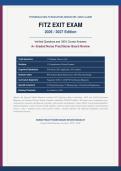
FITZGERALD HEALTH EDUCATION ASSOCIATES | ANCC & AANP
FITZ EXIT EXAM
Edition
Verified Questions and 100% Correct Answers
A+ Graded Nurse Practitioner Board Review
Total Questions 175 Multiple Choice (A-D)
Sections 11 Comprehensive Clinical Domains
Cognitive Distribution 20% Recall | 50% Application | 30% Analysis
Question Style 80% Scenario-Based Patient Cases | 20% Direct Knowledge
Curriculum Alignment Fitzgerald / ANCC / AANP NP Certification Blueprints
Special Inclusions 25 Clinical Reasoning | 15 Pharmacology | 10 Geriatrics/Polypharmacy
Passing Threshold A+ Graded (>= 95%)
Aligned with Fitzgerald Health Education Associates NP Certification Review Curriculum, ANCC and AANP Certification
Blueprints, and Advanced Practice Nursing Competency Standards (2026/2027 Edition). This board review examination covers
comprehensive assessment and diagnostic reasoning, cardiovascular and pulmonary systems, GI/GU, neurology/musculoskeletal,
endocrine/metabolic, women's and men's health, pediatrics, geriatrics, pharmacology and prescriptive authority, and professional
practice / ethics / healthcare policy. Each question includes a detailed rationale with Fitzgerald methodology and board
certification references.
NURSE PRACTITIONER BOARD REVIEW BOOKLET
Fitzgerald Health Education Associates | ANCC | AANP
,FITZ EXIT EXAM - 2026/2027 Edition - NP Board Review Fitzgerald / ANCC / AANP Aligned
Section 1: Assessment & Diagnostic Reasoning
Q1 - Q25 | 25 Questions | History-Taking, Physical Exam, Differential Diagnosis, Diagnostic Testing
Q1: A 54-year-old male presents with progressive exertional chest pressure radiating to the left arm, diaphoresis, and
dyspnea for the past 45 minutes. Vital signs: BP 152/94, HR 102, RR 22, SpO2 95% on RA. Which action represents
the most appropriate immediate diagnostic reasoning step according to Fitzgerald/AHA guidelines?
A. Obtain a complete past medical history and review of systems before proceeding to ECG.
B. Obtain a 12-lead ECG within 10 minutes of arrival and administer aspirin 162-325 mg chewed if no contraindication;
simultaneously draw cardiac biomarkers. *[CORRECT]*
C. Administer sublingual nitroglycerin and observe for 30 minutes before ECG.
D. Order a chest CT angiogram to rule out pulmonary embolism as the first diagnostic test.
Correct Answer: B
Rationale: Fitzgerald and AHA/ACC STEMI guidelines require a 12-lead ECG within 10 minutes of arrival for any suspected acute
coronary syndrome, with simultaneous aspirin administration (162-325 mg chewed) if no contraindication. Biomarkers (troponin) do not
elevate for 3-6 hours and should not delay ECG interpretation. Option A delays critical intervention. Option C may delay STEMI diagnosis.
Option D is inappropriate as the first test when ACS is the leading differential.
Q2: Which element of the history of present illness is most strongly associated with a diagnosis of stable angina versus
non-cardiac chest pain per Fitzgerald methodology?
A. Pleuritic pain that worsens with deep inspiration.
B. Substernal pressure lasting 30 seconds relieved by antacids.
C. Predictable exertional substernal pressure lasting 2-10 minutes, relieved by rest or nitroglycerin, with a consistent
pattern of provocation and relief. *[CORRECT]*
D. Sharp, stabbing chest pain lasting less than 5 seconds at the apex.
Correct Answer: C
Rationale: Fitzgerald defines stable angina by classic features: substernal location, provoked by exertion/stress, lasting 2-10 minutes,
relieved by rest or nitroglycerin (the '3 S's' - substernal, stress-provoked, short duration with relief). Pleuritic pain (option A) suggests pleural
or pericardial etiology. Pain relieved by antacids (option B) suggests GERD. Brief sharp apical pain (option D) is classic for non-cardiac
chest wall pain.
Q3: A 42-year-old female presents with fatigue, cold intolerance, and weight gain. TSH is 14.2 mIU/L (normal 0.4-4.0),
free T4 is 7.5 pmol/L (normal 10-20). Which physical examination finding is most consistent with the working
diagnosis?
A. Hyperreflexia with short relaxation phase
B. Delayed deep tendon reflex relaxation phase, bradycardia, and cool, dry skin *[CORRECT]*
C. Tachycardia, fine tremor, and warm moist skin
D. Proptosis and pretibial myxedema
Correct Answer: B
Rationale: The patient has primary hypothyroidism (elevated TSH, low free T4). Classic findings include delayed relaxation phase of deep
tendon reflexes (Woltman's sign), bradycardia, cool/dry skin, and constipation. Hyperreflexia with short relaxation (option A) suggests
hyperthyroidism. Option C describes hyperthyroidism. Option D (proptosis, pretibial myxedema) describes Graves' ophthalmopathy and
dermopathy, seen in hyperthyroidism, not hypothyroidism.
A+ Graded - Verified Questions and 100% Correct Answers Page 2
,FITZ EXIT EXAM - 2026/2027 Edition - NP Board Review Fitzgerald / ANCC / AANP Aligned
Q4: When taking a comprehensive health history, which component most strongly predicts future cardiovascular
events according to the Framingham Risk Score and Fitzgerald cardiovascular assessment framework?
A. Personal history of childhood asthma
B. Family history of premature coronary artery disease (male first-degree relative <55 years, female <65 years)
*[CORRECT]*
C. History of seasonal allergies
D. History of benign positional vertigo
Correct Answer: B
Rationale: Family history of premature CAD (male first-degree relative <55 years, female <65 years) is an independent risk factor in the
Framingham/ACC-AHA pooled cohort equations and Fitzgerald's cardiovascular risk assessment. The other options are not independent
predictors of cardiovascular events. A family history of premature CAD doubles personal risk and influences statin and aspirin primary
prevention decisions.
Q5: A 68-year-old male presents with new-onset confusion. Which assessment tool is most appropriate for objectively
quantifying cognitive impairment in the clinical setting per Fitzgerald geriatric assessment?
A. PHQ-9
B. Mini-Cog or Montreal Cognitive Assessment (MoCA) *[CORRECT]*
C. Edmonton Symptom Assessment Scale
D. Karnofsky Performance Scale
Correct Answer: B
Rationale: The Mini-Cog (3-item recall + clock draw) and MoCA are validated screening tools for cognitive impairment used in
Fitzgerald's geriatric assessment. PHQ-9 (option A) screens for depression. Edmonton (option C) is for palliative symptom burden.
Karnofsky (option D) measures functional performance in cancer/palliative patients. MoCA is more sensitive than MMSE for mild
cognitive impairment.
Q6: A 28-year-old female presents with a 2-day history of dysuria, frequency, and urgency. She is afebrile, has no
flank pain, no vaginal discharge, and no nausea. Per Fitzgerald/IDSA guidelines, which diagnostic test is most
appropriate?
A. Urine culture and sensitivity before any treatment
B. Empiric treatment based on clinical presentation alone; urinalysis can support the diagnosis if needed *[CORRECT]*
C. Renal ultrasound to evaluate for obstruction
D. Pelvic exam with cervical cultures
Correct Answer: B
Rationale: Fitzgerald/IDSA guidelines support empiric treatment of uncomplicated cystitis in premenopausal, non-pregnant women based
on classic symptoms; urinalysis (positive leukocyte esterase, nitrites) supports the diagnosis but culture is reserved for treatment failure,
recurrent infection, or complicated presentation. Option A is unnecessary in uncomplicated cases. Option C is reserved for complicated UTI
or suspected obstruction. Option D is not indicated without vaginal discharge or risk for STI.
Q7: Which percussion note is most characteristic of a large pleural effusion on the affected side?
A. Resonant
B. Hyperresonant
C. Dull or flat *[CORRECT]*
D. Tympanic
Correct Answer: C
Rationale: Percussion over a pleural effusion produces a dull or flat note due to the dense fluid replacing air-filled lung tissue. Resonant
(option A) is normal over air-filled lung. Hyperresonant (option B) suggests pneumothorax or emphysema. Tympanic (option D) is heard
over a gastric air bubble or large pneumothorax. The combination of dullness, decreased fremitus, and absent breath sounds characterizes
effusion.
A+ Graded - Verified Questions and 100% Correct Answers Page 3
, FITZ EXIT EXAM - 2026/2027 Edition - NP Board Review Fitzgerald / ANCC / AANP Aligned
Q8: A 56-year-old male with cirrhosis presents with abdominal distension. On physical exam, you suspect ascites.
Which bedside maneuver has the highest sensitivity for detecting moderate ascites?
A. Bulge sign
B. Fluid wave
C. Shifting dullness with percussion *[CORRECT]*
D. Percussion tenderness
Correct Answer: C
Rationale: Shifting dullness has the highest sensitivity (~83%) for detecting moderate ascites (typically >1,000 mL). The fluid wave is more
specific (~82%) but less sensitive and requires approximately 1,200 mL. The bulge sign detects smaller amounts in the lateral decubitus
position. Percussion tenderness suggests peritonitis rather than ascites. Ultrasound is the gold standard for confirming ascites.
Q9: A 35-year-old presents with headache, photophobia, and neck stiffness. On exam, Kernig and Brudzinski signs
are positive. What is the most appropriate immediate diagnostic action?
A. Perform a head CT without contrast, then lumbar puncture if no mass effect; if immunocompromised, give antibiotics
first *[CORRECT]*
B. Administer acetaminophen and observe for 24 hours
C. Perform a lumbar puncture immediately without imaging
D. Order an MRI brain with gadolinium as the first test
Correct Answer: A
Rationale: Fitzgerald and IDSA guidelines recommend head CT before lumbar puncture in patients with focal neurological deficits,
immunocompromise, history of CNS disease, new-onset seizures, or altered mental status to rule out mass effect. Empiric antibiotics (e.g.,
ceftriaxone + vancomycin) should be started if bacterial meningitis is suspected and LP is delayed. Option B delays critical treatment.
Option C risks herniation in patients with mass effect. Option D is inappropriate for acute suspected meningitis.
Q10: When assessing jugular venous distension (JVD), the patient should be positioned at what angle for accurate
measurement, and what is the upper limit of normal for JVP?
A. Supine at 0 degrees; 8 cm above the sternal angle
B. 30-45 degrees head elevation; JVP elevated more than 3-4 cm above the sternal angle is abnormal *[CORRECT]*
C. 90 degrees upright; any visible JVP is abnormal
D. Trendelenburg position; JVP cannot be measured accurately
Correct Answer: B
Rationale: Fitzgerald physical assessment technique positions the patient at 30-45 degrees head elevation; JVP measured more than 3-4 cm
above the sternal angle (angle of Louis) is abnormal and suggests elevated right atrial pressure (e.g., right heart failure, volume overload,
tricuspid regurgitation). At 0 degrees (option A), even normal JVP appears elevated. At 90 degrees (option C), low/normal JVP may be
invisible. Trendelenburg (option D) is not used for JVP assessment.
Q11: A 47-year-old male presents with acute onset severe tearing chest pain radiating to the back. BP is 168/98 in the
right arm and 142/86 in the left arm. Which finding on auscultation would most strongly suggest the suspected
diagnosis?
A. S3 gallop
B. Diastolic murmur of aortic regurgitation (new onset) *[CORRECT]*
C. Pericardial friction rub
D. Bilateral wheezing
Correct Answer: B
Rationale: Acute severe tearing chest pain radiating to the back with blood pressure differential (>15 mmHg between arms) suggests acute
aortic dissection. A new diastolic murmur of aortic regurgitation occurs when the dissection involves the aortic root, causing annular dilation
and incompetent valve closure. S3 gallop (option A) suggests heart failure. Pericardial friction rub (option C) suggests pericarditis. Bilateral
wheezing (option D) suggests asthma/COPD. Immediate CT angiography or transesophageal echo is diagnostic.
A+ Graded - Verified Questions and 100% Correct Answers Page 4
FITZ EXIT EXAM
Edition
Verified Questions and 100% Correct Answers
A+ Graded Nurse Practitioner Board Review
Total Questions 175 Multiple Choice (A-D)
Sections 11 Comprehensive Clinical Domains
Cognitive Distribution 20% Recall | 50% Application | 30% Analysis
Question Style 80% Scenario-Based Patient Cases | 20% Direct Knowledge
Curriculum Alignment Fitzgerald / ANCC / AANP NP Certification Blueprints
Special Inclusions 25 Clinical Reasoning | 15 Pharmacology | 10 Geriatrics/Polypharmacy
Passing Threshold A+ Graded (>= 95%)
Aligned with Fitzgerald Health Education Associates NP Certification Review Curriculum, ANCC and AANP Certification
Blueprints, and Advanced Practice Nursing Competency Standards (2026/2027 Edition). This board review examination covers
comprehensive assessment and diagnostic reasoning, cardiovascular and pulmonary systems, GI/GU, neurology/musculoskeletal,
endocrine/metabolic, women's and men's health, pediatrics, geriatrics, pharmacology and prescriptive authority, and professional
practice / ethics / healthcare policy. Each question includes a detailed rationale with Fitzgerald methodology and board
certification references.
NURSE PRACTITIONER BOARD REVIEW BOOKLET
Fitzgerald Health Education Associates | ANCC | AANP
,FITZ EXIT EXAM - 2026/2027 Edition - NP Board Review Fitzgerald / ANCC / AANP Aligned
Section 1: Assessment & Diagnostic Reasoning
Q1 - Q25 | 25 Questions | History-Taking, Physical Exam, Differential Diagnosis, Diagnostic Testing
Q1: A 54-year-old male presents with progressive exertional chest pressure radiating to the left arm, diaphoresis, and
dyspnea for the past 45 minutes. Vital signs: BP 152/94, HR 102, RR 22, SpO2 95% on RA. Which action represents
the most appropriate immediate diagnostic reasoning step according to Fitzgerald/AHA guidelines?
A. Obtain a complete past medical history and review of systems before proceeding to ECG.
B. Obtain a 12-lead ECG within 10 minutes of arrival and administer aspirin 162-325 mg chewed if no contraindication;
simultaneously draw cardiac biomarkers. *[CORRECT]*
C. Administer sublingual nitroglycerin and observe for 30 minutes before ECG.
D. Order a chest CT angiogram to rule out pulmonary embolism as the first diagnostic test.
Correct Answer: B
Rationale: Fitzgerald and AHA/ACC STEMI guidelines require a 12-lead ECG within 10 minutes of arrival for any suspected acute
coronary syndrome, with simultaneous aspirin administration (162-325 mg chewed) if no contraindication. Biomarkers (troponin) do not
elevate for 3-6 hours and should not delay ECG interpretation. Option A delays critical intervention. Option C may delay STEMI diagnosis.
Option D is inappropriate as the first test when ACS is the leading differential.
Q2: Which element of the history of present illness is most strongly associated with a diagnosis of stable angina versus
non-cardiac chest pain per Fitzgerald methodology?
A. Pleuritic pain that worsens with deep inspiration.
B. Substernal pressure lasting 30 seconds relieved by antacids.
C. Predictable exertional substernal pressure lasting 2-10 minutes, relieved by rest or nitroglycerin, with a consistent
pattern of provocation and relief. *[CORRECT]*
D. Sharp, stabbing chest pain lasting less than 5 seconds at the apex.
Correct Answer: C
Rationale: Fitzgerald defines stable angina by classic features: substernal location, provoked by exertion/stress, lasting 2-10 minutes,
relieved by rest or nitroglycerin (the '3 S's' - substernal, stress-provoked, short duration with relief). Pleuritic pain (option A) suggests pleural
or pericardial etiology. Pain relieved by antacids (option B) suggests GERD. Brief sharp apical pain (option D) is classic for non-cardiac
chest wall pain.
Q3: A 42-year-old female presents with fatigue, cold intolerance, and weight gain. TSH is 14.2 mIU/L (normal 0.4-4.0),
free T4 is 7.5 pmol/L (normal 10-20). Which physical examination finding is most consistent with the working
diagnosis?
A. Hyperreflexia with short relaxation phase
B. Delayed deep tendon reflex relaxation phase, bradycardia, and cool, dry skin *[CORRECT]*
C. Tachycardia, fine tremor, and warm moist skin
D. Proptosis and pretibial myxedema
Correct Answer: B
Rationale: The patient has primary hypothyroidism (elevated TSH, low free T4). Classic findings include delayed relaxation phase of deep
tendon reflexes (Woltman's sign), bradycardia, cool/dry skin, and constipation. Hyperreflexia with short relaxation (option A) suggests
hyperthyroidism. Option C describes hyperthyroidism. Option D (proptosis, pretibial myxedema) describes Graves' ophthalmopathy and
dermopathy, seen in hyperthyroidism, not hypothyroidism.
A+ Graded - Verified Questions and 100% Correct Answers Page 2
,FITZ EXIT EXAM - 2026/2027 Edition - NP Board Review Fitzgerald / ANCC / AANP Aligned
Q4: When taking a comprehensive health history, which component most strongly predicts future cardiovascular
events according to the Framingham Risk Score and Fitzgerald cardiovascular assessment framework?
A. Personal history of childhood asthma
B. Family history of premature coronary artery disease (male first-degree relative <55 years, female <65 years)
*[CORRECT]*
C. History of seasonal allergies
D. History of benign positional vertigo
Correct Answer: B
Rationale: Family history of premature CAD (male first-degree relative <55 years, female <65 years) is an independent risk factor in the
Framingham/ACC-AHA pooled cohort equations and Fitzgerald's cardiovascular risk assessment. The other options are not independent
predictors of cardiovascular events. A family history of premature CAD doubles personal risk and influences statin and aspirin primary
prevention decisions.
Q5: A 68-year-old male presents with new-onset confusion. Which assessment tool is most appropriate for objectively
quantifying cognitive impairment in the clinical setting per Fitzgerald geriatric assessment?
A. PHQ-9
B. Mini-Cog or Montreal Cognitive Assessment (MoCA) *[CORRECT]*
C. Edmonton Symptom Assessment Scale
D. Karnofsky Performance Scale
Correct Answer: B
Rationale: The Mini-Cog (3-item recall + clock draw) and MoCA are validated screening tools for cognitive impairment used in
Fitzgerald's geriatric assessment. PHQ-9 (option A) screens for depression. Edmonton (option C) is for palliative symptom burden.
Karnofsky (option D) measures functional performance in cancer/palliative patients. MoCA is more sensitive than MMSE for mild
cognitive impairment.
Q6: A 28-year-old female presents with a 2-day history of dysuria, frequency, and urgency. She is afebrile, has no
flank pain, no vaginal discharge, and no nausea. Per Fitzgerald/IDSA guidelines, which diagnostic test is most
appropriate?
A. Urine culture and sensitivity before any treatment
B. Empiric treatment based on clinical presentation alone; urinalysis can support the diagnosis if needed *[CORRECT]*
C. Renal ultrasound to evaluate for obstruction
D. Pelvic exam with cervical cultures
Correct Answer: B
Rationale: Fitzgerald/IDSA guidelines support empiric treatment of uncomplicated cystitis in premenopausal, non-pregnant women based
on classic symptoms; urinalysis (positive leukocyte esterase, nitrites) supports the diagnosis but culture is reserved for treatment failure,
recurrent infection, or complicated presentation. Option A is unnecessary in uncomplicated cases. Option C is reserved for complicated UTI
or suspected obstruction. Option D is not indicated without vaginal discharge or risk for STI.
Q7: Which percussion note is most characteristic of a large pleural effusion on the affected side?
A. Resonant
B. Hyperresonant
C. Dull or flat *[CORRECT]*
D. Tympanic
Correct Answer: C
Rationale: Percussion over a pleural effusion produces a dull or flat note due to the dense fluid replacing air-filled lung tissue. Resonant
(option A) is normal over air-filled lung. Hyperresonant (option B) suggests pneumothorax or emphysema. Tympanic (option D) is heard
over a gastric air bubble or large pneumothorax. The combination of dullness, decreased fremitus, and absent breath sounds characterizes
effusion.
A+ Graded - Verified Questions and 100% Correct Answers Page 3
, FITZ EXIT EXAM - 2026/2027 Edition - NP Board Review Fitzgerald / ANCC / AANP Aligned
Q8: A 56-year-old male with cirrhosis presents with abdominal distension. On physical exam, you suspect ascites.
Which bedside maneuver has the highest sensitivity for detecting moderate ascites?
A. Bulge sign
B. Fluid wave
C. Shifting dullness with percussion *[CORRECT]*
D. Percussion tenderness
Correct Answer: C
Rationale: Shifting dullness has the highest sensitivity (~83%) for detecting moderate ascites (typically >1,000 mL). The fluid wave is more
specific (~82%) but less sensitive and requires approximately 1,200 mL. The bulge sign detects smaller amounts in the lateral decubitus
position. Percussion tenderness suggests peritonitis rather than ascites. Ultrasound is the gold standard for confirming ascites.
Q9: A 35-year-old presents with headache, photophobia, and neck stiffness. On exam, Kernig and Brudzinski signs
are positive. What is the most appropriate immediate diagnostic action?
A. Perform a head CT without contrast, then lumbar puncture if no mass effect; if immunocompromised, give antibiotics
first *[CORRECT]*
B. Administer acetaminophen and observe for 24 hours
C. Perform a lumbar puncture immediately without imaging
D. Order an MRI brain with gadolinium as the first test
Correct Answer: A
Rationale: Fitzgerald and IDSA guidelines recommend head CT before lumbar puncture in patients with focal neurological deficits,
immunocompromise, history of CNS disease, new-onset seizures, or altered mental status to rule out mass effect. Empiric antibiotics (e.g.,
ceftriaxone + vancomycin) should be started if bacterial meningitis is suspected and LP is delayed. Option B delays critical treatment.
Option C risks herniation in patients with mass effect. Option D is inappropriate for acute suspected meningitis.
Q10: When assessing jugular venous distension (JVD), the patient should be positioned at what angle for accurate
measurement, and what is the upper limit of normal for JVP?
A. Supine at 0 degrees; 8 cm above the sternal angle
B. 30-45 degrees head elevation; JVP elevated more than 3-4 cm above the sternal angle is abnormal *[CORRECT]*
C. 90 degrees upright; any visible JVP is abnormal
D. Trendelenburg position; JVP cannot be measured accurately
Correct Answer: B
Rationale: Fitzgerald physical assessment technique positions the patient at 30-45 degrees head elevation; JVP measured more than 3-4 cm
above the sternal angle (angle of Louis) is abnormal and suggests elevated right atrial pressure (e.g., right heart failure, volume overload,
tricuspid regurgitation). At 0 degrees (option A), even normal JVP appears elevated. At 90 degrees (option C), low/normal JVP may be
invisible. Trendelenburg (option D) is not used for JVP assessment.
Q11: A 47-year-old male presents with acute onset severe tearing chest pain radiating to the back. BP is 168/98 in the
right arm and 142/86 in the left arm. Which finding on auscultation would most strongly suggest the suspected
diagnosis?
A. S3 gallop
B. Diastolic murmur of aortic regurgitation (new onset) *[CORRECT]*
C. Pericardial friction rub
D. Bilateral wheezing
Correct Answer: B
Rationale: Acute severe tearing chest pain radiating to the back with blood pressure differential (>15 mmHg between arms) suggests acute
aortic dissection. A new diastolic murmur of aortic regurgitation occurs when the dissection involves the aortic root, causing annular dilation
and incompetent valve closure. S3 gallop (option A) suggests heart failure. Pericardial friction rub (option C) suggests pericarditis. Bilateral
wheezing (option D) suggests asthma/COPD. Immediate CT angiography or transesophageal echo is diagnostic.
A+ Graded - Verified Questions and 100% Correct Answers Page 4


