
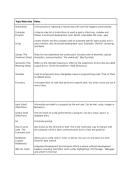
Topic/Main Idea Notes
Automation Is the process of replacing a manual step with one that happens automatically
Computer A step by step list of instructions to reach a goal is often long, complex and
Program follows a structured development cycle. Result: Executable File (.exe, .app)
Usually shorter and less complex Used to automate specific tasks quickly and it
Script uses a shorter, less structured development cycle. Examples: (Python, Javascript,
and Bash)
Syntax (The Rules for how statements are constructed. Includes order of elements, special
Grammer) (How) characters, and punctuation. “Me cookie eat.” (Bad Synntax)
Semantics (The Refers to the intended meaning or effect of the statements. Errors here are called
Meaning) (Why) Logical Errors. “Drink the sandwich.” (Bad Semantics)
Variables Used to temporarily store changeable values in programming code. Think of them
as labeled boxes.
Functions A reusable block of code that performs a specific task. You write it once and use it
many times.
Input (start) Information provided to a program by the end user. Can be text, voice, images or
(Data Flow) Biometrics
Output (end) The end result of a task performed by a program. Can be a value, report, or
(Data Flow) database entry
(#) Command prompt
How to write Also known as the Terminal or shell. This is the most basic way to interact with
code: The the computer which is direct communication and it is fast and powerful
Command Line
Notebooks Allows you to write code in “cells” or blocks. You can run one block at a time.
(Jupyter Great for data science
Notebooks)
Integrated Development Environments Which is where software development
IDEs (Vs Code) happens including Text Editor (with syntax highlighting), File Manager, Debugger,
and a Built-In Terminal
, What is Python? They are used for general purpose scripting language, used for automation and
apps, it is cross platform compatible (Win, Mac, Linux), Beginner-Friendly
(Readability)
What Python Is Not platform-specific (it works everywhere, unlike PowerShell). Not a client-side
Not?!!!!! language (it runs on servers/backend, unlike Javascript). Not purely
Object-Oriented language (It supports OOP, but can also be functional/procedural)
Platform-Specifi Languages designed for one OS. Powershell (Windows), Bash (Linux)
c
Cross-Platform Compatible with multiple operating systems. Python runs on everything
Client-Side Scripts executed in the user’s browser. Ex Javascript (web programming)
Scripting
Machine-Langua Lowest Level (Binary 1s and 0s). Communicates directly with hardware.
ge
Object-Oriented Code elements are treated as Objects with configurable properties (a form field
Programming that only accepts data)
(OOP)
Python The program that reads your Python code and translates it into computer
Interpreter instructions.
Automation Is the process of replacing a manual step with one that happens automatically
Computer A step by step list of instructions to reach a goal is often long, complex and
Program follows a structured development cycle. Result: Executable File (.exe, .app)
Usually shorter and less complex Used to automate specific tasks quickly and it
Script uses a shorter, less structured development cycle. Examples: (Python, Javascript,
and Bash)
Syntax (The Rules for how statements are constructed. Includes order of elements, special
Grammer) (How) characters, and punctuation. “Me cookie eat.” (Bad Synntax)
Semantics (The Refers to the intended meaning or effect of the statements. Errors here are called
Meaning) (Why) Logical Errors. “Drink the sandwich.” (Bad Semantics)
Variables Used to temporarily store changeable values in programming code. Think of them
as labeled boxes.
Functions A reusable block of code that performs a specific task. You write it once and use it
many times.
Input (start) Information provided to a program by the end user. Can be text, voice, images or
(Data Flow) Biometrics
Output (end) The end result of a task performed by a program. Can be a value, report, or
(Data Flow) database entry
(#) Command prompt
How to write Also known as the Terminal or shell. This is the most basic way to interact with
code: The the computer which is direct communication and it is fast and powerful
Command Line
Notebooks Allows you to write code in “cells” or blocks. You can run one block at a time.
(Jupyter Great for data science
Notebooks)
Integrated Development Environments Which is where software development
IDEs (Vs Code) happens including Text Editor (with syntax highlighting), File Manager, Debugger,
and a Built-In Terminal
, What is Python? They are used for general purpose scripting language, used for automation and
apps, it is cross platform compatible (Win, Mac, Linux), Beginner-Friendly
(Readability)
What Python Is Not platform-specific (it works everywhere, unlike PowerShell). Not a client-side
Not?!!!!! language (it runs on servers/backend, unlike Javascript). Not purely
Object-Oriented language (It supports OOP, but can also be functional/procedural)
Platform-Specifi Languages designed for one OS. Powershell (Windows), Bash (Linux)
c
Cross-Platform Compatible with multiple operating systems. Python runs on everything
Client-Side Scripts executed in the user’s browser. Ex Javascript (web programming)
Scripting
Machine-Langua Lowest Level (Binary 1s and 0s). Communicates directly with hardware.
ge
Object-Oriented Code elements are treated as Objects with configurable properties (a form field
Programming that only accepts data)
(OOP)
Python The program that reads your Python code and translates it into computer
Interpreter instructions.


