

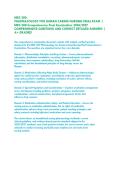
NRG 200-
PHARMACOLOGY FOR HUMAN CARING NURSING FINAL EXAM |
NRG 200-Comprehensive Final Examination 2026/2027
COMPREHENSIVE QUESTIONS AND CORRECT DETAILED ANSWERS |
A+ GRADED!
This comprehensive examination document contains 250 original, verified questions
designed for the NRG 200 Pharmacology for Human Caring Nursing Final Comprehensive
Examination. The questions are organized across four core domains:
Domain 1: Pharmacologic Principles and Drug Actions – Covers pharmacokinetics
(absorption, distribution, metabolism, excretion), pharmacodynamics (receptor
interactions, dose-response relationships), drug interactions, half-life
calculations, and the foundational principles of drug therapy across the
lifespan.
Domain 2: Medications Affecting Major Body Systems – Addresses pharmacologic
agents for cardiovascular, respiratory, neurological, endocrine, gastrointestinal,
renal, and psychiatric conditions, including mechanism of action, adverse effects,
nursing considerations, and patient monitoring.
Domain 3: Special Populations and Considerations – Explores medication management
across the lifespan including pediatric, geriatric, pregnancy and lactation
considerations, cultural considerations, and pharmacogenomic factors that
influence drug response.
Domain 4: Medication Administration, Safety, and Patient Education – Covers the
nursing process in medication administration, the six rights of medication
administration, adverse drug event prevention, patient teaching strategies, and
safety protocols including high-alert medications and error reporting.
The content draws on foundational nursing pharmacology textbooks, current
clinical guidelines, and evidence-based practice standards aligned to the
2026/2027 academic year. Each question includes the correct answer and a short
rationale to reinforce learning and build exam readiness for university-level
nursing students.
,DOMAIN 1: PHARMACOLOGIC PRINCIPLES AND DRUG ACTIONS
Question 1. What does pharmacokinetics describe?
A. What a drug does to the body at receptor sites
B. The cost analysis of drug therapy
C. What the body does to a drug—absorption, distribution, metabolism, and
excretion
D. The legal classification of medications
Correct Answer: C
Rationale: Kinetics is the movement story: liberation into absorption, travel
through distribution, transformation by metabolism, and departure through
excretion.
Question 2. What does pharmacodynamics study?
A. How the kidney removes a drug
B. What a drug does to the body, including receptor interactions and dose
response
C. How drugs are manufactured
D. How prescriptions are transmitted
Correct Answer: B
Rationale: Dynamics is the effect story—drug-receptor binding, dose-response
curves, and the mechanisms of therapeutic and adverse action.
Question 3. A drug with high first-pass metabolism is switched from oral to
sublingual. What is the expected change?
A. Higher bioavailability, because blood from the mouth bypasses the portal
circulation
B. Lower bioavailability from gut destruction
C. Identical blood levels by either route
D. Total loss of all drug effect
Correct Answer: A
Rationale: Sublingual absorption drains to the superior vena cava, skipping
hepatic first-pass extraction—more intact drug reaches the circulation.
,Question 4. Why does a loading dose sometimes precede maintenance dosing?
A. To empty the stomach before therapy
B. To double every maintenance dose forever
C. To fill the volume of distribution and reach target concentration without
waiting for accumulation
D. Because all drugs require loading always
Correct Answer: C
Rationale: When tissues must be saturated first, the loading dose fills the
tank so the steady-state tap begins immediately.
Question 5. After five half-lives of consistent dosing, how much of steady
state has been reached?
A. Fifty percent
B. Seventy-five percent
C. One hundred percent on dose one
D. About ninety-seven percent
Correct Answer: D
Rationale: Each half-life adds half the remaining gap; five intervals close
about ninety-seven percent of the distance to steady state.
Question 6. Why must phenytoin doses be titrated in small increments at
therapeutic levels?
A. Its metabolism saturates, so small dose increases cause large concentration
jumps
B. Its half-life shortens with each dose
C. It is eliminated unchanged by the lung
D. Its absorption stops at steady state
Correct Answer: A
Rationale: Zero-order saturation near therapeutic levels converts tiny
increments into steep concentration climbs—titration must crawl.
, Question 7. Which process moves a drug from plasma into tissues according to
its lipophilicity and perfusion?
A. Absorption into portal blood
B. First-pass oxidation
C. Distribution
D. Glomerular filtration alone
Correct Answer: C
Rationale: Lipid-soluble, well-perfused tissues receive drug fastest—that is
distribution's geography.
Question 8. Why can hypoalbuminemia raise the risk of toxicity from highly
protein-bound drugs?
A. Albumin destroys bound drugs slowly
B. Fewer binding sites leave more free, active drug circulating
C. Low albumin halts all absorption
D. Binding increases drug potency
Correct Answer: B
Rationale: Bound drug is the inactive reservoir; when albumin falls, the free
fraction rises without any dose change.
Question 9. Which hepatic enzyme family performs most drug biotransformation?
A. The renin-angiotensin enzymes
B. Pancreatic lipases
C. The cytochrome P450 system
D. Acetylcholinesterase family
Correct Answer: C
Rationale: The CYP enzyme cluster—especially 3A4 and 2D6—oxidizes the majority
of medications toward elimination.
Question 10. A steady drug level rises after erythromycin is added. What
mechanism fits?
A. Erythromycin doubles gastric emptying
PHARMACOLOGY FOR HUMAN CARING NURSING FINAL EXAM |
NRG 200-Comprehensive Final Examination 2026/2027
COMPREHENSIVE QUESTIONS AND CORRECT DETAILED ANSWERS |
A+ GRADED!
This comprehensive examination document contains 250 original, verified questions
designed for the NRG 200 Pharmacology for Human Caring Nursing Final Comprehensive
Examination. The questions are organized across four core domains:
Domain 1: Pharmacologic Principles and Drug Actions – Covers pharmacokinetics
(absorption, distribution, metabolism, excretion), pharmacodynamics (receptor
interactions, dose-response relationships), drug interactions, half-life
calculations, and the foundational principles of drug therapy across the
lifespan.
Domain 2: Medications Affecting Major Body Systems – Addresses pharmacologic
agents for cardiovascular, respiratory, neurological, endocrine, gastrointestinal,
renal, and psychiatric conditions, including mechanism of action, adverse effects,
nursing considerations, and patient monitoring.
Domain 3: Special Populations and Considerations – Explores medication management
across the lifespan including pediatric, geriatric, pregnancy and lactation
considerations, cultural considerations, and pharmacogenomic factors that
influence drug response.
Domain 4: Medication Administration, Safety, and Patient Education – Covers the
nursing process in medication administration, the six rights of medication
administration, adverse drug event prevention, patient teaching strategies, and
safety protocols including high-alert medications and error reporting.
The content draws on foundational nursing pharmacology textbooks, current
clinical guidelines, and evidence-based practice standards aligned to the
2026/2027 academic year. Each question includes the correct answer and a short
rationale to reinforce learning and build exam readiness for university-level
nursing students.
,DOMAIN 1: PHARMACOLOGIC PRINCIPLES AND DRUG ACTIONS
Question 1. What does pharmacokinetics describe?
A. What a drug does to the body at receptor sites
B. The cost analysis of drug therapy
C. What the body does to a drug—absorption, distribution, metabolism, and
excretion
D. The legal classification of medications
Correct Answer: C
Rationale: Kinetics is the movement story: liberation into absorption, travel
through distribution, transformation by metabolism, and departure through
excretion.
Question 2. What does pharmacodynamics study?
A. How the kidney removes a drug
B. What a drug does to the body, including receptor interactions and dose
response
C. How drugs are manufactured
D. How prescriptions are transmitted
Correct Answer: B
Rationale: Dynamics is the effect story—drug-receptor binding, dose-response
curves, and the mechanisms of therapeutic and adverse action.
Question 3. A drug with high first-pass metabolism is switched from oral to
sublingual. What is the expected change?
A. Higher bioavailability, because blood from the mouth bypasses the portal
circulation
B. Lower bioavailability from gut destruction
C. Identical blood levels by either route
D. Total loss of all drug effect
Correct Answer: A
Rationale: Sublingual absorption drains to the superior vena cava, skipping
hepatic first-pass extraction—more intact drug reaches the circulation.
,Question 4. Why does a loading dose sometimes precede maintenance dosing?
A. To empty the stomach before therapy
B. To double every maintenance dose forever
C. To fill the volume of distribution and reach target concentration without
waiting for accumulation
D. Because all drugs require loading always
Correct Answer: C
Rationale: When tissues must be saturated first, the loading dose fills the
tank so the steady-state tap begins immediately.
Question 5. After five half-lives of consistent dosing, how much of steady
state has been reached?
A. Fifty percent
B. Seventy-five percent
C. One hundred percent on dose one
D. About ninety-seven percent
Correct Answer: D
Rationale: Each half-life adds half the remaining gap; five intervals close
about ninety-seven percent of the distance to steady state.
Question 6. Why must phenytoin doses be titrated in small increments at
therapeutic levels?
A. Its metabolism saturates, so small dose increases cause large concentration
jumps
B. Its half-life shortens with each dose
C. It is eliminated unchanged by the lung
D. Its absorption stops at steady state
Correct Answer: A
Rationale: Zero-order saturation near therapeutic levels converts tiny
increments into steep concentration climbs—titration must crawl.
, Question 7. Which process moves a drug from plasma into tissues according to
its lipophilicity and perfusion?
A. Absorption into portal blood
B. First-pass oxidation
C. Distribution
D. Glomerular filtration alone
Correct Answer: C
Rationale: Lipid-soluble, well-perfused tissues receive drug fastest—that is
distribution's geography.
Question 8. Why can hypoalbuminemia raise the risk of toxicity from highly
protein-bound drugs?
A. Albumin destroys bound drugs slowly
B. Fewer binding sites leave more free, active drug circulating
C. Low albumin halts all absorption
D. Binding increases drug potency
Correct Answer: B
Rationale: Bound drug is the inactive reservoir; when albumin falls, the free
fraction rises without any dose change.
Question 9. Which hepatic enzyme family performs most drug biotransformation?
A. The renin-angiotensin enzymes
B. Pancreatic lipases
C. The cytochrome P450 system
D. Acetylcholinesterase family
Correct Answer: C
Rationale: The CYP enzyme cluster—especially 3A4 and 2D6—oxidizes the majority
of medications toward elimination.
Question 10. A steady drug level rises after erythromycin is added. What
mechanism fits?
A. Erythromycin doubles gastric emptying


