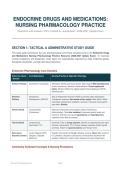
ENDOCRINE DRUGS AND MEDICATIONS:
NURSING PHARMACOLOGY PRACTICE
Questions and Answers 100% Verified A+ Guaranteed • 2026-2027 Update Exam
SECTION 1: TACTICAL & ADMINISTRATIVE STUDY GUIDE
This study guide summarizes the core pharmacological and clinical concepts found in the Endocrine Drugs
and Medications Nursing Pharmacology Practice Resource (2026-2027 Update Exam). To maximize
nursing competency and preparation, study topics are systematically organized by major endocrine glands,
therapeutic procedures, and high-alert drug interactions.
Endocrine Pharmacology Core Domains
Endocrine Gland Core Medications Nursing Priorities & High-Alert Warnings
/ Domain
Anterior Pituitary Somatropin (Humatrope) Stimulates skeletal and tissue growth. Main hazard: Mild hyperglycemia
(insulin resistance). Absolute contraindication: Closed epiphyseal
plates. Monitor children for slipped capital femoral epiphysis (SCFE)
(hip/knee pain).
Posterior Vasopressin, Acts as Antidiuretic Hormone (ADH) to promote water reabsorption.
Pituitary Desmopressin (DDAVP) Therapeutic response: Decreased urinary output. Side effects: Water
intoxication (drowsiness, headache, seizures). Intranasal route specific
side effect: Rhinitis.
Adrenal Gland Corticosteroids Reduces inflammation and replaces adrenal insufficiency.
(Prednisone) Administration: Take after breakfast to decrease gastric upset and
insomnia. Warning: Can cause hypokalemia and hyperglycemia
(requires insulin dose increases).
Thyroid Gland Levothyroxine Synthroid: Take on empty stomach. Monitor for hyperthyroid toxic signs
(Synthroid), PTU (tremors, tachycardia). PTU: Graves' disease treatment; blocks thyroid
synthesis. Watch for agranulocytosis (sore throat, fever).
Pancreas & Insulin (Regular, NPH, Regular: Only insulin for IV use. Glargine (Lantus): Never mix, onset 2-4
Glycemic Control Glargine), Glipizide, hrs, peakless. Glipizide (sulfonylurea): Avoid alcohol (disulfiram-like
Metformin reaction). Metformin: Hold for lactic acidosis risk (renal impairment).
Commonly Confused Concepts & Nursing Procedures
Nursing Pharmacology Series Page 1
, •
Regular vs. NPH Mixing Sequence: When drawing both insulins into a single syringe, the sequence must
always be Regular (clear) before NPH (cloudy). Inject air into NPH first, then regular, withdraw regular,
then withdraw NPH to prevent contaminating the regular vial.
•
Somatropin vs. Vasopressin: Somatropin is growth hormone used for growth deficiency (Turner
syndrome); vasopressin is antidiuretic hormone (ADH) used for diabetes insipidus to retain water and
concentrate urine.
•
Drug Interactions with Thyroid Hormone: Thyroid hormone replacements (Synthroid) decrease the action
of oral hypoglycemics (Metformin), but increase the action of anticoagulants (Warfarin) and
sympathomimetics (Epinephrine).
•
Sildenafil Contraindications: Viagra (sildenafil) acts as a vasodilator. When taken with nitrates or
nitroprusside, it triggers catastrophic, severe arterial hypotension.
Nursing Pharmacology Series Page 2
, ENDOCRINE DRUGS & MEDICATIONS STUDY GUIDE 2026-2027 UPDATE EXAM
SECTION 2: PRACTICE EXAM TEST BANK (50 QUESTIONS)
This section contains exactly 50 high-quality, comprehensive multiple-choice questions distributed across
all major chapters of endocrine pharmacology. The questions are structured to model actual NCLEX-RN and
HESI nursing examination parameters. Each question block is designed as an independent unit to facilitate
visual focus and clarity.
Question 1: Humatrope (somatropin) is being given to a female patient with Turner syndrome.
Which of the following clinical findings is associated with the administration of this
medication?
A. Decreased alanine aminotransferase (ALT) and aspartate aminotransferase (AST) levels
B. Mild hyperglycemia
C. Acute hypotension
D. Systemic water intoxication
ANSWER : B — Mild hyperglycemia
Explanation: Humatrope (somatropin) is a recombinant human growth hormone. An excess of growth
hormone induces insulin resistance and can cause mild hyperglycemia. Thus, blood glucose levels
should be monitored. Elevated AST and ALT are expected (Option A). Hypertension, not hypotension, is a
potential side effect (Option C). Water intoxication is not directly associated with somatropin therapy
(Option D).
Question 2: A nurse provides instructions to a client regarding the administration of oral
prednisone. The nurse instructs the client that the best time to take the medication is during
which of the following times?
A. Directly before breakfast
B. After breakfast
C. Late evening
D. Directly before bedtime
ANSWER : B — After breakfast
Explanation: Prednisone is a corticosteroid (glucocorticoid) that can cause significant gastric irritation.
Taking it after a meal (like breakfast) reduces gastric upset. Furthermore, administering it early in the
morning mimics the natural diurnal burst of glucocorticoids released by the adrenal glands, minimizing
the risk of adrenal insufficiency and avoiding insomnia (which makes evening/bedtime dosing
undesirable).
Nursing Pharmacology Practice Test Bank Page 3
NURSING PHARMACOLOGY PRACTICE
Questions and Answers 100% Verified A+ Guaranteed • 2026-2027 Update Exam
SECTION 1: TACTICAL & ADMINISTRATIVE STUDY GUIDE
This study guide summarizes the core pharmacological and clinical concepts found in the Endocrine Drugs
and Medications Nursing Pharmacology Practice Resource (2026-2027 Update Exam). To maximize
nursing competency and preparation, study topics are systematically organized by major endocrine glands,
therapeutic procedures, and high-alert drug interactions.
Endocrine Pharmacology Core Domains
Endocrine Gland Core Medications Nursing Priorities & High-Alert Warnings
/ Domain
Anterior Pituitary Somatropin (Humatrope) Stimulates skeletal and tissue growth. Main hazard: Mild hyperglycemia
(insulin resistance). Absolute contraindication: Closed epiphyseal
plates. Monitor children for slipped capital femoral epiphysis (SCFE)
(hip/knee pain).
Posterior Vasopressin, Acts as Antidiuretic Hormone (ADH) to promote water reabsorption.
Pituitary Desmopressin (DDAVP) Therapeutic response: Decreased urinary output. Side effects: Water
intoxication (drowsiness, headache, seizures). Intranasal route specific
side effect: Rhinitis.
Adrenal Gland Corticosteroids Reduces inflammation and replaces adrenal insufficiency.
(Prednisone) Administration: Take after breakfast to decrease gastric upset and
insomnia. Warning: Can cause hypokalemia and hyperglycemia
(requires insulin dose increases).
Thyroid Gland Levothyroxine Synthroid: Take on empty stomach. Monitor for hyperthyroid toxic signs
(Synthroid), PTU (tremors, tachycardia). PTU: Graves' disease treatment; blocks thyroid
synthesis. Watch for agranulocytosis (sore throat, fever).
Pancreas & Insulin (Regular, NPH, Regular: Only insulin for IV use. Glargine (Lantus): Never mix, onset 2-4
Glycemic Control Glargine), Glipizide, hrs, peakless. Glipizide (sulfonylurea): Avoid alcohol (disulfiram-like
Metformin reaction). Metformin: Hold for lactic acidosis risk (renal impairment).
Commonly Confused Concepts & Nursing Procedures
Nursing Pharmacology Series Page 1
, •
Regular vs. NPH Mixing Sequence: When drawing both insulins into a single syringe, the sequence must
always be Regular (clear) before NPH (cloudy). Inject air into NPH first, then regular, withdraw regular,
then withdraw NPH to prevent contaminating the regular vial.
•
Somatropin vs. Vasopressin: Somatropin is growth hormone used for growth deficiency (Turner
syndrome); vasopressin is antidiuretic hormone (ADH) used for diabetes insipidus to retain water and
concentrate urine.
•
Drug Interactions with Thyroid Hormone: Thyroid hormone replacements (Synthroid) decrease the action
of oral hypoglycemics (Metformin), but increase the action of anticoagulants (Warfarin) and
sympathomimetics (Epinephrine).
•
Sildenafil Contraindications: Viagra (sildenafil) acts as a vasodilator. When taken with nitrates or
nitroprusside, it triggers catastrophic, severe arterial hypotension.
Nursing Pharmacology Series Page 2
, ENDOCRINE DRUGS & MEDICATIONS STUDY GUIDE 2026-2027 UPDATE EXAM
SECTION 2: PRACTICE EXAM TEST BANK (50 QUESTIONS)
This section contains exactly 50 high-quality, comprehensive multiple-choice questions distributed across
all major chapters of endocrine pharmacology. The questions are structured to model actual NCLEX-RN and
HESI nursing examination parameters. Each question block is designed as an independent unit to facilitate
visual focus and clarity.
Question 1: Humatrope (somatropin) is being given to a female patient with Turner syndrome.
Which of the following clinical findings is associated with the administration of this
medication?
A. Decreased alanine aminotransferase (ALT) and aspartate aminotransferase (AST) levels
B. Mild hyperglycemia
C. Acute hypotension
D. Systemic water intoxication
ANSWER : B — Mild hyperglycemia
Explanation: Humatrope (somatropin) is a recombinant human growth hormone. An excess of growth
hormone induces insulin resistance and can cause mild hyperglycemia. Thus, blood glucose levels
should be monitored. Elevated AST and ALT are expected (Option A). Hypertension, not hypotension, is a
potential side effect (Option C). Water intoxication is not directly associated with somatropin therapy
(Option D).
Question 2: A nurse provides instructions to a client regarding the administration of oral
prednisone. The nurse instructs the client that the best time to take the medication is during
which of the following times?
A. Directly before breakfast
B. After breakfast
C. Late evening
D. Directly before bedtime
ANSWER : B — After breakfast
Explanation: Prednisone is a corticosteroid (glucocorticoid) that can cause significant gastric irritation.
Taking it after a meal (like breakfast) reduces gastric upset. Furthermore, administering it early in the
morning mimics the natural diurnal burst of glucocorticoids released by the adrenal glands, minimizing
the risk of adrenal insufficiency and avoiding insomnia (which makes evening/bedtime dosing
undesirable).
Nursing Pharmacology Practice Test Bank Page 3