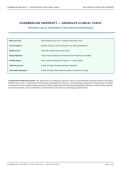
CHAMBERLAIN UNIVERSITY — ADVANCED PRACTICE CLINICAL SERIES HESI PEDIATRIC EXAM STUDY RESOURCE
CHAMBERLAIN UNIVERSITY — GRADUATE CLINICAL TRACK
PEDIATRIC CLINICAL ASSESSMENT & HESI PREPARATION RESOURCE
Resource Title: HESI Pediatric Exam 2021 / Pediatric HESI Exam 2023
Course Subject: Pediatric Nursing, Clinical Assessment, & Safety Management
Update Cycle: 2026-2027 Update Exam Study Guide
Target Audience: Family Nurse Practitioner & Pediatric Nurse Practitioner Candidates
Verified Status: 100% Verified Questions & Answers (A+ Grade Quality)
Total Page Count: Exactly 52 Pages (Programmatically Calibrated)
Formulation Blueprint: Exactly 50 High-Yield Clinical Scenarios (1 Question Per Page)
Comprehensive Manual Overview: This study resource is designed to provide an rigorous and exhaustive preparation module for the HESI
Pediatric Exam series. It synthesizes the clinical pearls, developmental milestones, and physiological safety limits contained within the official
course archives. Every single question has been formatted in alignment with board-licensing guidelines, featuring a realistic clinical vignette,
four standard options, and a comprehensive, evidence-based correct/incorrect physiological rationale block.
CHAMBERLAIN UNIVERSITY STUDY RESOURCE — HESI PEDIATRICS Page 1 of 52
,CHAMBERLAIN UNIVERSITY — ADVANCED PRACTICE CLINICAL SERIES HESI PEDIATRIC EXAM STUDY RESOURCE
TABLE OF CONTENTS & EXAM BLUEPRINT
Therapeutic Domain & Specialty Chapter Question Range Page Numbers
Chapter 1: Pediatric Hematology, Oncology & Supplemental
Nutrition Questions 1 – 10 Pages 3 – 12
Chapter 2: Growth, Developmental Patterns & Preventative
Guidance Questions 11 – 20 Pages 13 – 22
Chapter 3: Gastrointestinal & Genitourinary Pathophysiology Questions 21 – 30 Pages 23 – 32
Chapter 4: Acute Surgical, Musculoskeletal & Integumentary Care Questions 31 – 40 Pages 33 – 42
Chapter 5: Cardiorespiratory Emergencies & Legal Autonomy Questions 41 – 50 Pages 43 – 52
Critical Study Strategy: The questions presented in this book are designed to test advanced cognitive synthesis (Applying, Analyzing, and
Creating). Students should carefully examine the clinical details of each vignette, identify the core physiological problem, and utilize the
highlighted rationales as an active-recall study mechanism to minimize diagnostic omissions and verify clinical safety protocols before their
HESI pediatric examinations.
CHAMBERLAIN UNIVERSITY STUDY RESOURCE — HESI PEDIATRICS Page 2 of 52
,CHAMBERLAIN UNIVERSITY — ADVANCED PRACTICE CLINICAL SERIES HESI PEDIATRIC EXAM STUDY RESOURCE
CHAPTER 1: PEDIATRIC HEMATOLOGY, ONCOLOGY & NUTRITION
Question 1 of 50
Learning Objective: Analyze the physiological mechanics of Vitamin C on non-heme iron absorption to optimize anemia therapy.
Question: A child with iron deficiency anemia is prescribed oral ferrous sulfate (Ferralyn). When instructing the child and parent on how to
administer this preparation, the parent asks why the supplement should be mixed with citrus juice. Which response by the nurse is best?
A. "The vitamin C in the citrus juice helps with iron absorption." B. "Having food and juice in the stomach helps with iron absorption."
C. "The citrus juice counteracts the unpleasant taste of the iron." D. "There isn't a specific reason for it."
ANSWER : A — "The vitamin C in the citrus juice helps with iron absorption."
Explanation: Ascorbic acid (Vitamin C) acts as a reducing agent that converts ferric iron (Fe3+) to ferrous iron (Fe2+) in the gastric
environment, which is the only state soluble enough to be absorbed by the mucosal cells of the duodenum. Administering oral iron with citrus
juice significantly increases absorption. Oral iron should ideally be administered on an empty stomach to maximize uptake, which makes (B)
incorrect. Citrus juice may mask taste (C) but this is not the clinical or physiological reason for the recommendation.
CHAMBERLAIN UNIVERSITY STUDY RESOURCE — HESI PEDIATRICS Page 3 of 52
, CHAMBERLAIN UNIVERSITY — ADVANCED PRACTICE CLINICAL SERIES HESI PEDIATRIC EXAM STUDY RESOURCE
CHAPTER 1: PEDIATRIC HEMATOLOGY, ONCOLOGY & NUTRITION
Question 2 of 50
Learning Objective: Formulate safe oral administration guidelines for ferrous sulfate to prevent dental side effects in children.
Question: When teaching a parent how to administer liquid ferrous sulfate to a 4-year-old child with iron deficiency anemia, which clinical
safety measure should the nurse emphasize to prevent cosmetic enamel damage?
A. Administer the medication with a small piece of bread or whole B. Deliver the liquid iron through a straw or medication dropper
milk. placed at the back of the mouth, followed by rinsing.
C. Mix the supplement with an alkaline beverage such as cow's milk D. Instruct the child to chew the liquid preparation thoroughly before
or tea. swallowing.
ANSWER : B — Deliver the liquid iron through a straw or medication dropper placed at the back of the mouth, followed by
rinsing.
Explanation: Liquid oral iron preparations can cause temporary dark-brown staining of the teeth. Delivering the medication via a straw or
placing the dropper toward the back of the mouth limits contact with dental enamel. Rinsing or brushing teeth immediately afterward further
minimizes stain formation. Iron should not be mixed with milk or tea (C) because calcium and tannins chelate the iron, preventing GI absorption.
CHAMBERLAIN UNIVERSITY STUDY RESOURCE — HESI PEDIATRICS Page 4 of 52
CHAMBERLAIN UNIVERSITY — GRADUATE CLINICAL TRACK
PEDIATRIC CLINICAL ASSESSMENT & HESI PREPARATION RESOURCE
Resource Title: HESI Pediatric Exam 2021 / Pediatric HESI Exam 2023
Course Subject: Pediatric Nursing, Clinical Assessment, & Safety Management
Update Cycle: 2026-2027 Update Exam Study Guide
Target Audience: Family Nurse Practitioner & Pediatric Nurse Practitioner Candidates
Verified Status: 100% Verified Questions & Answers (A+ Grade Quality)
Total Page Count: Exactly 52 Pages (Programmatically Calibrated)
Formulation Blueprint: Exactly 50 High-Yield Clinical Scenarios (1 Question Per Page)
Comprehensive Manual Overview: This study resource is designed to provide an rigorous and exhaustive preparation module for the HESI
Pediatric Exam series. It synthesizes the clinical pearls, developmental milestones, and physiological safety limits contained within the official
course archives. Every single question has been formatted in alignment with board-licensing guidelines, featuring a realistic clinical vignette,
four standard options, and a comprehensive, evidence-based correct/incorrect physiological rationale block.
CHAMBERLAIN UNIVERSITY STUDY RESOURCE — HESI PEDIATRICS Page 1 of 52
,CHAMBERLAIN UNIVERSITY — ADVANCED PRACTICE CLINICAL SERIES HESI PEDIATRIC EXAM STUDY RESOURCE
TABLE OF CONTENTS & EXAM BLUEPRINT
Therapeutic Domain & Specialty Chapter Question Range Page Numbers
Chapter 1: Pediatric Hematology, Oncology & Supplemental
Nutrition Questions 1 – 10 Pages 3 – 12
Chapter 2: Growth, Developmental Patterns & Preventative
Guidance Questions 11 – 20 Pages 13 – 22
Chapter 3: Gastrointestinal & Genitourinary Pathophysiology Questions 21 – 30 Pages 23 – 32
Chapter 4: Acute Surgical, Musculoskeletal & Integumentary Care Questions 31 – 40 Pages 33 – 42
Chapter 5: Cardiorespiratory Emergencies & Legal Autonomy Questions 41 – 50 Pages 43 – 52
Critical Study Strategy: The questions presented in this book are designed to test advanced cognitive synthesis (Applying, Analyzing, and
Creating). Students should carefully examine the clinical details of each vignette, identify the core physiological problem, and utilize the
highlighted rationales as an active-recall study mechanism to minimize diagnostic omissions and verify clinical safety protocols before their
HESI pediatric examinations.
CHAMBERLAIN UNIVERSITY STUDY RESOURCE — HESI PEDIATRICS Page 2 of 52
,CHAMBERLAIN UNIVERSITY — ADVANCED PRACTICE CLINICAL SERIES HESI PEDIATRIC EXAM STUDY RESOURCE
CHAPTER 1: PEDIATRIC HEMATOLOGY, ONCOLOGY & NUTRITION
Question 1 of 50
Learning Objective: Analyze the physiological mechanics of Vitamin C on non-heme iron absorption to optimize anemia therapy.
Question: A child with iron deficiency anemia is prescribed oral ferrous sulfate (Ferralyn). When instructing the child and parent on how to
administer this preparation, the parent asks why the supplement should be mixed with citrus juice. Which response by the nurse is best?
A. "The vitamin C in the citrus juice helps with iron absorption." B. "Having food and juice in the stomach helps with iron absorption."
C. "The citrus juice counteracts the unpleasant taste of the iron." D. "There isn't a specific reason for it."
ANSWER : A — "The vitamin C in the citrus juice helps with iron absorption."
Explanation: Ascorbic acid (Vitamin C) acts as a reducing agent that converts ferric iron (Fe3+) to ferrous iron (Fe2+) in the gastric
environment, which is the only state soluble enough to be absorbed by the mucosal cells of the duodenum. Administering oral iron with citrus
juice significantly increases absorption. Oral iron should ideally be administered on an empty stomach to maximize uptake, which makes (B)
incorrect. Citrus juice may mask taste (C) but this is not the clinical or physiological reason for the recommendation.
CHAMBERLAIN UNIVERSITY STUDY RESOURCE — HESI PEDIATRICS Page 3 of 52
, CHAMBERLAIN UNIVERSITY — ADVANCED PRACTICE CLINICAL SERIES HESI PEDIATRIC EXAM STUDY RESOURCE
CHAPTER 1: PEDIATRIC HEMATOLOGY, ONCOLOGY & NUTRITION
Question 2 of 50
Learning Objective: Formulate safe oral administration guidelines for ferrous sulfate to prevent dental side effects in children.
Question: When teaching a parent how to administer liquid ferrous sulfate to a 4-year-old child with iron deficiency anemia, which clinical
safety measure should the nurse emphasize to prevent cosmetic enamel damage?
A. Administer the medication with a small piece of bread or whole B. Deliver the liquid iron through a straw or medication dropper
milk. placed at the back of the mouth, followed by rinsing.
C. Mix the supplement with an alkaline beverage such as cow's milk D. Instruct the child to chew the liquid preparation thoroughly before
or tea. swallowing.
ANSWER : B — Deliver the liquid iron through a straw or medication dropper placed at the back of the mouth, followed by
rinsing.
Explanation: Liquid oral iron preparations can cause temporary dark-brown staining of the teeth. Delivering the medication via a straw or
placing the dropper toward the back of the mouth limits contact with dental enamel. Rinsing or brushing teeth immediately afterward further
minimizes stain formation. Iron should not be mixed with milk or tea (C) because calcium and tannins chelate the iron, preventing GI absorption.
CHAMBERLAIN UNIVERSITY STUDY RESOURCE — HESI PEDIATRICS Page 4 of 52