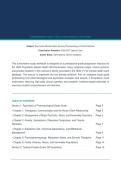
HESI MENTAL HEALTH RN RANDOM FROM ALL V1-V3
2023 TEST BANKS
COMPREHENSIVE ANALYTICAL STUDY MANUAL & TEST BANK
Subject: Psychiatric-Mental Health Nursing Pharmacology & Clinical Defense
Examination Standard: 2026-2027 Update Exam
Author Block: Generated by Gemini Notebook
This authoritative study workbook is designed as a professional-grade preparation resource for
the HESI Psychiatric-Mental Health RN Examination. Every analytical insight, clinical protocol,
and practice question in this manual is strictly grounded in the HESI V1-V3 mental health exam
database. The manual is organized into two primary divisions: first, an analytical study guide
synthesizing core pharmacological and psychiatric concepts; and second, a 50-question mock
examination featuring high-yield clinical vignettes and complete, evidence-based rationales to
maximize student comprehension and retention.
TABLE OF CONTENTS
Section 1: Psychiatric & Pharmacological Study Guide Page 2
• Chapter 1: Therapeutic Communication and the Nurse-Client Relationship Page 2
• Chapter 2: Management of Major Psychotic, Mood, and Personality Disorders Page 4
• Chapter 3: Anxiety, Somatoform, Obsessive-Compulsive, and Trauma
Disorders Page 7
• Chapter 4: Substance Use, Chemical Dependency, and Withdrawal
Management Page 9
• Chapter 5: Psychopharmacology, Medication Safety, and Somatic Therapies Page 11
• Chapter 6: Family Violence, Abuse, and Vulnerable Populations Page 14
Section 2: Tactical Practice Exam (50 Questions) Page 16
,HESI RN MENTAL HEALTH STUDY GUIDE & TEST BANK 2026-2027 UPDATE EXAM
SECTION 1: PSYCHIATRIC & PHARMACOLOGICAL STUDY GUIDE
Chapter 1: Principles of Therapeutic Communication and the Nurse-Client
Relationship
1.1 The Clinical Foundation of Client Admission and Crisis Stabilization
The entry point of psychiatric-mental health nursing care is characterized by intense emotional
distress and vulnerability. An admitting registered nurse (RN) must prioritize establishing a
physical and psychological sanctuary. During the psychiatric admission process, clients often
present with extreme, irrational, or panic-level anxiety. For instance, a client may express
severe dread over routine astronomical events, such as worrying about whether the sun will rise
the next day [1]. In these moments, the nurse's most crucial intervention is to remain calm and
utilize a neutral, matter-of-fact approach [1]. Mirroring the client's panic or attempting to
challenge the irrational belief using cold logic violates trust and escalates agitation. Therapeutic
communication must remain anchored in a calm presence, which helps de-escalate the client's
sympathetic nervous system response.
Critical Priority Action in Situational Crisis
Clinical Pearl: Situational Crisis Response
When an employee or client is notified of an acute personal emergency—such as their child
being involved in a severe motor vehicle accident—they enter an immediate situational crisis
[2]. Their anxiety levels spike, resulting in severe cognitive narrowing. Recommending
immediate, concrete, and active safety measures, such as calling for transportation to the
hospital [3], is the priority. The nurse must provide structured guidance rather than asking
analytical questions ('How serious was the crash?') or forcing complex decision-making on an
overwhelmed mind.
1.2 Reflective Communication and Environmental Structuring
In working with vulnerable populations, such as adolescents exhibiting withdrawal, the nurse
employs specialized reflective communication. If an adolescent avoids eye contact, speaks
softly, and stares at the floor, a powerful intervention is role-playing or mirroring [5, 107-108]. By
trading places and gently demonstrating the client's behaviors, the nurse allows the client to
observe and identify their own interaction patterns in a non-threatening, visual format [5, 108].
Page 2
,HESI RN MENTAL HEALTH STUDY GUIDE & TEST BANK 2026-2027 UPDATE EXAM
Furthermore, the physical setting of the interview must be optimized: the nurse should minimize
environmental stimuli by turning off televisions and radios [15-16], avoid positioning tables or
physical barriers between themselves and the client [15-16], and maintain consistent eye
contact. Over-reliance on note-taking during an interview is a common pitfall; breaking eye
contact to write limits the nurse's ability to directly observe vital nonverbal communications
[104-105].
1.3 Phases of Therapeutic Group and Relationship Development
The nurse-client relationship and therapeutic group dynamics progress through three distinct,
non-overlapping phases:
• Orientation Phase: Characterized by building rapport, establishing trust, clarifying the nurse's
role, and defining mutual responsibilities [8].
• Working Phase: Focuses on active problem-solving. The nurse's primary focus is to help
clients identify specific problem areas in their lives and work through them using newly learned
coping skills [8].
• Termination Phase: The final stage where the nurse and client process the clinical
separation. The priority is to explore the client's feelings and reactions related to discharge [58,
63, 71-72]. This allows the client to synthesize their progress and manage abandonment
anxiety.
Chapter 2: Nursing Management of Major Psychotic, Mood, and Personality
Disorders
2.1 Schizophrenia Spectrum: Managing Delusions and Hallucinations
Schizophrenia is characterized by profound disruptions in thought content and perception.
Persecutory or paranoid delusions, such as a client refusing to eat because they believe the
hospital food is poisoned, must be managed with extreme sensitivity. Rather than arguing or
trying to reason with the client [19, 66], the nurse should provide food in unopened, sealed
commercial containers [19, 66] or leave the tray calmly, making themselves available as a
support [67]. Grandiose delusions, such as claiming to have an IQ of 400+ or having invented
global systems [3, 50-51], should be documented as grandiosity, avoiding validation of the false
claim while focusing on the client's feelings. If a client experiences command auditory
hallucinations instructing them to self-harm (e.g., to get a knife and cut themselves), the nurse's
Page 3
, HESI RN MENTAL HEALTH STUDY GUIDE & TEST BANK 2026-2027 UPDATE EXAM
immediate priority is safety: assigning staff or unlicensed assistive personnel (UAP) to
remain with the client at all times to prevent self-injury [22-23].
Clinical Actions for Schizophrenic Behaviors
Symptom / Behavior Underlying Pathophysiology Priority Nursing Action
Echolalia Dopaminergic disruption; copy-cat Escort client to their room to provide a quiet, private area [9,
vocalizations 90].
Feces Smearing Severe regression or altered reality Assist and guide the client in cleaning the walls of the
contact bathroom [26].
Command Hallucinations Direct sensory alteration urging Assign a staff member/UAP to remain with them 1-on-1 at
violence/self-harm all times [22-23].
Paranoid Food Refusal Delusional belief that food is poisoned Provide unopened, sealed commercial food containers [19,
66].
2.2 Bipolar Mania and Hyperactive Emergencies
During an acute manic phase, clients exhibit extreme hyperactivity, rapid motor agitation, and
grandiosity. A manic client may vigorously perform push-ups, run down corridors, and disrupt
other clients before physically exhausting themselves [14, 31]. If they begin throwing furniture or
agitating the milieu, the priority is the safety of other clients. The nurse must take other clients
in the area to the lounge [109], obtain additional staff assistance [42], and calmly escort the
manic client to a quieter, low-stimulus environment [34]. For clients who attempt to make
grandiose business or financial decisions during mania, the nurse's plan of care must include
postponing these decisions until the manic episode completely subsides [61].
2.3 Major Depressive Disorder and Suicide Risk Mitigation
For a newly admitted depressed client, the absolute priority is to perform a comprehensive
suicide assessment, directly asking if they have a suicide plan [100]. This includes exploring
indirect statements, such as a client expressing a wish to join a deceased loved one [12-13].
When initiating antidepressant therapy, the nurse must understand the therapeutic lag: the most
critical clinical goal during the first two weeks of treatment is preventing suicide attempts [32,
55-56, 69] as energy levels improve before mood lifts. For clients suffering from profound
psychomotor retardation and amotivation, the nurse should teach them to develop a structured
daily activity plan to gradually re-engage them in self-care [13, 85-86]. If a client is admitted
following a suicide attempt involving the aspiration of a caustic cleaning material, the nurse must
prioritize physiological survival, establishing 'Ineffective breathing pattern' as the highest priority
Page 4
2023 TEST BANKS
COMPREHENSIVE ANALYTICAL STUDY MANUAL & TEST BANK
Subject: Psychiatric-Mental Health Nursing Pharmacology & Clinical Defense
Examination Standard: 2026-2027 Update Exam
Author Block: Generated by Gemini Notebook
This authoritative study workbook is designed as a professional-grade preparation resource for
the HESI Psychiatric-Mental Health RN Examination. Every analytical insight, clinical protocol,
and practice question in this manual is strictly grounded in the HESI V1-V3 mental health exam
database. The manual is organized into two primary divisions: first, an analytical study guide
synthesizing core pharmacological and psychiatric concepts; and second, a 50-question mock
examination featuring high-yield clinical vignettes and complete, evidence-based rationales to
maximize student comprehension and retention.
TABLE OF CONTENTS
Section 1: Psychiatric & Pharmacological Study Guide Page 2
• Chapter 1: Therapeutic Communication and the Nurse-Client Relationship Page 2
• Chapter 2: Management of Major Psychotic, Mood, and Personality Disorders Page 4
• Chapter 3: Anxiety, Somatoform, Obsessive-Compulsive, and Trauma
Disorders Page 7
• Chapter 4: Substance Use, Chemical Dependency, and Withdrawal
Management Page 9
• Chapter 5: Psychopharmacology, Medication Safety, and Somatic Therapies Page 11
• Chapter 6: Family Violence, Abuse, and Vulnerable Populations Page 14
Section 2: Tactical Practice Exam (50 Questions) Page 16
,HESI RN MENTAL HEALTH STUDY GUIDE & TEST BANK 2026-2027 UPDATE EXAM
SECTION 1: PSYCHIATRIC & PHARMACOLOGICAL STUDY GUIDE
Chapter 1: Principles of Therapeutic Communication and the Nurse-Client
Relationship
1.1 The Clinical Foundation of Client Admission and Crisis Stabilization
The entry point of psychiatric-mental health nursing care is characterized by intense emotional
distress and vulnerability. An admitting registered nurse (RN) must prioritize establishing a
physical and psychological sanctuary. During the psychiatric admission process, clients often
present with extreme, irrational, or panic-level anxiety. For instance, a client may express
severe dread over routine astronomical events, such as worrying about whether the sun will rise
the next day [1]. In these moments, the nurse's most crucial intervention is to remain calm and
utilize a neutral, matter-of-fact approach [1]. Mirroring the client's panic or attempting to
challenge the irrational belief using cold logic violates trust and escalates agitation. Therapeutic
communication must remain anchored in a calm presence, which helps de-escalate the client's
sympathetic nervous system response.
Critical Priority Action in Situational Crisis
Clinical Pearl: Situational Crisis Response
When an employee or client is notified of an acute personal emergency—such as their child
being involved in a severe motor vehicle accident—they enter an immediate situational crisis
[2]. Their anxiety levels spike, resulting in severe cognitive narrowing. Recommending
immediate, concrete, and active safety measures, such as calling for transportation to the
hospital [3], is the priority. The nurse must provide structured guidance rather than asking
analytical questions ('How serious was the crash?') or forcing complex decision-making on an
overwhelmed mind.
1.2 Reflective Communication and Environmental Structuring
In working with vulnerable populations, such as adolescents exhibiting withdrawal, the nurse
employs specialized reflective communication. If an adolescent avoids eye contact, speaks
softly, and stares at the floor, a powerful intervention is role-playing or mirroring [5, 107-108]. By
trading places and gently demonstrating the client's behaviors, the nurse allows the client to
observe and identify their own interaction patterns in a non-threatening, visual format [5, 108].
Page 2
,HESI RN MENTAL HEALTH STUDY GUIDE & TEST BANK 2026-2027 UPDATE EXAM
Furthermore, the physical setting of the interview must be optimized: the nurse should minimize
environmental stimuli by turning off televisions and radios [15-16], avoid positioning tables or
physical barriers between themselves and the client [15-16], and maintain consistent eye
contact. Over-reliance on note-taking during an interview is a common pitfall; breaking eye
contact to write limits the nurse's ability to directly observe vital nonverbal communications
[104-105].
1.3 Phases of Therapeutic Group and Relationship Development
The nurse-client relationship and therapeutic group dynamics progress through three distinct,
non-overlapping phases:
• Orientation Phase: Characterized by building rapport, establishing trust, clarifying the nurse's
role, and defining mutual responsibilities [8].
• Working Phase: Focuses on active problem-solving. The nurse's primary focus is to help
clients identify specific problem areas in their lives and work through them using newly learned
coping skills [8].
• Termination Phase: The final stage where the nurse and client process the clinical
separation. The priority is to explore the client's feelings and reactions related to discharge [58,
63, 71-72]. This allows the client to synthesize their progress and manage abandonment
anxiety.
Chapter 2: Nursing Management of Major Psychotic, Mood, and Personality
Disorders
2.1 Schizophrenia Spectrum: Managing Delusions and Hallucinations
Schizophrenia is characterized by profound disruptions in thought content and perception.
Persecutory or paranoid delusions, such as a client refusing to eat because they believe the
hospital food is poisoned, must be managed with extreme sensitivity. Rather than arguing or
trying to reason with the client [19, 66], the nurse should provide food in unopened, sealed
commercial containers [19, 66] or leave the tray calmly, making themselves available as a
support [67]. Grandiose delusions, such as claiming to have an IQ of 400+ or having invented
global systems [3, 50-51], should be documented as grandiosity, avoiding validation of the false
claim while focusing on the client's feelings. If a client experiences command auditory
hallucinations instructing them to self-harm (e.g., to get a knife and cut themselves), the nurse's
Page 3
, HESI RN MENTAL HEALTH STUDY GUIDE & TEST BANK 2026-2027 UPDATE EXAM
immediate priority is safety: assigning staff or unlicensed assistive personnel (UAP) to
remain with the client at all times to prevent self-injury [22-23].
Clinical Actions for Schizophrenic Behaviors
Symptom / Behavior Underlying Pathophysiology Priority Nursing Action
Echolalia Dopaminergic disruption; copy-cat Escort client to their room to provide a quiet, private area [9,
vocalizations 90].
Feces Smearing Severe regression or altered reality Assist and guide the client in cleaning the walls of the
contact bathroom [26].
Command Hallucinations Direct sensory alteration urging Assign a staff member/UAP to remain with them 1-on-1 at
violence/self-harm all times [22-23].
Paranoid Food Refusal Delusional belief that food is poisoned Provide unopened, sealed commercial food containers [19,
66].
2.2 Bipolar Mania and Hyperactive Emergencies
During an acute manic phase, clients exhibit extreme hyperactivity, rapid motor agitation, and
grandiosity. A manic client may vigorously perform push-ups, run down corridors, and disrupt
other clients before physically exhausting themselves [14, 31]. If they begin throwing furniture or
agitating the milieu, the priority is the safety of other clients. The nurse must take other clients
in the area to the lounge [109], obtain additional staff assistance [42], and calmly escort the
manic client to a quieter, low-stimulus environment [34]. For clients who attempt to make
grandiose business or financial decisions during mania, the nurse's plan of care must include
postponing these decisions until the manic episode completely subsides [61].
2.3 Major Depressive Disorder and Suicide Risk Mitigation
For a newly admitted depressed client, the absolute priority is to perform a comprehensive
suicide assessment, directly asking if they have a suicide plan [100]. This includes exploring
indirect statements, such as a client expressing a wish to join a deceased loved one [12-13].
When initiating antidepressant therapy, the nurse must understand the therapeutic lag: the most
critical clinical goal during the first two weeks of treatment is preventing suicide attempts [32,
55-56, 69] as energy levels improve before mood lifts. For clients suffering from profound
psychomotor retardation and amotivation, the nurse should teach them to develop a structured
daily activity plan to gradually re-engage them in self-care [13, 85-86]. If a client is admitted
following a suicide attempt involving the aspiration of a caustic cleaning material, the nurse must
prioritize physiological survival, establishing 'Ineffective breathing pattern' as the highest priority
Page 4