
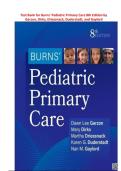
Test Bank for Burns' Pediatric Primary Care, 8th Edition by Dawn Lee Garzon, Mary Dirks, Martha Driessnack, Karen G. Duderstadt, and Nan M. Gaylord.
Prepare for pediatric primary care, nursing, nurse practitioner, and advanced clinical coursework with this comprehensive Test Bank for Burns' Pediatric Primary Care, 8th Edition by Dawn Lee Garzon, Mary Dirks, Martha Driessnack, Karen G. Duderstadt, and Nan M. Gaylord. This supplementary study resource is designed to help students review important pediatric primary care concepts, strengthen clinical reasoning, and practice applying assessment and management principles to children and adolescents. The 8th edition provides a broad foundation in pediatric primary care and addresses health promotion, disease prevention, assessment, management, and referral considerations across childhood and adolescence. The text includes developmental principles, family assessment, nutrition, breastfeeding, sleep, elimination, physical activity, immunizations, injury prevention, child maltreatment, pediatric pain and fever management, toxic exposures, palliative care, and numerous pediatric health conditions. Comprehensive Pediatric Primary Care Review Pediatric primary care requires healthcare professionals to understand normal growth and development while recognizing signs of illness and developmental concerns. This study resource can help learners review important pediatric concepts in an organized question-based format. Students can use practice questions to reinforce knowledge of pediatric assessment, developmental milestones, health promotion, disease prevention, clinical management, patient education, and family-centered care. Regular question practice can also help students identify areas where additional review is needed. Pediatric Assessment and Health History Accurate pediatric assessment is fundamental to primary care. Unlike adult patients, children may have age-specific communication needs, developmental considerations, and unique physical findings. Students can review concepts related to pediatric and family assessment, health histories, physical examinations, developmental evaluation, screening, and recognition of abnormal findings. Practice questions can help learners connect assessment information with appropriate clinical decisions. Growth and Development Growth and development are central components of pediatric primary care. Children experience substantial physical, cognitive, emotional, and social changes from infancy through adolescence. The 8th edition includes developmental management of newborns and neonates, infants, early childhood, middle childhood, and adolescents. Students can use practice questions to review developmental principles, age-specific expectations, developmental screening, and factors that may affect healthy development. Infant and Child Health Primary care for infants and children requires careful attention to nutrition, growth, immunization, safety, sleep, elimination, oral health, and developmental progress. Practice questions can help students review routine pediatric care and recognize situations that require additional assessment, education, follow-up, consultation, or referral. Adolescent Health Adolescence introduces unique physical, psychological, social, and behavioral health considerations. Students can review topics related to adolescent development, sexuality, gender identity, mental health, health promotion, risk reduction, nutrition, physical activity, and preventive care. Case-based practice can help learners understand how healthcare providers can create supportive, confidential, developmentally appropriate interactions with adolescent patients and their families. Nutrition and Breastfeeding Nutrition is an essential part of pediatric primary care. Students can review age-specific nutritional requirements, healthy eating, feeding concerns, breastfeeding, infant nutrition, and nutritional assessment. The textbook includes dedicated chapters on nutrition and breastfeeding, making these important areas for pediatric primary care review. Immunizations and Preventive Care Preventive healthcare is a major component of pediatric primary care. Students can review immunization principles, preventive screening, anticipatory guidance, injury prevention, and health education. Practice questions can encourage learners to think about age-appropriate preventive services and identify opportunities for patient and family education. Pediatric Behavioral and Mental Health Children and adolescents may experience behavioral and mental health concerns that require careful assessment and appropriate intervention. Students can review behavioral health promotion, neurodivergence, developmental concerns, and common mental and behavioral health disorders. The 8th edition specifically includes behavioral and mental health promotion as well as neurodivergence and behavioral and mental health disorders. Pediatric Respiratory Disorders Respiratory problems are common reasons children seek healthcare. Students can review assessment and management concepts involving pediatric respiratory disorders, recognizing abnormal findings, and determining when additional evaluation or referral may be appropriate. Question-based practice can help learners distinguish common pediatric respiratory presentations and understand important safety considerations. Pediatric Cardiovascular Disorders Students can also use the resource to review pediatric cardiovascular conditions and associated assessment considerations. Practice scenarios may involve clinical findings, symptoms, diagnostic evaluation, treatment considerations, patient education, and referral. Gastrointestinal Disorders Pediatric gastrointestinal concerns can involve nutrition, hydration, elimination, infection, inflammation, and other clinical factors. Students can review common gastrointestinal disorders and practice applying assessment and management principles to pediatric cases. Infectious Diseases Infectious diseases are an important part of pediatric primary care. Students can review common childhood infections, signs and symptoms, prevention, immunization considerations, treatment principles, and patient education. Practice questions can help learners recognize clinical findings and determine appropriate management or follow-up considerations. Dermatologic Conditions Skin conditions are frequently encountered in pediatric primary care. Students can review common dermatologic disorders, assessment findings, treatment principles, hygiene considerations, and family education. Case-based questions can help students differentiate between common pediatric skin presentations and identify findings that may require additional attention. Neurologic Disorders Pediatric neurologic conditions require careful assessment and recognition of developmental and neurological findings. Students can review neurological disorders, signs and symptoms, assessment concepts, management principles, and referral considerations. Endocrine and Metabolic Disorders The resource can support review of pediatric endocrine and metabolic disorders, including assessment, diagnostic considerations, management, patient education, and long-term follow-up. Students can practice connecting clinical findings with appropriate nursing or advanced-practice interventions. Hematologic Disorders Pediatric hematologic conditions can affect growth, development, energy levels, and overall health. Practice questions can help learners review assessment findings, diagnostic concepts, treatment considerations, and patient education. Musculoskeletal Disorders Students can review pediatric musculoskeletal conditions, injuries, developmental concerns, physical assessment findings, and management principles. These concepts can be especially useful for learners preparing for primary care and pediatric clinical examinations. Genitourinary and Reproductive Health Pediatric genitourinary and reproductive health includes age-specific assessment, developmental considerations, common disorders, preventive care, and adolescent reproductive health. The 8th edition includes a dedicated section addressing genitourinary disorders and gynecology and reproductive health. Pediatric Injuries and Toxic Exposures Injury prevention and management are essential elements of pediatric primary care. Students can review injury prevention, pediatric injuries, poisoning and toxic exposures, safety education, and appropriate clinical responses. Practice scenarios can help learners develop clinical judgment when determining which findings require urgent attention. Child Maltreatment Child maltreatment is an important pediatric safety issue. The 8th edition includes a dedicated chapter on child maltreatment. Students can review recognition, assessment, documentation, safety considerations, mandatory reporting principles, and appropriate professional responses within the scope of their local laws and institutional policies. Pediatric Pain and Fever Pain and fever are common pediatric complaints. Students can review age-appropriate assessment, symptom management, medication considerations, nonpharmacological approaches, caregiver education, and situations that require further evaluation. Pediatric Palliative Care The 8th edition introduces pediatric palliative care as a dedicated topic. Students can review principles of supportive care, communication with families, symptom management, quality of life, and interdisciplinary approaches. Diversity, Equity, Inclusion, and Family-Centered Care Pediatric healthcare must consider the individual needs of children and their families. The 8th edition includes dedicated coverage of justice, equity, inclusion, and diversity. Students can use practice questions to develop awareness of culturally responsive care, communication, health disparities, family involvement, and individualized patient education. Clinical Judgment and Critical Thinking Pediatric primary care examinations frequently require students to interpret clinical information rather than simply recall facts. Questions may involve prioritization, assessment findings, developmental expectations, patient safety, differential considerations, treatment planning, and referral. Working through practice questions can help learners develop a systematic approach to these scenarios. Students can ask themselves which finding is most concerning, what information should be collected next, which intervention is most appropriate, and when consultation or referral is necessary. Nurse Practitioner and Advanced Practice Preparation The textbook is written from a pediatric nurse practitioner perspective and is intended to provide a comprehensive foundation in pediatric primary care. This makes the material particularly relevant to students in pediatric nurse practitioner and family nurse practitioner programs. Students can use practice questions to reinforce advanced assessment, clinical management, preventive care, health promotion, and patient education concepts. Useful for Nursing and Healthcare Students This resource may be useful for: Pediatric nursing students Pediatric nurse practitioner students Family nurse practitioner students Registered nursing students Practical nursing students Advanced practice nursing students Primary care students Pediatric healthcare students Nursing students preparing for pediatric examinations Learners reviewing pediatric clinical judgment Key Study Areas Students may use this resource to review: Pediatric primary care Pediatric assessment Family assessment Growth and development Developmental theories Newborn care Neonatal care Infant care Early childhood Middle childhood Adolescent health Pediatric nutrition Breastfeeding Sleep Elimination Physical activity Immunizations Dental and oral health Injury prevention Child maltreatment Pediatric pain Fever management Toxic exposures Palliative care Congenital disorders Neonatal disorders Behavioral health Neurodivergence Eye disorders Vision disorders Ear disorders Hearing disorders Respiratory disorders Cardiovascular disorders Gastrointestinal disorders Infectious diseases Inflammatory disorders Dermatologic disorders Hematologic disorders Endocrine disorders Metabolic disorders Musculoskeletal disorders Neurologic disorders Genitourinary disorders Gynecologic health Reproductive health These topics correspond to the published 8th-edition table of contents. Independent Study and Examination Preparation Students can incorporate practice questions into a regular study schedule. Begin by reviewing the relevant textbook chapter and lecture material, then complete practice questions without immediately checking the answers. After completing each section, identify missed concepts and return to the textbook for clarification. Creating topic-specific study sessions can make preparation more efficient. For example, students can dedicate one session to developmental milestones, another to pediatric respiratory disorders, and another to preventive care and immunizations. Supplementary Educational Resource This test bank should be used as a supplementary educational resource rather than a replacement for the official textbook, instructor materials, clinical education, or current pediatric practice guidelines. Pediatric clinical recommendations can change over time, particularly in areas such as immunization schedules, medication dosing, screening recommendations, and disease management. Students should therefore verify clinical information against current authoritative sources and follow their institution's policies. Key Features Pediatric primary care practice material Pediatric assessment review Growth and development concepts Newborn and infant care Childhood health management Adolescent health Pediatric nutrition Breastfeeding concepts Immunization review Injury prevention Child maltreatment concepts Pediatric pain and fever management Toxic exposure review Behavioral and mental health concepts Neurodivergence Pediatric respiratory disorders Cardiovascular disorders Gastrointestinal disorders Infectious diseases Dermatologic disorders Hematologic disorders Endocrine and metabolic disorders Musculoskeletal disorders Neurologic disorders Genitourinary disorders Reproductive health Clinical reasoning Patient and family education Preventive healthcare Health promotion Critical-thinking practice Clinical judgment development Suggested Study Approach For effective preparation, begin with the relevant textbook chapter and classroom materials. Review important developmental, assessment, diagnostic, and management concepts before completing the practice questions. Answer each question independently before reviewing the explanation. When an answer is incorrect, identify the underlying concept that caused the mistake and return to the relevant study material. Students can organize their review around the major sections of pediatric primary care: assessment and development, preventive care, behavioral health, common pediatric disorders, acute conditions, chronic conditions, and family-centered care. Combining practice questions with textbook review, active recall, clinical case analysis, flashcards, and spaced repetition can make study sessions more effective. Final Overview The Test Bank for Burns' Pediatric Primary Care, 8th Edition by Garzon, Dirks, Driessnack, Duderstadt, and Gaylord provides a structured study approach for learners reviewing pediatric primary care concepts. The 8th edition covers the full spectrum of pediatric primary care from infancy through adolescence, emphasizing assessment, prevention, health promotion, management, and appropriate referral. With coverage ranging from growth and development, nutrition, immunizations, behavioral health, and injury prevention to respiratory, cardiovascular, gastrointestinal, infectious, neurologic, endocrine, dermatologic, and reproductive conditions, this resource can complement a comprehensive pediatric nursing or advanced practice study plan. When used alongside the official textbook, instructor guidance, current pediatric references, and clinical education, question-based review can help students strengthen knowledge, identify learning gaps, and develop greater confidence in applying pediatric primary care concepts.
Document information
- Uploaded on
- August 28, 2026
- Number of pages
- 135
- Written in
- 2026/2027
- Type
- Exam (elaborations)
- Contains
- Questions & answers


