Primary sector: collection or production of natural resources, food & raw materials directly from the land or sea
Raw materials: natural resources directly from land or sea
Arable agriculture: farmers grow crops
Pastoral farmers keep animals
Commercial farmers aim to produce crops and rear animals in order to sell them for profit. They are sedentary (stay in one place)
Subsistence farmers aim to produce enough crops and rear just enough animals to feed themselves and their family.
Extensive farming: involves a low input of capital, material and labor with large amounts of land which produces a low yield
Intensive farming: involves high inputs of capital, fertilisers, labour and give a high yield.
Factors which influence farming:
• Capital
• Profit potential
• Labour
• Market
• Government
• Relief
• Climate
Shifting cultivation: (slash & burn) a
practise used by indigenous tribes in tropical
rainforests. A patch of forest is cleared by a
combination of felling and burning. Crops
are grown for a few years before the soil
loses its fertility. Then the farmer moves to a
new patch and the forests grow back. This
process takes generations and only works
with small clearings.
Malaysia: rice farming
Roughly 2 thirds of the world’s population rely on rice as a staple to their diet. Rice takes 3-6 months to grow from seeds to
mature plants. There are three main stages: Vegetative, Nurturing and ripening phases.
Malaysia produces over 2.5 million tonnes of rice each year. They have 2400mm of rain annually, average temperatures of
31-34 degrees C with 7 hours of sunshine each day.
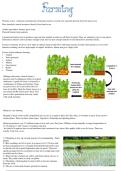
Its island of Langkawi has several traditional and commercial rice farms. Rice paddy fields cover 8.6 acres. There are
usually 2 harvests a year.
1.) Ploughing to mix up soil and prepare it for transplanting - Water
buffalo
2.) Rice seedlings are left to grow in a nursery for 15-30 days and
are then transplanted to a wet paddy field (field flooded with water
so that the rice has a good temperature and can grow). There are
significant gaps between each plant so they have enough space and
so catfish can live there.
3.) When the tips of plants are yellow and plants droop, the rice is
ready. They drain water to easily cut plants.
4.) Threshing: vibrating plant to grain which is heavier separates
from the stock
5.) The rice is dried and cleaned, packed for markets.
Raw materials: natural resources directly from land or sea
Arable agriculture: farmers grow crops
Pastoral farmers keep animals
Commercial farmers aim to produce crops and rear animals in order to sell them for profit. They are sedentary (stay in one place)
Subsistence farmers aim to produce enough crops and rear just enough animals to feed themselves and their family.
Extensive farming: involves a low input of capital, material and labor with large amounts of land which produces a low yield
Intensive farming: involves high inputs of capital, fertilisers, labour and give a high yield.
Factors which influence farming:
• Capital
• Profit potential
• Labour
• Market
• Government
• Relief
• Climate
Shifting cultivation: (slash & burn) a
practise used by indigenous tribes in tropical
rainforests. A patch of forest is cleared by a
combination of felling and burning. Crops
are grown for a few years before the soil
loses its fertility. Then the farmer moves to a
new patch and the forests grow back. This
process takes generations and only works
with small clearings.
Malaysia: rice farming
Roughly 2 thirds of the world’s population rely on rice as a staple to their diet. Rice takes 3-6 months to grow from seeds to
mature plants. There are three main stages: Vegetative, Nurturing and ripening phases.
Malaysia produces over 2.5 million tonnes of rice each year. They have 2400mm of rain annually, average temperatures of
31-34 degrees C with 7 hours of sunshine each day.
Its island of Langkawi has several traditional and commercial rice farms. Rice paddy fields cover 8.6 acres. There are
usually 2 harvests a year.
1.) Ploughing to mix up soil and prepare it for transplanting - Water
buffalo
2.) Rice seedlings are left to grow in a nursery for 15-30 days and
are then transplanted to a wet paddy field (field flooded with water
so that the rice has a good temperature and can grow). There are
significant gaps between each plant so they have enough space and
so catfish can live there.
3.) When the tips of plants are yellow and plants droop, the rice is
ready. They drain water to easily cut plants.
4.) Threshing: vibrating plant to grain which is heavier separates
from the stock
5.) The rice is dried and cleaned, packed for markets.