
Biomes
Weather: the current state of the atmosphere with regards to temperature, cloud cover, wind speed and direction, precipitation, humidity
air pressure and sunshine.It is related to short-term, day to day changes in the atmosphere for a place.
Climate: the average condition in the atmosphere over a long period of time (usually 30 years)
Global ecosystems: very large ecological areas on the earth’s surface with animals and plants adapting to their environment
Factors that affect climate zones:
• Latitude Climate graphs: Show annual average precipitation and average temperature of an area.
• Altitude - You can find the hottest, coldest, wettest and driest months.
• Ocean currents
• Prevailing wind direction
• Distance from the sea
Annual Temperature Range: the difference between the highest
average temperature and lowest average temperature over the
period of a year
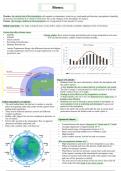
Impact of Latitude:
• Radiation from the sun is absorbed by clouds, the atmosphere and
the earth’s surface
• At low latitudes the sun is almost directly overhead all year round.
The Sun’s energy is concentrated in a small area here as it hits the
Earth’s surface at less of an angle
• Heating is more effective so the temperature is warmer
• At high latitudes, the sun’s rays are dispersed over a larger area, so
heating is less effective
Global atmospheric circulation: • Radiation also travels through a greater depth of atmosphere so
• The earth redistributes the heat on its surface to stop the more radiation is lost to scattering and absorption by gases and
poles from getting colder and colder and the equator from particles in the atmosphere
getting hotter and hotter • Due to the earth’s tilt, as the earth orbit the sun, it creates more
• These lead to different pressure systems and different pronounced seasons the further north or south a place is
weather conditions
• Hadley cells: largest, hot air rises creating low pressure, so
lots of rainfall Equatorial climate:
• Ferrel cells: not driven by temperature, flow in opposite
directions of Hadley and polar cells • Located between the tropics (between 10 ° South and 10 ° North
• Polar cells: smallest cells, cold dense air • Average temperature of approximately 26 °C
• Small annual range of temperature (between 2-3)
• Heavy (convectional) rainfall (over 1500mm a year)
• High humidity
• Lacks weather seasons, but has hot and wet seasons
Why are equatorial climates wet?
• High temperatures and moist air from transpiration, sea, lakes..
• Warm air expands and rises, this has less wright and leaves
surface low pressure systems
• Wind blows into the low pressure system from north and south
of the equator, meeting at the intertropical convergence zone
(where air masses from north and south of the equator converge
and zone of low pressure is created)
• The zone moves as the position of the sun moves due to the tilt
of the earth, this often leads to two rainy seasons
Weather: the current state of the atmosphere with regards to temperature, cloud cover, wind speed and direction, precipitation, humidity
air pressure and sunshine.It is related to short-term, day to day changes in the atmosphere for a place.
Climate: the average condition in the atmosphere over a long period of time (usually 30 years)
Global ecosystems: very large ecological areas on the earth’s surface with animals and plants adapting to their environment
Factors that affect climate zones:
• Latitude Climate graphs: Show annual average precipitation and average temperature of an area.
• Altitude - You can find the hottest, coldest, wettest and driest months.
• Ocean currents
• Prevailing wind direction
• Distance from the sea
Annual Temperature Range: the difference between the highest
average temperature and lowest average temperature over the
period of a year
Impact of Latitude:
• Radiation from the sun is absorbed by clouds, the atmosphere and
the earth’s surface
• At low latitudes the sun is almost directly overhead all year round.
The Sun’s energy is concentrated in a small area here as it hits the
Earth’s surface at less of an angle
• Heating is more effective so the temperature is warmer
• At high latitudes, the sun’s rays are dispersed over a larger area, so
heating is less effective
Global atmospheric circulation: • Radiation also travels through a greater depth of atmosphere so
• The earth redistributes the heat on its surface to stop the more radiation is lost to scattering and absorption by gases and
poles from getting colder and colder and the equator from particles in the atmosphere
getting hotter and hotter • Due to the earth’s tilt, as the earth orbit the sun, it creates more
• These lead to different pressure systems and different pronounced seasons the further north or south a place is
weather conditions
• Hadley cells: largest, hot air rises creating low pressure, so
lots of rainfall Equatorial climate:
• Ferrel cells: not driven by temperature, flow in opposite
directions of Hadley and polar cells • Located between the tropics (between 10 ° South and 10 ° North
• Polar cells: smallest cells, cold dense air • Average temperature of approximately 26 °C
• Small annual range of temperature (between 2-3)
• Heavy (convectional) rainfall (over 1500mm a year)
• High humidity
• Lacks weather seasons, but has hot and wet seasons
Why are equatorial climates wet?
• High temperatures and moist air from transpiration, sea, lakes..
• Warm air expands and rises, this has less wright and leaves
surface low pressure systems
• Wind blows into the low pressure system from north and south
of the equator, meeting at the intertropical convergence zone
(where air masses from north and south of the equator converge
and zone of low pressure is created)
• The zone moves as the position of the sun moves due to the tilt
of the earth, this often leads to two rainy seasons


