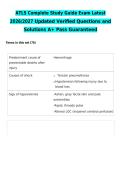
ATLS Complete Study Guide Exam Latest
2026/2027 Updated Verified Questions and
Solutions A+ Pass Guaranteed
Terms in this set (70)
Predominant cause of Hemorrhage
preventable deaths after
injury
Causes of shock 1) Tension pneumothorax
2) Hypotension following injury due to
blood loss
Sigs of hypovolemia -Ashen, gray facial skin and pale
extremities
-Rapid, thready pulse
-Altered LOC (impaired cerebral perfusion)
, Most common origin of Hypovolemic shock
shock associated with injury
Treatment of hypovolemic 1) Warmed IV fluid therapy with
shock crystalloids (37-40C or 98.6-104F) with
bolus of 1L of isotonic solution
2) Blood transfusion
The__score of the GCS Motor
correlates with outcome.
Until proven otherwise, alway central nervous system injury
presume that changes in
level of consciousness are a
result of....
Optimal temperature for 39C or 102.2F
warmed crystalloid IV fluids
Physiologic parameters that Pulse rate, BP, pulse pressure, ventilatory
reflect adequacy of rate, ABG levels, body temperature and
resuscitation urinary output
Capnography Confirm intubation of the airway
(NOT the proper placement of tube)
Measures concentration of CO2 in
expired air over time
Provides insight into patient's ventilation,
circulation and metabolism
2026/2027 Updated Verified Questions and
Solutions A+ Pass Guaranteed
Terms in this set (70)
Predominant cause of Hemorrhage
preventable deaths after
injury
Causes of shock 1) Tension pneumothorax
2) Hypotension following injury due to
blood loss
Sigs of hypovolemia -Ashen, gray facial skin and pale
extremities
-Rapid, thready pulse
-Altered LOC (impaired cerebral perfusion)
, Most common origin of Hypovolemic shock
shock associated with injury
Treatment of hypovolemic 1) Warmed IV fluid therapy with
shock crystalloids (37-40C or 98.6-104F) with
bolus of 1L of isotonic solution
2) Blood transfusion
The__score of the GCS Motor
correlates with outcome.
Until proven otherwise, alway central nervous system injury
presume that changes in
level of consciousness are a
result of....
Optimal temperature for 39C or 102.2F
warmed crystalloid IV fluids
Physiologic parameters that Pulse rate, BP, pulse pressure, ventilatory
reflect adequacy of rate, ABG levels, body temperature and
resuscitation urinary output
Capnography Confirm intubation of the airway
(NOT the proper placement of tube)
Measures concentration of CO2 in
expired air over time
Provides insight into patient's ventilation,
circulation and metabolism