

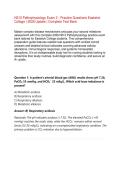
N212 Pathophysiology Exam 2 - Practice Questions Eastwick
College | 2026 Update | Complete Test Bank
Master complex disease mechanisms and pass your second milestone
assessment with this complete 2026 N212 Pathophysiology practice exam
bank tailored for Eastwick College students. This comprehensive
preparation guide features realistic test questions with verified correct
answers and detailed clinical rationales covering advanced cellular
alterations, immunological responses, and systemic homeostatic
disruptions. It is an indispensable study tool for nursing students looking to
streamline their study routines, build diagnostic confidence, and secure an
A+ grade.
Question 1: A patient's arterial blood gas (ABG) results show: pH 7.28,
PaCO₂ 55 mmHg, and HCO₃⁻ 25 mEq/L. Which acid-base imbalance is
present?
A) Metabolic acidosis
B) Respiratory acidosis
C) Respiratory alkalosis
D) Metabolic alkalosis
Answer: B) Respiratory acidosis
Rationale: The pH indicates acidosis (<7.35). The elevated PaCO₂ (>45
mmHg) matches the acidic state, while the HCO₃⁻ remains within normal
limits (22-26 mEq/L), indicating an uncompensated respiratory condition. The
primary problem is CO₂ retention due to hypoventilation .
,Question 2: Which cellular adaptation is characterized by a reversible
replacement of one mature cell type by another mature cell type, often
due to chronic irritation?
A) Hyperplasia
B) Metaplasia
C) Dysplasia
D) Anaplasia
Answer: B) Metaplasia
Rationale: Metaplasia occurs when a chronic stressor causes one
differentiated cell type to be replaced by another better suited to withstand
the environment. A classic example is ciliated columnar epithelium changing
to squamous epithelium in the airways of chronic smokers .
Question 3: A patient experiences myocardial infarction due to
prolonged ischemia. Which type of cellular necrosis will occur in the
heart tissue?
A) Liquefactive necrosis
B) Caseous necrosis
C) Fat necrosis
D) Coagulative necrosis
Answer: D) Coagulative necrosis
Rationale: Coagulative necrosis typically results from sudden, severe ischemia
or hypoxia in solid organs (except the brain). Cellular proteins denature and
coagulate while maintaining structural architecture. This is the characteristic
necrosis pattern seen in myocardial infarction .
,Question 4: During an acute inflammatory response, which chemical
mediator is primarily responsible for causing rapid vasodilation and
increased vascular permeability immediately after injury?
A) Leukotrienes
B) Histamine
C) Interleukin-1
D) C-reactive protein
Answer: B) Histamine
Rationale: Histamine is pre-formed and stored inside mast cell granules,
allowing it to be released instantly to cause endothelial contraction and
vasodilation during early-stage inflammation. This leads to the hallmark
signs of redness and heat .
Question 5: What is the primary pathophysiological mechanism behind
the development of generalized edema in a patient suffering from
severe liver failure?
A) Increased capillary hydrostatic pressure
B) Decreased capillary oncotic pressure
C) Increased interstitial fluid osmotic pressure
D) Lymphatic obstruction
Answer: B) Decreased capillary oncotic pressure
Rationale: The liver synthesizes albumin, which is the major driver of colloid
oncotic pressure. Severe liver failure halts albumin production, causing fluid
to shift from capillaries into the interstitial spaces. This results in generalized
edema and ascites .
, Question 6: Which type of hypersensitivity reaction is mediated by IgE
antibodies binding to mast cells, resulting in anaphylaxis upon re-
exposure to an allergen?
A) Type I Hypersensitivity
B) Type II Hypersensitivity
C) Type III Hypersensitivity
D) Type IV Hypersensitivity
Answer: A) Type I Hypersensitivity
Rationale: Type I hypersensitivity involves allergen cross-linking of IgE
antibodies fixed to mast cells and basophils, triggering immediate
degranulation and release of histamine and leukotrienes. This mediates
allergic reactions and anaphylaxis .
Question 7: A patient is diagnosed with an autoimmune disease where
antibodies bind to and block acetylcholine receptors at the
neuromuscular junction. What is this condition?
A) Multiple Sclerosis
B) Guillain-Barré Syndrome
C) Myasthenia Gravis
D) Huntington's Disease
Answer: C) Myasthenia Gravis
Rationale: Myasthenia gravis is a Type II cytotoxic hypersensitivity disorder
where autoantibodies attack nicotinic acetylcholine receptors, impairing
neuromuscular transmission and causing progressive muscle weakness.
Symptoms include ptosis, diplopia, and difficulty swallowing .
College | 2026 Update | Complete Test Bank
Master complex disease mechanisms and pass your second milestone
assessment with this complete 2026 N212 Pathophysiology practice exam
bank tailored for Eastwick College students. This comprehensive
preparation guide features realistic test questions with verified correct
answers and detailed clinical rationales covering advanced cellular
alterations, immunological responses, and systemic homeostatic
disruptions. It is an indispensable study tool for nursing students looking to
streamline their study routines, build diagnostic confidence, and secure an
A+ grade.
Question 1: A patient's arterial blood gas (ABG) results show: pH 7.28,
PaCO₂ 55 mmHg, and HCO₃⁻ 25 mEq/L. Which acid-base imbalance is
present?
A) Metabolic acidosis
B) Respiratory acidosis
C) Respiratory alkalosis
D) Metabolic alkalosis
Answer: B) Respiratory acidosis
Rationale: The pH indicates acidosis (<7.35). The elevated PaCO₂ (>45
mmHg) matches the acidic state, while the HCO₃⁻ remains within normal
limits (22-26 mEq/L), indicating an uncompensated respiratory condition. The
primary problem is CO₂ retention due to hypoventilation .
,Question 2: Which cellular adaptation is characterized by a reversible
replacement of one mature cell type by another mature cell type, often
due to chronic irritation?
A) Hyperplasia
B) Metaplasia
C) Dysplasia
D) Anaplasia
Answer: B) Metaplasia
Rationale: Metaplasia occurs when a chronic stressor causes one
differentiated cell type to be replaced by another better suited to withstand
the environment. A classic example is ciliated columnar epithelium changing
to squamous epithelium in the airways of chronic smokers .
Question 3: A patient experiences myocardial infarction due to
prolonged ischemia. Which type of cellular necrosis will occur in the
heart tissue?
A) Liquefactive necrosis
B) Caseous necrosis
C) Fat necrosis
D) Coagulative necrosis
Answer: D) Coagulative necrosis
Rationale: Coagulative necrosis typically results from sudden, severe ischemia
or hypoxia in solid organs (except the brain). Cellular proteins denature and
coagulate while maintaining structural architecture. This is the characteristic
necrosis pattern seen in myocardial infarction .
,Question 4: During an acute inflammatory response, which chemical
mediator is primarily responsible for causing rapid vasodilation and
increased vascular permeability immediately after injury?
A) Leukotrienes
B) Histamine
C) Interleukin-1
D) C-reactive protein
Answer: B) Histamine
Rationale: Histamine is pre-formed and stored inside mast cell granules,
allowing it to be released instantly to cause endothelial contraction and
vasodilation during early-stage inflammation. This leads to the hallmark
signs of redness and heat .
Question 5: What is the primary pathophysiological mechanism behind
the development of generalized edema in a patient suffering from
severe liver failure?
A) Increased capillary hydrostatic pressure
B) Decreased capillary oncotic pressure
C) Increased interstitial fluid osmotic pressure
D) Lymphatic obstruction
Answer: B) Decreased capillary oncotic pressure
Rationale: The liver synthesizes albumin, which is the major driver of colloid
oncotic pressure. Severe liver failure halts albumin production, causing fluid
to shift from capillaries into the interstitial spaces. This results in generalized
edema and ascites .
, Question 6: Which type of hypersensitivity reaction is mediated by IgE
antibodies binding to mast cells, resulting in anaphylaxis upon re-
exposure to an allergen?
A) Type I Hypersensitivity
B) Type II Hypersensitivity
C) Type III Hypersensitivity
D) Type IV Hypersensitivity
Answer: A) Type I Hypersensitivity
Rationale: Type I hypersensitivity involves allergen cross-linking of IgE
antibodies fixed to mast cells and basophils, triggering immediate
degranulation and release of histamine and leukotrienes. This mediates
allergic reactions and anaphylaxis .
Question 7: A patient is diagnosed with an autoimmune disease where
antibodies bind to and block acetylcholine receptors at the
neuromuscular junction. What is this condition?
A) Multiple Sclerosis
B) Guillain-Barré Syndrome
C) Myasthenia Gravis
D) Huntington's Disease
Answer: C) Myasthenia Gravis
Rationale: Myasthenia gravis is a Type II cytotoxic hypersensitivity disorder
where autoantibodies attack nicotinic acetylcholine receptors, impairing
neuromuscular transmission and causing progressive muscle weakness.
Symptoms include ptosis, diplopia, and difficulty swallowing .


