

FINRA SIE Exam – 2026/2027 Edition – Full Exam Preparation Page 1
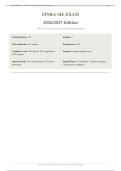
FINRA SIE EXAM
2026/2027 Edition
100% Correct Answers for Full Exam Preparation
Total Questions: 150 Sections: 5
Time Allocation: 135 minutes Passing Score: 70%
Cognitive Levels: 30% Recall / 50% Application / Format: 4-option multiple choice
20% Analysis
Question Style: 75% scenario-based / 25% direct Special Focus: 15 suitability, 15 options strategies,
knowledge 10 regulatory compliance
Aligned with FINRA SIE Exam Content Outline – 2026/2027 Edition
,FINRA SIE Exam – 2026/2027 Edition – Full Exam Preparation Page 2
Section 1: Knowledge of Capital Markets
Q1: A technology startup files a registration statement with the SEC for its first public stock offering.
The company has not yet set the final offering price and is conducting a roadshow to gauge investor
interest. During the 20-day waiting period between filing and effectiveness, the company issues a
document containing material information about its business and financials. This document is known
as a:
A. Final prospectus delivered to all purchasers
B. Preliminary prospectus (red herring) *[CORRECT]*
C. Free-writing prospectus exempt from SEC review
D. Tombstone advertisement offering the securities for sale directly
Correct Answer: B
Rationale: Under the Securities Act of 1933, during the 20-day waiting period after filing the registration
statement and before the SEC declares it effective, issuers may distribute a preliminary prospectus, commonly
called a 'red herring' because of its red legend stating the securities are not yet registered for sale. The final
prospectus is delivered only after effectiveness, free-writing prospectuses must be filed with the SEC in most
cases, and tombstone advertisements may only disclose where to obtain the statutory prospectus—not offer the
securities directly.
Q2: XYZ Corporation's IPO is structured as a firm commitment underwriting. The underwriter
agrees to purchase 5 million shares from the issuer at $18 per share and reoffers them to the public at
$20 per share. If the public purchases all 5 million shares, what is the underwriter's gross spread, and
which party bears the financial risk if the public demand falls short of 5 million shares?
A. $2 per share; the issuer bears all risk
B. $2 per share; the underwriter bears the financial risk *[CORRECT]*
C. $20 per share; the issuer bears all risk
D. $18 per share; the underwriter bears the financial risk
Correct Answer: B
Rationale: In a firm commitment underwriting, the underwriter purchases the entire issue from the issuer at a
discount ($18) and resells to the public at the public offering price ($20), earning the $2-per-share gross spread
as compensation. Because the underwriter has committed to purchase all shares from the issuer, the
underwriter—not the issuer—bears the risk of any unsold portion. In a best-efforts arrangement, by contrast, the
issuer would retain the unsold risk.
Aligned with FINRA SIE Exam Content Outline – 2026/2027 Edition
,FINRA SIE Exam – 2026/2027 Edition – Full Exam Preparation Page 3
Q3: A broker-dealer participates in a new municipal bond offering as part of a syndicate. The
syndicate agrees to use a 'Western' account structure. One syndicate member, having sold its full
allocation, is approached by a customer wishing to purchase additional bonds beyond the member's
original share. Under the Western account agreement, this member may:
A. Sell additional bonds only from its original allotment; unsold bonds of other members remain
their liability *[CORRECT]*
B. Sell from any syndicate member's unsold allotment and share the liability proportionally
C. Sell only at a price higher than the public offering price
D. Decline the order because Western accounts prohibit any further sales after allotment
Correct Answer: A
Rationale: In a Western (divided) syndicate account, each member is responsible only for its own allotment and
has no obligation to sell the unsold portions of other members. The member may sell additional bonds only out of
its own remaining allotment. In an Eastern (undivided) account, by contrast, each member is liable for its
proportional share of any unsold bonds in the entire syndicate, creating joint liability.
Q4: An investor purchases 1,000 shares of ABC Corp in the secondary market on the NYSE. Which of
the following best describes the transaction and the role of the NYSE in this trade?
A. It is a primary market transaction; the NYSE acts as the issuer of the security
B. It is a primary market transaction; the NYSE facilitates the direct sale from the issuer
C. It is a secondary market transaction; the NYSE provides a regulated auction market matching
buyers and sellers *[CORRECT]*
D. It is a private placement; the NYSE merely records the trade for regulatory purposes
Correct Answer: C
Rationale: Trading among investors on an exchange such as the NYSE represents the secondary market, where
previously issued securities change hands without issuer involvement. The NYSE functions as a regulated auction
(order-driven) market that matches buy and sell orders, providing price discovery and liquidity. Primary market
transactions involve the issuer selling securities directly to investors, while private placements are exempt
offerings under Regulation D and do not trade on exchanges.
Q5: A broker-dealer is a market maker in NQX Pharmaceuticals, quoting a bid of $24.50 and an ask
(offer) of $24.78 for 1,000 shares. A customer enters a market order to sell 500 shares. At what price
will the customer's order most likely execute, and what is the dealer's quoted spread?
A. $24.78 per share; spread is $0.28
B. $24.50 per share; spread is $0.28 *[CORRECT]*
C. $24.64 per share; spread is $0.28
D. $24.78 per share; spread is $0.50
Correct Answer: B
Rationale: A market sell order executes at the dealer's bid price—the price the dealer is willing to pay—which is
$24.50. The spread is the difference between the ask ($24.78) and the bid ($24.50), equal to $0.28. The
midpoint ($24.64) is a reference price, not an execution price for a market order. The dealer profits from the
spread by buying at the bid and selling at the ask.
Aligned with FINRA SIE Exam Content Outline – 2026/2027 Edition
, FINRA SIE Exam – 2026/2027 Edition – Full Exam Preparation Page 4
Q6: A customer wishes to purchase shares of an NYSE-listed company but her broker-dealer is not a
member of the NYSE. The broker-dealer routes the order through a member firm that executes the
order on the exchange. This arrangement is known as:
A. Principal trading, where the broker-dealer trades from its own inventory
B. An over-the-counter (OTC) transaction exempt from exchange rules
C. A third-market trade executed off the exchange floor
D. An exchange member acting as the broker-dealer's clearing agent for execution on the
exchange *[CORRECT]*
Correct Answer: D
Rationale: When a non-member broker-dealer routes an order to an exchange member firm for execution on the
exchange, the member firm acts as the executing broker or clearing agent for the non-member. This is distinct
from principal trading (dealer trades from inventory), third-market trades (off-exchange transactions in
exchange-listed securities), and OTC transactions (negotiated off-exchange trading, typically in non-listed
securities).
Q7: Which of the following best describes the role of the Financial Industry Regulatory Authority
(FINRA) in the U.S. securities markets?
A. FINRA is a government agency directly funded by Congressional appropriations
B. FINRA is a self-regulatory organization (SRO) that oversees broker-dealers and registered
representatives *[CORRECT]*
C. FINRA regulates investment advisers and is supervised by the SEC under the Investment Advisers Act
of 1940
D. FINRA operates as a national securities exchange listing all U.S. equities
Correct Answer: B
Rationale: FINRA is a self-regulatory organization (SRO) authorized by Congress through the Securities
Exchange Act of 1934 and overseen by the SEC. It writes and enforces rules governing broker-dealers and their
registered representatives, conducts examinations, and operates an arbitration forum. FINRA is funded by
member firm assessments, not Congressional appropriations. Investment advisers are primarily regulated by the
SEC or states under the Investment Advisers Act of 1940, not FINRA.
Q8: An OTC equity security is not listed on any national securities exchange. The broker-dealer
quoting the security must comply with FINRA Rule 6432, which requires the firm to obtain and
document certain information before publishing a quote. This requirement is known as the:
A. Suitability determination under FINRA Rule 2111
B. Best execution obligation under FINRA Rule 5310
C. Qui tam certification of quote compliance *[CORRECT]*
D. Mandatory SEC registration of all OTC dealers
Correct Answer: C
Rationale: FINRA Rule 6432 requires broker-dealers to obtain a 'qui tam' certification—more precisely, the
Form 211 certification—demonstrating that the firm has complied with the information requirements of SEC
Rule 15c2-11 before publishing a quotation in an OTC equity security not listed on a national exchange. The rule
is designed to ensure that there is adequate current public information about the issuer before market making
begins. Suitability and best execution are separate FINRA rules, and SEC registration of dealers is governed by
the Exchange Act, not by Rule 6432.
Aligned with FINRA SIE Exam Content Outline – 2026/2027 Edition
FINRA SIE EXAM
2026/2027 Edition
100% Correct Answers for Full Exam Preparation
Total Questions: 150 Sections: 5
Time Allocation: 135 minutes Passing Score: 70%
Cognitive Levels: 30% Recall / 50% Application / Format: 4-option multiple choice
20% Analysis
Question Style: 75% scenario-based / 25% direct Special Focus: 15 suitability, 15 options strategies,
knowledge 10 regulatory compliance
Aligned with FINRA SIE Exam Content Outline – 2026/2027 Edition
,FINRA SIE Exam – 2026/2027 Edition – Full Exam Preparation Page 2
Section 1: Knowledge of Capital Markets
Q1: A technology startup files a registration statement with the SEC for its first public stock offering.
The company has not yet set the final offering price and is conducting a roadshow to gauge investor
interest. During the 20-day waiting period between filing and effectiveness, the company issues a
document containing material information about its business and financials. This document is known
as a:
A. Final prospectus delivered to all purchasers
B. Preliminary prospectus (red herring) *[CORRECT]*
C. Free-writing prospectus exempt from SEC review
D. Tombstone advertisement offering the securities for sale directly
Correct Answer: B
Rationale: Under the Securities Act of 1933, during the 20-day waiting period after filing the registration
statement and before the SEC declares it effective, issuers may distribute a preliminary prospectus, commonly
called a 'red herring' because of its red legend stating the securities are not yet registered for sale. The final
prospectus is delivered only after effectiveness, free-writing prospectuses must be filed with the SEC in most
cases, and tombstone advertisements may only disclose where to obtain the statutory prospectus—not offer the
securities directly.
Q2: XYZ Corporation's IPO is structured as a firm commitment underwriting. The underwriter
agrees to purchase 5 million shares from the issuer at $18 per share and reoffers them to the public at
$20 per share. If the public purchases all 5 million shares, what is the underwriter's gross spread, and
which party bears the financial risk if the public demand falls short of 5 million shares?
A. $2 per share; the issuer bears all risk
B. $2 per share; the underwriter bears the financial risk *[CORRECT]*
C. $20 per share; the issuer bears all risk
D. $18 per share; the underwriter bears the financial risk
Correct Answer: B
Rationale: In a firm commitment underwriting, the underwriter purchases the entire issue from the issuer at a
discount ($18) and resells to the public at the public offering price ($20), earning the $2-per-share gross spread
as compensation. Because the underwriter has committed to purchase all shares from the issuer, the
underwriter—not the issuer—bears the risk of any unsold portion. In a best-efforts arrangement, by contrast, the
issuer would retain the unsold risk.
Aligned with FINRA SIE Exam Content Outline – 2026/2027 Edition
,FINRA SIE Exam – 2026/2027 Edition – Full Exam Preparation Page 3
Q3: A broker-dealer participates in a new municipal bond offering as part of a syndicate. The
syndicate agrees to use a 'Western' account structure. One syndicate member, having sold its full
allocation, is approached by a customer wishing to purchase additional bonds beyond the member's
original share. Under the Western account agreement, this member may:
A. Sell additional bonds only from its original allotment; unsold bonds of other members remain
their liability *[CORRECT]*
B. Sell from any syndicate member's unsold allotment and share the liability proportionally
C. Sell only at a price higher than the public offering price
D. Decline the order because Western accounts prohibit any further sales after allotment
Correct Answer: A
Rationale: In a Western (divided) syndicate account, each member is responsible only for its own allotment and
has no obligation to sell the unsold portions of other members. The member may sell additional bonds only out of
its own remaining allotment. In an Eastern (undivided) account, by contrast, each member is liable for its
proportional share of any unsold bonds in the entire syndicate, creating joint liability.
Q4: An investor purchases 1,000 shares of ABC Corp in the secondary market on the NYSE. Which of
the following best describes the transaction and the role of the NYSE in this trade?
A. It is a primary market transaction; the NYSE acts as the issuer of the security
B. It is a primary market transaction; the NYSE facilitates the direct sale from the issuer
C. It is a secondary market transaction; the NYSE provides a regulated auction market matching
buyers and sellers *[CORRECT]*
D. It is a private placement; the NYSE merely records the trade for regulatory purposes
Correct Answer: C
Rationale: Trading among investors on an exchange such as the NYSE represents the secondary market, where
previously issued securities change hands without issuer involvement. The NYSE functions as a regulated auction
(order-driven) market that matches buy and sell orders, providing price discovery and liquidity. Primary market
transactions involve the issuer selling securities directly to investors, while private placements are exempt
offerings under Regulation D and do not trade on exchanges.
Q5: A broker-dealer is a market maker in NQX Pharmaceuticals, quoting a bid of $24.50 and an ask
(offer) of $24.78 for 1,000 shares. A customer enters a market order to sell 500 shares. At what price
will the customer's order most likely execute, and what is the dealer's quoted spread?
A. $24.78 per share; spread is $0.28
B. $24.50 per share; spread is $0.28 *[CORRECT]*
C. $24.64 per share; spread is $0.28
D. $24.78 per share; spread is $0.50
Correct Answer: B
Rationale: A market sell order executes at the dealer's bid price—the price the dealer is willing to pay—which is
$24.50. The spread is the difference between the ask ($24.78) and the bid ($24.50), equal to $0.28. The
midpoint ($24.64) is a reference price, not an execution price for a market order. The dealer profits from the
spread by buying at the bid and selling at the ask.
Aligned with FINRA SIE Exam Content Outline – 2026/2027 Edition
, FINRA SIE Exam – 2026/2027 Edition – Full Exam Preparation Page 4
Q6: A customer wishes to purchase shares of an NYSE-listed company but her broker-dealer is not a
member of the NYSE. The broker-dealer routes the order through a member firm that executes the
order on the exchange. This arrangement is known as:
A. Principal trading, where the broker-dealer trades from its own inventory
B. An over-the-counter (OTC) transaction exempt from exchange rules
C. A third-market trade executed off the exchange floor
D. An exchange member acting as the broker-dealer's clearing agent for execution on the
exchange *[CORRECT]*
Correct Answer: D
Rationale: When a non-member broker-dealer routes an order to an exchange member firm for execution on the
exchange, the member firm acts as the executing broker or clearing agent for the non-member. This is distinct
from principal trading (dealer trades from inventory), third-market trades (off-exchange transactions in
exchange-listed securities), and OTC transactions (negotiated off-exchange trading, typically in non-listed
securities).
Q7: Which of the following best describes the role of the Financial Industry Regulatory Authority
(FINRA) in the U.S. securities markets?
A. FINRA is a government agency directly funded by Congressional appropriations
B. FINRA is a self-regulatory organization (SRO) that oversees broker-dealers and registered
representatives *[CORRECT]*
C. FINRA regulates investment advisers and is supervised by the SEC under the Investment Advisers Act
of 1940
D. FINRA operates as a national securities exchange listing all U.S. equities
Correct Answer: B
Rationale: FINRA is a self-regulatory organization (SRO) authorized by Congress through the Securities
Exchange Act of 1934 and overseen by the SEC. It writes and enforces rules governing broker-dealers and their
registered representatives, conducts examinations, and operates an arbitration forum. FINRA is funded by
member firm assessments, not Congressional appropriations. Investment advisers are primarily regulated by the
SEC or states under the Investment Advisers Act of 1940, not FINRA.
Q8: An OTC equity security is not listed on any national securities exchange. The broker-dealer
quoting the security must comply with FINRA Rule 6432, which requires the firm to obtain and
document certain information before publishing a quote. This requirement is known as the:
A. Suitability determination under FINRA Rule 2111
B. Best execution obligation under FINRA Rule 5310
C. Qui tam certification of quote compliance *[CORRECT]*
D. Mandatory SEC registration of all OTC dealers
Correct Answer: C
Rationale: FINRA Rule 6432 requires broker-dealers to obtain a 'qui tam' certification—more precisely, the
Form 211 certification—demonstrating that the firm has complied with the information requirements of SEC
Rule 15c2-11 before publishing a quotation in an OTC equity security not listed on a national exchange. The rule
is designed to ensure that there is adequate current public information about the issuer before market making
begins. Suitability and best execution are separate FINRA rules, and SEC registration of dealers is governed by
the Exchange Act, not by Rule 6432.
Aligned with FINRA SIE Exam Content Outline – 2026/2027 Edition


