

Club Pilates Instructor Certification
Practice Exam Complete 60-Question
Comprehensive Assessment.
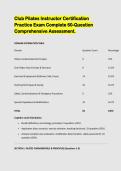
DOMAIN DISTRIBUTION TABLE
Domain Question Count Percentage
Pilates Fundamentals & Principles 9 15%
Club Pilates Class Formats & Structure 8 13.3%
Exercises & Equipment (Reformer, Mat, Props) 14 23.3%
Teaching Techniques & Cueing 10 16.7%
Safety, Contraindications & Emergency Procedures 9 15%
Special Populations & Modifications 10 16.7%
TOTAL 60 100%
Cognitive Level Distribution:
• Recall (definitions, terminology, principles): 9 questions (15%)
• Application (class scenarios, exercise selection, teaching decisions): 33 questions (55%)
• Analysis (complex class evaluation, modification determination, safety assessment): 18
questions (30%)
SECTION 1: PILATES FUNDAMENTALS & PRINCIPLES (Questions 1-9)
,Q1: Joseph Pilates originally named his method "Contrology." What was the primary
philosophy behind this name?
A. The emphasis on cardiovascular conditioning and endurance training
B. The complete coordination of body, mind, and spirit through controlled movement
C. The focus on building maximal muscular strength and power
D. The integration of dance techniques with traditional weightlifting
Correct Answer: B [CORRECT]
Rationale: Joseph Pilates named his method "Contrology" to emphasize the complete
coordination of body, mind, and spirit through controlled movement. This philosophy reflects
the core belief that the mind controls the muscles, and deliberate, conscious movement
patterns create balanced physical development. The term "Contrology" underscores that every
exercise is performed with intention and mental focus.
Q2: Which of the following is NOT one of the six original Pilates principles?
A. Breath
B. Concentration
C. Flexibility
D. Flow
Correct Answer: C [CORRECT]
Rationale: The six original Pilates principles are breath, concentration, centering, control,
precision, and flow. Flexibility, while a benefit of Pilates practice, is not one of the foundational
principles. These six principles guide every exercise and teaching decision in the Pilates method,
ensuring that movement quality takes precedence over quantity.
Q3: During a Club Pilates class, an instructor notices a participant holding their breath during
the Hundred exercise. What is the most appropriate cue to correct this?
A. "Push harder through your arms and squeeze your glutes"
B. "Inhale for five counts, exhale for five counts, keeping your abdominals scooped"
C. "Speed up your arm pumping to finish faster"
D. "Drop your legs lower to increase the challenge"
Correct Answer: B [CORRECT]
, Rationale: Breath is one of the six Pilates principles and is essential for maintaining core
engagement and preventing unnecessary tension. Cueing the specific breathing pattern (inhale
for five counts, exhale for five counts) helps the participant coordinate breath with movement
while maintaining abdominal scoop. This instruction addresses the breath principle directly and
reinforces the mind-body connection central to Pilates.
Q4: A new student asks how Pilates differs from traditional strength training. What is the
most accurate response based on Pilates principles?
A. "Pilates focuses exclusively on building large muscle mass through heavy resistance"
B. "Pilates emphasizes controlled, precise movements that integrate the whole body with focus
on core stability"
C. "Pilates eliminates the need for any other form of exercise"
D. "Pilates primarily targets cardiovascular endurance through rapid movements"
Correct Answer: B [CORRECT]
Rationale: Pilates emphasizes controlled, precise movements that integrate the whole body
with a primary focus on core stability, distinguishing it from traditional strength training that
often isolates muscle groups. The principles of control, precision, and centering guide
practitioners to move with intention and awareness. This holistic approach develops balanced
musculature, improved posture, and functional movement patterns.
Q5: The Pilates principle of "centering" refers to which concept?
A. Exercising only in the center of the Reformer carriage
B. All movement originates from the body's center (core/powerhouse)
C. Maintaining equal weight distribution on both feet
D. Keeping the body centered on the mat during exercise
Correct Answer: B [CORRECT]
Rationale: Centering in Pilates refers to the concept that all movement originates from the
body's center, often called the "powerhouse" which includes the abdominals, lower back, hips,
and glutes. This principle emphasizes that the core initiates and supports all movement,
creating stability before mobility. Understanding centering is fundamental to proper exercise
execution and teaching in Club Pilates classes.
Practice Exam Complete 60-Question
Comprehensive Assessment.
DOMAIN DISTRIBUTION TABLE
Domain Question Count Percentage
Pilates Fundamentals & Principles 9 15%
Club Pilates Class Formats & Structure 8 13.3%
Exercises & Equipment (Reformer, Mat, Props) 14 23.3%
Teaching Techniques & Cueing 10 16.7%
Safety, Contraindications & Emergency Procedures 9 15%
Special Populations & Modifications 10 16.7%
TOTAL 60 100%
Cognitive Level Distribution:
• Recall (definitions, terminology, principles): 9 questions (15%)
• Application (class scenarios, exercise selection, teaching decisions): 33 questions (55%)
• Analysis (complex class evaluation, modification determination, safety assessment): 18
questions (30%)
SECTION 1: PILATES FUNDAMENTALS & PRINCIPLES (Questions 1-9)
,Q1: Joseph Pilates originally named his method "Contrology." What was the primary
philosophy behind this name?
A. The emphasis on cardiovascular conditioning and endurance training
B. The complete coordination of body, mind, and spirit through controlled movement
C. The focus on building maximal muscular strength and power
D. The integration of dance techniques with traditional weightlifting
Correct Answer: B [CORRECT]
Rationale: Joseph Pilates named his method "Contrology" to emphasize the complete
coordination of body, mind, and spirit through controlled movement. This philosophy reflects
the core belief that the mind controls the muscles, and deliberate, conscious movement
patterns create balanced physical development. The term "Contrology" underscores that every
exercise is performed with intention and mental focus.
Q2: Which of the following is NOT one of the six original Pilates principles?
A. Breath
B. Concentration
C. Flexibility
D. Flow
Correct Answer: C [CORRECT]
Rationale: The six original Pilates principles are breath, concentration, centering, control,
precision, and flow. Flexibility, while a benefit of Pilates practice, is not one of the foundational
principles. These six principles guide every exercise and teaching decision in the Pilates method,
ensuring that movement quality takes precedence over quantity.
Q3: During a Club Pilates class, an instructor notices a participant holding their breath during
the Hundred exercise. What is the most appropriate cue to correct this?
A. "Push harder through your arms and squeeze your glutes"
B. "Inhale for five counts, exhale for five counts, keeping your abdominals scooped"
C. "Speed up your arm pumping to finish faster"
D. "Drop your legs lower to increase the challenge"
Correct Answer: B [CORRECT]
, Rationale: Breath is one of the six Pilates principles and is essential for maintaining core
engagement and preventing unnecessary tension. Cueing the specific breathing pattern (inhale
for five counts, exhale for five counts) helps the participant coordinate breath with movement
while maintaining abdominal scoop. This instruction addresses the breath principle directly and
reinforces the mind-body connection central to Pilates.
Q4: A new student asks how Pilates differs from traditional strength training. What is the
most accurate response based on Pilates principles?
A. "Pilates focuses exclusively on building large muscle mass through heavy resistance"
B. "Pilates emphasizes controlled, precise movements that integrate the whole body with focus
on core stability"
C. "Pilates eliminates the need for any other form of exercise"
D. "Pilates primarily targets cardiovascular endurance through rapid movements"
Correct Answer: B [CORRECT]
Rationale: Pilates emphasizes controlled, precise movements that integrate the whole body
with a primary focus on core stability, distinguishing it from traditional strength training that
often isolates muscle groups. The principles of control, precision, and centering guide
practitioners to move with intention and awareness. This holistic approach develops balanced
musculature, improved posture, and functional movement patterns.
Q5: The Pilates principle of "centering" refers to which concept?
A. Exercising only in the center of the Reformer carriage
B. All movement originates from the body's center (core/powerhouse)
C. Maintaining equal weight distribution on both feet
D. Keeping the body centered on the mat during exercise
Correct Answer: B [CORRECT]
Rationale: Centering in Pilates refers to the concept that all movement originates from the
body's center, often called the "powerhouse" which includes the abdominals, lower back, hips,
and glutes. This principle emphasizes that the core initiates and supports all movement,
creating stability before mobility. Understanding centering is fundamental to proper exercise
execution and teaching in Club Pilates classes.


