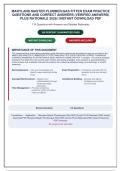
MARYLAND MASTER PLUMBER/GAS FITTER EXAM PRACTICE
QUESTIONS AND CORRECT ANSWERS (VERIFIED ANSWERS)
PLUS RATIONALE 2026/| INSTANT DOWNLOAD PDF
110 Questions with Answers and Detailed Rationales
100 PERCENT GUARANTEED PASS
INSTANT DOWNLOAD ANSWERS INCLUDED
IMPORTANCE OF THIS DOCUMENT
This comprehensive examination preparation guide has been meticulously developed to help you succeed in the
MARYLAND MASTER PLUMBER/GAS FITTER EXAM PRACTICE QUESTIONS AND CORRECT ANSWERS
(VERIFIED ANSWERS) PLUS RATIONALE 2026/| INSTANT DOWNLOAD PDF. It contains 110 carefully selected
questions that reflect the most current exam content and testing strategies. Each question is accompanied by a
correct answer and a detailed rationale that explains the underlying pathophysiology, pharmacology, or clinical
reasoning.
Self-Assessment – Test your knowledge and Exam Preparation – Familiarize yourself with the
identify areas requiring further question format and content
study areas
Concept Reinforcement – Deepen your Confidence Building – Develop test-taking
understanding through strategies and reduce
evidence-based exam anxiety
rationales
Time Management – Practice answering
questions under simulated
exam conditions
Review Summary 110 Questions
Foundations - Application - Maryland Master Plumber/gas Fitter AND Correct PLUS Rationale 2026/ Instant
Download PDF Maryland Master Plumber/gas Fitter AND Correct PLUS Rationale 2026/ Instant Download
PDF University
All answers with rationales
,Table of Contents
Content Area Questions Key Topics
Plumbing Systems AND 1-19 System, Water, Pressure, Required, Minimum
Components
GAS Piping AND GAS Fitting 20-38 System, Minimum, Required, Pressure, Water
Venting AND Combustion 39-57 System, Pressure, Stack, Maximum, Required
AIR
Water Supply AND 58-76 System, Building, Minimum, Required, Inches
Distribution
Drainage Waste AND VENT 77-95 Required, Minimum, System, Plumber, Building
Systems
Fixtures AND Appliances 96-110 Water, Plumber, Pressure, System, Minimum
TOTAL 110 All questions include answers and detailed rationales
,Section A - Plumbing Systems AND Components
Q1.
A plumber is installing a gas piping system in a commercial building using corrugated
stainless steel tubing (CSST). The building has a lightning protection system. According
to NFPA 54 and manufacturer instructions, which of the following is the most critical
requirement for bonding CSST?
A. Bond the CSST to the building's B. Bond the CSST to the appliance
grounding electrode system using a grounding conductor at each appliance
minimum 6 AWG copper conductor at the connection.
first point of entry.
C. Connect the CSST to the electrical D. Use dielectric unions at all connections to
service neutral at the meter. prevent galvanic corrosion.
Correct: A - Bond the CSST to the building's grounding electrode system using a
minimum 6 AWG copper conductor at the first point of entry.
Rationale:CSST must be bonded to the building's grounding electrode system with a
minimum 6 AWG copper conductor at the first point of entry to prevent arcing from lightning.
Bonding at appliances or to the neutral is incorrect; dielectric unions are for corrosion, not
bonding.
Why the other answers are wrong:
B. Bonding at each appliance does not provide a single low-impedance path for lightning
currents; the bond must be at the first point of entry.
C. Connecting to the neutral at the meter is improper and can create a parallel path for neutral
current, violating NEC and NFPA 54.
D. Dielectric unions prevent galvanic corrosion but do not provide the required electrical
bonding for lightning protection.
Reference: NFPA 54: National Fuel Gas Code, 2024, Section 7.13
Q2.
A plumbing system in a high-rise building has a dedicated sanitary stack receiving
discharges from fixtures on multiple floors. The stack is 4 inches in diameter and serves
20 water closets. The building's plumbing code requires venting that prevents trap seal
loss. Considering the stack's load and venting requirements, what is the maximum
number of fixture units that can be connected to this stack if it is to be vented as a
single-stack system?
A. 256 fixture units B. 500 fixture units
C. 160 fixture units D. 100 fixture units
Correct: A - 256 fixture units
Page 3
, Section A - Plumbing Systems AND Components
Rationale: For a 4-inch sanitary stack, the maximum fixture unit load is 256 when the stack is
vented as a single-stack system (per IPC Table 916.1). This value accounts for the stack's
capacity and venting requirements to prevent trap seal loss.
Why the other answers are wrong:
B. 500 is the maximum for a 5-inch stack, not 4-inch.
C. 160 is the capacity for a 3-inch stack.
D. 100 is an arbitrary value; the code specifies 256 for a 4-inch stack.
Reference: International Plumbing Code (IPC) 2024, Table 916.1
Q3.
A gas fitter is installing a propane gas system for a commercial kitchen. The system
includes a manifold with multiple appliances. The appliances are rated at 50,000 Btu/h
each. The manifold is supplied by a 1-inch pipe. The equivalent length of the piping
system from the tank to the manifold is 80 feet. Using the standard gas piping sizing
tables for propane at 11 inches water column pressure drop, what is the maximum
number of appliances that can be connected to this manifold?
A. 4 appliances B. 6 appliances
C. 8 appliances D. 10 appliances
Correct: B - 6 appliances
Rationale:Using the propane gas piping sizing table (NFPA 54, Table 402.4(2)), a 1-inch pipe
at 80 feet equivalent length can supply approximately 300,000 Btu/h. Dividing by 50,000 Btu/h
per appliance gives 6 appliances.
Why the other answers are wrong:
A. 4 would be the capacity for a 3/4-inch pipe at 80 feet.
C. 8 appliances would require 400,000 Btu/h, exceeding the 1-inch pipe capacity.
D. 10 appliances would require 500,000 Btu/h, far exceeding the pipe capacity.
Reference: NFPA 54, Table 402.4(2)
Q4.
A plumber is designing a drainage system for a hospital laboratory that will discharge
chemical waste. The waste stream includes dilute sulfuric acid and organic solvents.
Which piping material is most appropriate for this application?
A. Cast iron with epoxy lining B. Copper type K
C. Polyvinyl chloride (PVC) D. Glass (borosilicate) with PTFE joints
Correct: D - Glass (borosilicate) with PTFE joints
Page 4
QUESTIONS AND CORRECT ANSWERS (VERIFIED ANSWERS)
PLUS RATIONALE 2026/| INSTANT DOWNLOAD PDF
110 Questions with Answers and Detailed Rationales
100 PERCENT GUARANTEED PASS
INSTANT DOWNLOAD ANSWERS INCLUDED
IMPORTANCE OF THIS DOCUMENT
This comprehensive examination preparation guide has been meticulously developed to help you succeed in the
MARYLAND MASTER PLUMBER/GAS FITTER EXAM PRACTICE QUESTIONS AND CORRECT ANSWERS
(VERIFIED ANSWERS) PLUS RATIONALE 2026/| INSTANT DOWNLOAD PDF. It contains 110 carefully selected
questions that reflect the most current exam content and testing strategies. Each question is accompanied by a
correct answer and a detailed rationale that explains the underlying pathophysiology, pharmacology, or clinical
reasoning.
Self-Assessment – Test your knowledge and Exam Preparation – Familiarize yourself with the
identify areas requiring further question format and content
study areas
Concept Reinforcement – Deepen your Confidence Building – Develop test-taking
understanding through strategies and reduce
evidence-based exam anxiety
rationales
Time Management – Practice answering
questions under simulated
exam conditions
Review Summary 110 Questions
Foundations - Application - Maryland Master Plumber/gas Fitter AND Correct PLUS Rationale 2026/ Instant
Download PDF Maryland Master Plumber/gas Fitter AND Correct PLUS Rationale 2026/ Instant Download
PDF University
All answers with rationales
,Table of Contents
Content Area Questions Key Topics
Plumbing Systems AND 1-19 System, Water, Pressure, Required, Minimum
Components
GAS Piping AND GAS Fitting 20-38 System, Minimum, Required, Pressure, Water
Venting AND Combustion 39-57 System, Pressure, Stack, Maximum, Required
AIR
Water Supply AND 58-76 System, Building, Minimum, Required, Inches
Distribution
Drainage Waste AND VENT 77-95 Required, Minimum, System, Plumber, Building
Systems
Fixtures AND Appliances 96-110 Water, Plumber, Pressure, System, Minimum
TOTAL 110 All questions include answers and detailed rationales
,Section A - Plumbing Systems AND Components
Q1.
A plumber is installing a gas piping system in a commercial building using corrugated
stainless steel tubing (CSST). The building has a lightning protection system. According
to NFPA 54 and manufacturer instructions, which of the following is the most critical
requirement for bonding CSST?
A. Bond the CSST to the building's B. Bond the CSST to the appliance
grounding electrode system using a grounding conductor at each appliance
minimum 6 AWG copper conductor at the connection.
first point of entry.
C. Connect the CSST to the electrical D. Use dielectric unions at all connections to
service neutral at the meter. prevent galvanic corrosion.
Correct: A - Bond the CSST to the building's grounding electrode system using a
minimum 6 AWG copper conductor at the first point of entry.
Rationale:CSST must be bonded to the building's grounding electrode system with a
minimum 6 AWG copper conductor at the first point of entry to prevent arcing from lightning.
Bonding at appliances or to the neutral is incorrect; dielectric unions are for corrosion, not
bonding.
Why the other answers are wrong:
B. Bonding at each appliance does not provide a single low-impedance path for lightning
currents; the bond must be at the first point of entry.
C. Connecting to the neutral at the meter is improper and can create a parallel path for neutral
current, violating NEC and NFPA 54.
D. Dielectric unions prevent galvanic corrosion but do not provide the required electrical
bonding for lightning protection.
Reference: NFPA 54: National Fuel Gas Code, 2024, Section 7.13
Q2.
A plumbing system in a high-rise building has a dedicated sanitary stack receiving
discharges from fixtures on multiple floors. The stack is 4 inches in diameter and serves
20 water closets. The building's plumbing code requires venting that prevents trap seal
loss. Considering the stack's load and venting requirements, what is the maximum
number of fixture units that can be connected to this stack if it is to be vented as a
single-stack system?
A. 256 fixture units B. 500 fixture units
C. 160 fixture units D. 100 fixture units
Correct: A - 256 fixture units
Page 3
, Section A - Plumbing Systems AND Components
Rationale: For a 4-inch sanitary stack, the maximum fixture unit load is 256 when the stack is
vented as a single-stack system (per IPC Table 916.1). This value accounts for the stack's
capacity and venting requirements to prevent trap seal loss.
Why the other answers are wrong:
B. 500 is the maximum for a 5-inch stack, not 4-inch.
C. 160 is the capacity for a 3-inch stack.
D. 100 is an arbitrary value; the code specifies 256 for a 4-inch stack.
Reference: International Plumbing Code (IPC) 2024, Table 916.1
Q3.
A gas fitter is installing a propane gas system for a commercial kitchen. The system
includes a manifold with multiple appliances. The appliances are rated at 50,000 Btu/h
each. The manifold is supplied by a 1-inch pipe. The equivalent length of the piping
system from the tank to the manifold is 80 feet. Using the standard gas piping sizing
tables for propane at 11 inches water column pressure drop, what is the maximum
number of appliances that can be connected to this manifold?
A. 4 appliances B. 6 appliances
C. 8 appliances D. 10 appliances
Correct: B - 6 appliances
Rationale:Using the propane gas piping sizing table (NFPA 54, Table 402.4(2)), a 1-inch pipe
at 80 feet equivalent length can supply approximately 300,000 Btu/h. Dividing by 50,000 Btu/h
per appliance gives 6 appliances.
Why the other answers are wrong:
A. 4 would be the capacity for a 3/4-inch pipe at 80 feet.
C. 8 appliances would require 400,000 Btu/h, exceeding the 1-inch pipe capacity.
D. 10 appliances would require 500,000 Btu/h, far exceeding the pipe capacity.
Reference: NFPA 54, Table 402.4(2)
Q4.
A plumber is designing a drainage system for a hospital laboratory that will discharge
chemical waste. The waste stream includes dilute sulfuric acid and organic solvents.
Which piping material is most appropriate for this application?
A. Cast iron with epoxy lining B. Copper type K
C. Polyvinyl chloride (PVC) D. Glass (borosilicate) with PTFE joints
Correct: D - Glass (borosilicate) with PTFE joints
Page 4