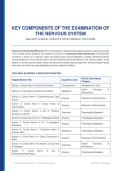
KEY COMPONENTS OF THE EXAMINATION OF
THE NERVOUS SYSTEM
2026-2027 CLINICAL UPDATE & STUDY MANUAL TEST BANK
Overview of the Clinical Resource: This comprehensive, professionally typeset test bank is directly grounded
in the verified clinical guidelines and textbook curriculum for Advanced Health Assessment at Chamberlain
University. It serves as a rigorous, highly educational study manual designed to prepare advanced practice
nursing students for clinical board exams and real-world physical examinations of the nervous system. Every
question is framed around realistic clinical scenarios and includes learning objectives, detailed evidence-based
rationales, and critical warnings highlighting common cognitive mistakes.
TEST BANK BLUEPRINT & SPECIFICATION MATRIX
NCLEX Client Needs
Chapter/Section Title Cognitive Levels
Category
Section 1: Mental Status & Cognitive Evaluation Comprehension Management of Care
Health Promotion &
Section 2: Cranial Nerve I (Olfactory Sensation) Application
Maintenance
Section 3: Cranial Nerve II (Ophthalmoscopic Optic
Analysis Reduction of Risk Potential
Fundi)
Section 4: Cranial Nerve II (Visual Fields by
Analysis Reduction of Risk Potential
Confrontation)
Section 5: Cranial Nerves II and III (Pupillary
Evaluation Physiological Adaptation
Dynamics & Horner)
Section 6: Cranial Nerves III, IV, VI (Diplopia & Ptosis) Analysis Physiological Adaptation
Section 7: Cranial Nerves III, IV, VI (Nystagmus
Analysis Physiological Adaptation
Etiologies)
Section 8: Cranial Nerve V (Trigeminal Motor &
Application Physiological Adaptation
Sensory Path)
Section 9: Cranial Nerve VII (Facial Expressions &
Analysis Reduction of Risk Potential
Bell's)
Section 10: Cranial Nerve VIII (Auditory Tuning Forks Health Promotion &
Evaluation
& Pathways) Maintenance
Section 11: Cranial Nerves IX and X
Analysis Physiological Adaptation
(Glossopharyngeal/Vagus)
Advanced Health Assessment — Chamberlain University 2026-2027 Clinical Manual
,Section 12: Cranial Nerve XI (Spinal Accessory
Application Physiological Adaptation
Strength)
Section 13: Cranial Nerve XII (Hypoglossal Tongue
Analysis Reduction of Risk Potential
Deviation)
Section 14: Motor System (Muscle Bulk & Tone
Analysis Physiological Adaptation
Evaluation)
Section 15: Motor System (Upper Extremity Myotome Health Promotion &
Application
Levels) Maintenance
Section 16: Motor System (Lower Extremity Myotome Health Promotion &
Application
Levels) Maintenance
Section 17: Coordination (Proprioception & Romberg
Evaluation Reduction of Risk Potential
Mechanics)
Section 18: Sensory System (Discriminative
Application Reduction of Risk Potential
Stereognosis)
Section 19: Reflexes (Deep Tendon Reflexes &
Application Physiological Adaptation
Myotatic Spinal)
Section 20: Reflexes (Superficial Plantar Response &
Evaluation Physiological Adaptation
Cutaneous)
Advanced Health Assessment — Chamberlain University 2026-2027 Clinical Manual
, SECTION 1: MENTAL STATUS & COGNITIVE EVALUATION
Question 1
Learning Objective: Differentiate components of the mental status examination, focusing on abstract reasoning.
During a comprehensive mental status examination, an advanced practice nurse evaluates a patient's cognitive
abilities. Which of the following clinical tests is the most appropriate method to specifically assess the patient's
abstract reasoning?
A The patient repeats 3 words after 10 minutes to test short-term recall.
.
B The patient names the current president and details personal medical histories.
.
C The patient explains a common proverb, such as 'Don't cry over spilled milk.'
.
D The patient reads aloud from a clinical manual and defines complex medical acronyms.
.
ANSWER ■: C
Detailed Explanation: Abstract reasoning is assessed by asking the patient to explain a common proverb
(e.g., 'Don't cry over spilled milk') or by having them identify similarities between two objects (e.g., orange and
apple). Option A describes testing short-term memory or recall. Option B describes testing long-term memory
or general information. Option D describes testing language function (fluency, repetition, and reading), not
higher-level abstract reasoning.
Key Concept: Abstract reasoning requires the patient to move beyond concrete interpretations of metaphors
or comparisons to identify generalized principles.
■■ COMMON MISTAKE: Students commonly confuse concrete cognitive tasks (like memory recall or calculating serial
sevens) with conceptual abstract reasoning assessments, which rely on proverb interpretation or similarities.
DIFFICULTY: Cognitive Level: Understanding (Comprehension) | MSC: Client Needs: Safe and Effective Care Environment:
Management of Care
Advanced Health Assessment — Chamberlain University 2026-2027 Clinical Manual
THE NERVOUS SYSTEM
2026-2027 CLINICAL UPDATE & STUDY MANUAL TEST BANK
Overview of the Clinical Resource: This comprehensive, professionally typeset test bank is directly grounded
in the verified clinical guidelines and textbook curriculum for Advanced Health Assessment at Chamberlain
University. It serves as a rigorous, highly educational study manual designed to prepare advanced practice
nursing students for clinical board exams and real-world physical examinations of the nervous system. Every
question is framed around realistic clinical scenarios and includes learning objectives, detailed evidence-based
rationales, and critical warnings highlighting common cognitive mistakes.
TEST BANK BLUEPRINT & SPECIFICATION MATRIX
NCLEX Client Needs
Chapter/Section Title Cognitive Levels
Category
Section 1: Mental Status & Cognitive Evaluation Comprehension Management of Care
Health Promotion &
Section 2: Cranial Nerve I (Olfactory Sensation) Application
Maintenance
Section 3: Cranial Nerve II (Ophthalmoscopic Optic
Analysis Reduction of Risk Potential
Fundi)
Section 4: Cranial Nerve II (Visual Fields by
Analysis Reduction of Risk Potential
Confrontation)
Section 5: Cranial Nerves II and III (Pupillary
Evaluation Physiological Adaptation
Dynamics & Horner)
Section 6: Cranial Nerves III, IV, VI (Diplopia & Ptosis) Analysis Physiological Adaptation
Section 7: Cranial Nerves III, IV, VI (Nystagmus
Analysis Physiological Adaptation
Etiologies)
Section 8: Cranial Nerve V (Trigeminal Motor &
Application Physiological Adaptation
Sensory Path)
Section 9: Cranial Nerve VII (Facial Expressions &
Analysis Reduction of Risk Potential
Bell's)
Section 10: Cranial Nerve VIII (Auditory Tuning Forks Health Promotion &
Evaluation
& Pathways) Maintenance
Section 11: Cranial Nerves IX and X
Analysis Physiological Adaptation
(Glossopharyngeal/Vagus)
Advanced Health Assessment — Chamberlain University 2026-2027 Clinical Manual
,Section 12: Cranial Nerve XI (Spinal Accessory
Application Physiological Adaptation
Strength)
Section 13: Cranial Nerve XII (Hypoglossal Tongue
Analysis Reduction of Risk Potential
Deviation)
Section 14: Motor System (Muscle Bulk & Tone
Analysis Physiological Adaptation
Evaluation)
Section 15: Motor System (Upper Extremity Myotome Health Promotion &
Application
Levels) Maintenance
Section 16: Motor System (Lower Extremity Myotome Health Promotion &
Application
Levels) Maintenance
Section 17: Coordination (Proprioception & Romberg
Evaluation Reduction of Risk Potential
Mechanics)
Section 18: Sensory System (Discriminative
Application Reduction of Risk Potential
Stereognosis)
Section 19: Reflexes (Deep Tendon Reflexes &
Application Physiological Adaptation
Myotatic Spinal)
Section 20: Reflexes (Superficial Plantar Response &
Evaluation Physiological Adaptation
Cutaneous)
Advanced Health Assessment — Chamberlain University 2026-2027 Clinical Manual
, SECTION 1: MENTAL STATUS & COGNITIVE EVALUATION
Question 1
Learning Objective: Differentiate components of the mental status examination, focusing on abstract reasoning.
During a comprehensive mental status examination, an advanced practice nurse evaluates a patient's cognitive
abilities. Which of the following clinical tests is the most appropriate method to specifically assess the patient's
abstract reasoning?
A The patient repeats 3 words after 10 minutes to test short-term recall.
.
B The patient names the current president and details personal medical histories.
.
C The patient explains a common proverb, such as 'Don't cry over spilled milk.'
.
D The patient reads aloud from a clinical manual and defines complex medical acronyms.
.
ANSWER ■: C
Detailed Explanation: Abstract reasoning is assessed by asking the patient to explain a common proverb
(e.g., 'Don't cry over spilled milk') or by having them identify similarities between two objects (e.g., orange and
apple). Option A describes testing short-term memory or recall. Option B describes testing long-term memory
or general information. Option D describes testing language function (fluency, repetition, and reading), not
higher-level abstract reasoning.
Key Concept: Abstract reasoning requires the patient to move beyond concrete interpretations of metaphors
or comparisons to identify generalized principles.
■■ COMMON MISTAKE: Students commonly confuse concrete cognitive tasks (like memory recall or calculating serial
sevens) with conceptual abstract reasoning assessments, which rely on proverb interpretation or similarities.
DIFFICULTY: Cognitive Level: Understanding (Comprehension) | MSC: Client Needs: Safe and Effective Care Environment:
Management of Care
Advanced Health Assessment — Chamberlain University 2026-2027 Clinical Manual