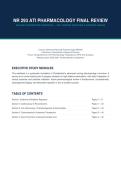
NR 293 ATI PHARMACOLOGY FINAL REVIEW
2026-2027 EXAM MASTER WORKBOOK — 100% VERIFIED QUESTIONS & ANSWERS AGRADE
Course: Advanced Nursing Pharmacology (NR293)
Institution: Chamberlain College of Nursing
Focus: Comprehensive ATI Pharmacology Preparation & HPA Axis Analysis
Release Cycle: 2026–2027 Verified Rotation Guidelines
EXECUTIVE STUDY MODULES
This workbook is a systematic translation of Chamberlain's advanced nursing pharmacology curriculum. It
serves as an active-learning tool to prepare students for high-stakes examinations, with direct integration of
clinical scenarios and rationale validation. Active pharmacological review of levothyroxine, corticosteroids,
anticoagulant bridging, and electrolyte regulation is key to student success.
TABLE OF CONTENTS
Section I: Endocrine & Metabolic Regulation Pages 3 – 10
Section II: Cardiovascular & Renal Systems Pages 11 – 20
Section III: Anti-Inflammatory, Chemotherapeutics & Antimicrobials Pages 21 – 30
Section IV: Gastrointestinal & Autonomic Therapeutics Pages 31 – 40
Section V: Neuro-Psychiatric & Advanced Cardiac Care Pages 41 – 50
,NR 293 ATI PHARMACOLOGY FINAL REVIEW 2026-2027 EXAM MASTER WORKBOOK
CLINICAL PRACTICE MODULES & SYSTEMATIC PHARMACOLOGY
Endocrine Feedback Mechanisms (Levothyroxine & Corticosteroids)
The hypothalamic-pituitary-thyroid (HPT) axis regulates metabolism via thyroid stimulating hormone (TSH)
and thyroxine (T4). In hypothyroid states, TSH rises in an attempt to stimulate a nonfunctional thyroid gland.
Administration of exogenous levothyroxine turns off this pituitary feedback loop, reducing serum TSH to
normal. Corticosteroids like prednisone act similarly to endogenous cortisol; abrupt withdrawal suppresses
the hypothalamic-pituitary-adrenal (HPA) axis, precipitating a life-threatening adrenal crisis (adrenocortical
insufficiency) due to adrenal atrophy.
Cardiovascular & Diuretic Electrolyte Pathways
Loop diuretics like furosemide inhibit the Na+/K+/2Cl- symporter in the thick ascending limb of Henle's loop,
causing profound excretion of sodium, potassium, calcium, magnesium, and chloride. This requires
meticulous monitoring for hypokalemia (often presenting as painful leg cramps) and hypocalcemia.
Conversely, it decreases uric acid clearance, risking hyperuricemia and acute gout attacks.
Anticoagulant Bridging Therapy (Heparin and Warfarin)
Warfarin's mechanism of action involves inhibiting Vitamin K epoxide reductase, which has a slow onset of 3
to 5 days because it does not affect circulating clotting factors. During this lag time, fast-acting parenteral
anticoagulants like heparin must be co-administered ('bridged') to protect the client. Continuous IV heparin
stops clot growth but does not dissolve them; that relies on the body's natural fibrinolysis. Heparin is
monitored via aPTT, whereas warfarin is monitored via PT/INR.
Chamberlain College of Nursing — 100% Verified Questions and Answers Agrade Page 2 of 50
,NR 293 ATI PHARMACOLOGY FINAL REVIEW 2026-2027 EXAM MASTER WORKBOOK
Question 1: A nurse is assessing a client who is taking levothyroxine. The nurse should
recognize that which of the following findings is a manifestation of levothyroxine overdose?
A. Constipation
B. Drowsiness
C. Insomnia
D. Hypoactive deep-tendon reflexes
ANSWER ■: C — Insomnia
Levothyroxine overdose will result in manifestations of hyperthyroidism, which include insomnia, tachycardia, and
hyperthermia. Constipation, drowsiness, and hypoactive deep-tendon reflexes are classic manifestations of
hypothyroidism, indicating an inadequate or subtherapeutic dose of levothyroxine.
Question 2: A nurse is reviewing the medical record of a client who has been on levothyroxine
for several months. Which of the following findings indicates a therapeutic response to the
medication?
A. Decrease in level of thyroxine (T4)
B. Increase in weight
C. Increase in hours of sleep per night
D. Decrease in level of thyroid stimulating hormone (TSH)
ANSWER ■: D — Decrease in level of thyroid stimulating hormone (TSH)
In hypothyroidism, the nonfunctioning thyroid gland is unable to respond to TSH, and no endogenous thyroid hormones
are released. This results in an elevation of the TSH level as the anterior pituitary continues to release TSH to stimulate
the thyroid gland. Administration of exogenous thyroid hormones, such as levothyroxine, turns off this feedback loop,
which results in a decreased level of TSH. A therapeutic response would also include an increase in T4, a decrease in
weight (due to increased metabolism), and a decrease in hours of sleep per night (due to resolved sluggishness).
Chamberlain College of Nursing — 100% Verified Questions and Answers Agrade Page 3 of 50
, NR 293 ATI PHARMACOLOGY FINAL REVIEW 2026-2027 EXAM MASTER WORKBOOK
Question 3: A nurse is reviewing the medication list for a client who has a new diagnosis of type
2 diabetes mellitus. The nurse should recognize which of the following medications can cause
glucose intolerance?
A. Ranitidine
B. Guaifenesin
C. Prednisone
D. Atorvastatin
ANSWER ■: C — Prednisone
Prednisone is a corticosteroid that can cause glucose intolerance and hyperglycemia. Clients taking corticosteroids may
require an increased dosage of hypoglycemic medication or insulin. Ranitidine can occasionally elevate serum
creatinine. Guaifenesin can cause mild drowsiness or dizziness. Atorvastatin is associated with muscle toxicity and liver
enzyme elevations but not glucose intolerance.
Question 4: A nurse is assessing a client after administering mydriatic eye drops. Which of the
following manifestations indicates to the nurse that the client has developed a systemic
anticholinergic effect?
A. Seizures
B. Tachypnea
C. Constipation
D. Hypothermia
ANSWER ■: C — Constipation
Mydriatic eye drops can cause systemic anticholinergic effects such as constipation, dry mouth, photophobia, blurred
vision, and tachycardia due to systemic absorption. Seizures, tachypnea, and hypothermia are not standard systemic
anticholinergic effects of mydriatics.
Chamberlain College of Nursing — 100% Verified Questions and Answers Agrade Page 4 of 50
2026-2027 EXAM MASTER WORKBOOK — 100% VERIFIED QUESTIONS & ANSWERS AGRADE
Course: Advanced Nursing Pharmacology (NR293)
Institution: Chamberlain College of Nursing
Focus: Comprehensive ATI Pharmacology Preparation & HPA Axis Analysis
Release Cycle: 2026–2027 Verified Rotation Guidelines
EXECUTIVE STUDY MODULES
This workbook is a systematic translation of Chamberlain's advanced nursing pharmacology curriculum. It
serves as an active-learning tool to prepare students for high-stakes examinations, with direct integration of
clinical scenarios and rationale validation. Active pharmacological review of levothyroxine, corticosteroids,
anticoagulant bridging, and electrolyte regulation is key to student success.
TABLE OF CONTENTS
Section I: Endocrine & Metabolic Regulation Pages 3 – 10
Section II: Cardiovascular & Renal Systems Pages 11 – 20
Section III: Anti-Inflammatory, Chemotherapeutics & Antimicrobials Pages 21 – 30
Section IV: Gastrointestinal & Autonomic Therapeutics Pages 31 – 40
Section V: Neuro-Psychiatric & Advanced Cardiac Care Pages 41 – 50
,NR 293 ATI PHARMACOLOGY FINAL REVIEW 2026-2027 EXAM MASTER WORKBOOK
CLINICAL PRACTICE MODULES & SYSTEMATIC PHARMACOLOGY
Endocrine Feedback Mechanisms (Levothyroxine & Corticosteroids)
The hypothalamic-pituitary-thyroid (HPT) axis regulates metabolism via thyroid stimulating hormone (TSH)
and thyroxine (T4). In hypothyroid states, TSH rises in an attempt to stimulate a nonfunctional thyroid gland.
Administration of exogenous levothyroxine turns off this pituitary feedback loop, reducing serum TSH to
normal. Corticosteroids like prednisone act similarly to endogenous cortisol; abrupt withdrawal suppresses
the hypothalamic-pituitary-adrenal (HPA) axis, precipitating a life-threatening adrenal crisis (adrenocortical
insufficiency) due to adrenal atrophy.
Cardiovascular & Diuretic Electrolyte Pathways
Loop diuretics like furosemide inhibit the Na+/K+/2Cl- symporter in the thick ascending limb of Henle's loop,
causing profound excretion of sodium, potassium, calcium, magnesium, and chloride. This requires
meticulous monitoring for hypokalemia (often presenting as painful leg cramps) and hypocalcemia.
Conversely, it decreases uric acid clearance, risking hyperuricemia and acute gout attacks.
Anticoagulant Bridging Therapy (Heparin and Warfarin)
Warfarin's mechanism of action involves inhibiting Vitamin K epoxide reductase, which has a slow onset of 3
to 5 days because it does not affect circulating clotting factors. During this lag time, fast-acting parenteral
anticoagulants like heparin must be co-administered ('bridged') to protect the client. Continuous IV heparin
stops clot growth but does not dissolve them; that relies on the body's natural fibrinolysis. Heparin is
monitored via aPTT, whereas warfarin is monitored via PT/INR.
Chamberlain College of Nursing — 100% Verified Questions and Answers Agrade Page 2 of 50
,NR 293 ATI PHARMACOLOGY FINAL REVIEW 2026-2027 EXAM MASTER WORKBOOK
Question 1: A nurse is assessing a client who is taking levothyroxine. The nurse should
recognize that which of the following findings is a manifestation of levothyroxine overdose?
A. Constipation
B. Drowsiness
C. Insomnia
D. Hypoactive deep-tendon reflexes
ANSWER ■: C — Insomnia
Levothyroxine overdose will result in manifestations of hyperthyroidism, which include insomnia, tachycardia, and
hyperthermia. Constipation, drowsiness, and hypoactive deep-tendon reflexes are classic manifestations of
hypothyroidism, indicating an inadequate or subtherapeutic dose of levothyroxine.
Question 2: A nurse is reviewing the medical record of a client who has been on levothyroxine
for several months. Which of the following findings indicates a therapeutic response to the
medication?
A. Decrease in level of thyroxine (T4)
B. Increase in weight
C. Increase in hours of sleep per night
D. Decrease in level of thyroid stimulating hormone (TSH)
ANSWER ■: D — Decrease in level of thyroid stimulating hormone (TSH)
In hypothyroidism, the nonfunctioning thyroid gland is unable to respond to TSH, and no endogenous thyroid hormones
are released. This results in an elevation of the TSH level as the anterior pituitary continues to release TSH to stimulate
the thyroid gland. Administration of exogenous thyroid hormones, such as levothyroxine, turns off this feedback loop,
which results in a decreased level of TSH. A therapeutic response would also include an increase in T4, a decrease in
weight (due to increased metabolism), and a decrease in hours of sleep per night (due to resolved sluggishness).
Chamberlain College of Nursing — 100% Verified Questions and Answers Agrade Page 3 of 50
, NR 293 ATI PHARMACOLOGY FINAL REVIEW 2026-2027 EXAM MASTER WORKBOOK
Question 3: A nurse is reviewing the medication list for a client who has a new diagnosis of type
2 diabetes mellitus. The nurse should recognize which of the following medications can cause
glucose intolerance?
A. Ranitidine
B. Guaifenesin
C. Prednisone
D. Atorvastatin
ANSWER ■: C — Prednisone
Prednisone is a corticosteroid that can cause glucose intolerance and hyperglycemia. Clients taking corticosteroids may
require an increased dosage of hypoglycemic medication or insulin. Ranitidine can occasionally elevate serum
creatinine. Guaifenesin can cause mild drowsiness or dizziness. Atorvastatin is associated with muscle toxicity and liver
enzyme elevations but not glucose intolerance.
Question 4: A nurse is assessing a client after administering mydriatic eye drops. Which of the
following manifestations indicates to the nurse that the client has developed a systemic
anticholinergic effect?
A. Seizures
B. Tachypnea
C. Constipation
D. Hypothermia
ANSWER ■: C — Constipation
Mydriatic eye drops can cause systemic anticholinergic effects such as constipation, dry mouth, photophobia, blurred
vision, and tachycardia due to systemic absorption. Seizures, tachypnea, and hypothermia are not standard systemic
anticholinergic effects of mydriatics.
Chamberlain College of Nursing — 100% Verified Questions and Answers Agrade Page 4 of 50