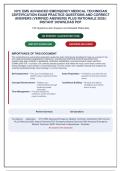
NYC EMS ADVANCED EMERGENCY MEDICAL TECHNICIAN
CERTIFICATION EXAM PRACTICE QUESTIONS AND CORRECT
ANSWERS (VERIFIED ANSWERS) PLUS RATIONALE 2026/|
INSTANT DOWNLOAD PDF
130 Questions with Answers and Detailed Rationales
100 PERCENT GUARANTEED PASS
INSTANT DOWNLOAD ANSWERS INCLUDED
IMPORTANCE OF THIS DOCUMENT
This comprehensive examination preparation guide has been meticulously developed to help you succeed in the
NYC EMS ADVANCED EMERGENCY MEDICAL TECHNICIAN CERTIFICATION EXAM PRACTICE
QUESTIONS AND CORRECT ANSWERS (VERIFIED ANSWERS) PLUS RATIONALE 2026/| INSTANT
DOWNLOAD PDF. It contains 130 carefully selected questions that reflect the most current exam content and
testing strategies. Each question is accompanied by a correct answer and a detailed rationale that explains the
underlying pathophysiology, pharmacology, or clinical reasoning.
Self-Assessment – Test your knowledge and Exam Preparation – Familiarize yourself with the
identify areas requiring further question format and content
study areas
Concept Reinforcement – Deepen your Confidence Building – Develop test-taking
understanding through strategies and reduce
evidence-based exam anxiety
rationales
Time Management – Practice answering
questions under simulated
exam conditions
Review Summary 130 Questions
Foundations - Application - NYC EMS Advanced Emergency Medical Technician Certification AND Correct
PLUS Rationale 2026/ Instant Download PDF Emergency Medical Services EMS Advanced Emergency
Medical Technician AEMT Advanced Undergraduate / Graduate
All answers with rationales
,Table of Contents
Content Area Questions Key Topics
Airway Respiration AND 1-22 Appropriate, Immediate, Chest, Respiratory, Intervention
Ventilation
Cardiology AND 23-44 Presents, History, Respiratory, Appropriate, Suspected
Resuscitation
Trauma 45-66 Appropriate, Respiratory, Describes, Injury, Prehospital
Medical Emergencies 67-88 Appropriate, Severe, Suspected, Immediate, Rhythm
EMS Operations 89-110 Appropriate, Prehospital, History, Presents, Chest
Pediatrics 111-130 Appropriate, Respiratory, Describes, History, Acute
TOTAL 130 All questions include answers and detailed rationales
,Section A - Airway Respiration AND Ventilation
Q1.
A patient with severe respiratory distress has a SpO of 82% on high-flow oxygen. They are
conscious and have a strong cough. Which intervention is most appropriate to improve
oxygenation and avoid complications?
A. Initiate CPAP at 10 cm HO B. Perform immediate endotracheal
intubation
C. Administer nebulized albuterol D. Place patient in supine position
Correct: A - Initiate CPAP at 10 cm HO
Rationale:CPAP provides positive pressure to recruit alveoli and improve oxygenation without
the risks of intubation. The patient is conscious with a strong cough, so intubation is not yet
indicated. Albuterol is for bronchospasm, not hypoxemia per se. Supine positioning can
worsen respiratory mechanics.
Why the other answers are wrong:
B. Intubation is invasive and unnecessary if the patient can maintain their airway and is
conscious.
C. Albuterol does not directly improve oxygenation in non-bronchospastic conditions.
D. Supine positioning can exacerbate ventilation-perfusion mismatch and respiratory distress.
Reference: AHA 2020 Guidelines for CPR and ECC; NAEMSP Prehospital CPAP Recommendations
Q2.
Which ECG finding is most indicative of hyperkalemia and warrants immediate treatment?
A. Peaked T waves B. Prolonged PR interval
C. Wide QRS complex D. ST-segment depression
Correct: C - Wide QRS complex
Rationale:Wide QRS complex in hyperkalemia indicates severe cardiac conduction
impairment, which is immediately life-threatening and requires emergent treatment. Peaked T
waves are an early sign but not as critical. Prolonged PR and ST depression are less specific.
Why the other answers are wrong:
A. Peaked T waves are an early sign but not as immediately life-threatening as a wide QRS.
B. Prolonged PR interval can occur but is not the most indicative of severe hyperkalemia.
D. ST-segment depression is not a classic sign of hyperkalemia.
Reference: Marx, J. (2025). Rosen's Emergency Medicine, 10th Ed., Ch. 119
Page 3
, Section A - Airway Respiration AND Ventilation
Q3.
During a mass-casualty incident, which patient should be triaged as 'immediate' (red tag)
according to START?
A. Patient with a radial pulse of 120/min and B. Patient who is apneic after opening the
capillary refill < 2 seconds airway
C. Patient with a respiratory rate of 8/min D. Patient who is able to walk but has a
fractured femur
Correct: C - Patient with a respiratory rate of 8/min
Rationale:In START triage, a respiratory rate < 10 or > 30 is classified as immediate (red). A
patient with a radial pulse and normal capillary refill is delayed (yellow). Apneic after airway
opening is dead (black). Walking wounded are green.
Why the other answers are wrong:
A. This patient has adequate perfusion and would be classified as delayed.
B. Apnea after airway opening indicates death in START triage.
D. Walking wounded are classified as green (minor).
Reference: START Triage Algorithm, CDC
Q4.
Which medication is most appropriate for a patient with symptomatic bradycardia
unresponsive to atropine?
A. Dopamine infusion B. Epinephrine 1 mg IV push
C. Adenosine 6 mg rapid push D. Amiodarone 300 mg IV
Correct: A - Dopamine infusion
Rationale:Dopamine is a vasopressor that increases heart rate and blood pressure, making it
appropriate for symptomatic bradycardia after atropine failure. Epinephrine is also used, but
dopamine is specifically indicated per ACLS guidelines. Adenosine treats tachyarrhythmias,
and amiodarone is for ventricular arrhythmias.
Why the other answers are wrong:
B. Epinephrine is an alternative but not the first-line after atropine; dopamine is preferred.
C. Adenosine is for supraventricular tachycardia, not bradycardia.
D. Amiodarone is for ventricular arrhythmias, not bradycardia.
Reference: ACLS Guidelines 2020; AHA
Q5.
Which finding is most consistent with a tension pneumothorax in a patient with
penetrating chest trauma?
Page 4
CERTIFICATION EXAM PRACTICE QUESTIONS AND CORRECT
ANSWERS (VERIFIED ANSWERS) PLUS RATIONALE 2026/|
INSTANT DOWNLOAD PDF
130 Questions with Answers and Detailed Rationales
100 PERCENT GUARANTEED PASS
INSTANT DOWNLOAD ANSWERS INCLUDED
IMPORTANCE OF THIS DOCUMENT
This comprehensive examination preparation guide has been meticulously developed to help you succeed in the
NYC EMS ADVANCED EMERGENCY MEDICAL TECHNICIAN CERTIFICATION EXAM PRACTICE
QUESTIONS AND CORRECT ANSWERS (VERIFIED ANSWERS) PLUS RATIONALE 2026/| INSTANT
DOWNLOAD PDF. It contains 130 carefully selected questions that reflect the most current exam content and
testing strategies. Each question is accompanied by a correct answer and a detailed rationale that explains the
underlying pathophysiology, pharmacology, or clinical reasoning.
Self-Assessment – Test your knowledge and Exam Preparation – Familiarize yourself with the
identify areas requiring further question format and content
study areas
Concept Reinforcement – Deepen your Confidence Building – Develop test-taking
understanding through strategies and reduce
evidence-based exam anxiety
rationales
Time Management – Practice answering
questions under simulated
exam conditions
Review Summary 130 Questions
Foundations - Application - NYC EMS Advanced Emergency Medical Technician Certification AND Correct
PLUS Rationale 2026/ Instant Download PDF Emergency Medical Services EMS Advanced Emergency
Medical Technician AEMT Advanced Undergraduate / Graduate
All answers with rationales
,Table of Contents
Content Area Questions Key Topics
Airway Respiration AND 1-22 Appropriate, Immediate, Chest, Respiratory, Intervention
Ventilation
Cardiology AND 23-44 Presents, History, Respiratory, Appropriate, Suspected
Resuscitation
Trauma 45-66 Appropriate, Respiratory, Describes, Injury, Prehospital
Medical Emergencies 67-88 Appropriate, Severe, Suspected, Immediate, Rhythm
EMS Operations 89-110 Appropriate, Prehospital, History, Presents, Chest
Pediatrics 111-130 Appropriate, Respiratory, Describes, History, Acute
TOTAL 130 All questions include answers and detailed rationales
,Section A - Airway Respiration AND Ventilation
Q1.
A patient with severe respiratory distress has a SpO of 82% on high-flow oxygen. They are
conscious and have a strong cough. Which intervention is most appropriate to improve
oxygenation and avoid complications?
A. Initiate CPAP at 10 cm HO B. Perform immediate endotracheal
intubation
C. Administer nebulized albuterol D. Place patient in supine position
Correct: A - Initiate CPAP at 10 cm HO
Rationale:CPAP provides positive pressure to recruit alveoli and improve oxygenation without
the risks of intubation. The patient is conscious with a strong cough, so intubation is not yet
indicated. Albuterol is for bronchospasm, not hypoxemia per se. Supine positioning can
worsen respiratory mechanics.
Why the other answers are wrong:
B. Intubation is invasive and unnecessary if the patient can maintain their airway and is
conscious.
C. Albuterol does not directly improve oxygenation in non-bronchospastic conditions.
D. Supine positioning can exacerbate ventilation-perfusion mismatch and respiratory distress.
Reference: AHA 2020 Guidelines for CPR and ECC; NAEMSP Prehospital CPAP Recommendations
Q2.
Which ECG finding is most indicative of hyperkalemia and warrants immediate treatment?
A. Peaked T waves B. Prolonged PR interval
C. Wide QRS complex D. ST-segment depression
Correct: C - Wide QRS complex
Rationale:Wide QRS complex in hyperkalemia indicates severe cardiac conduction
impairment, which is immediately life-threatening and requires emergent treatment. Peaked T
waves are an early sign but not as critical. Prolonged PR and ST depression are less specific.
Why the other answers are wrong:
A. Peaked T waves are an early sign but not as immediately life-threatening as a wide QRS.
B. Prolonged PR interval can occur but is not the most indicative of severe hyperkalemia.
D. ST-segment depression is not a classic sign of hyperkalemia.
Reference: Marx, J. (2025). Rosen's Emergency Medicine, 10th Ed., Ch. 119
Page 3
, Section A - Airway Respiration AND Ventilation
Q3.
During a mass-casualty incident, which patient should be triaged as 'immediate' (red tag)
according to START?
A. Patient with a radial pulse of 120/min and B. Patient who is apneic after opening the
capillary refill < 2 seconds airway
C. Patient with a respiratory rate of 8/min D. Patient who is able to walk but has a
fractured femur
Correct: C - Patient with a respiratory rate of 8/min
Rationale:In START triage, a respiratory rate < 10 or > 30 is classified as immediate (red). A
patient with a radial pulse and normal capillary refill is delayed (yellow). Apneic after airway
opening is dead (black). Walking wounded are green.
Why the other answers are wrong:
A. This patient has adequate perfusion and would be classified as delayed.
B. Apnea after airway opening indicates death in START triage.
D. Walking wounded are classified as green (minor).
Reference: START Triage Algorithm, CDC
Q4.
Which medication is most appropriate for a patient with symptomatic bradycardia
unresponsive to atropine?
A. Dopamine infusion B. Epinephrine 1 mg IV push
C. Adenosine 6 mg rapid push D. Amiodarone 300 mg IV
Correct: A - Dopamine infusion
Rationale:Dopamine is a vasopressor that increases heart rate and blood pressure, making it
appropriate for symptomatic bradycardia after atropine failure. Epinephrine is also used, but
dopamine is specifically indicated per ACLS guidelines. Adenosine treats tachyarrhythmias,
and amiodarone is for ventricular arrhythmias.
Why the other answers are wrong:
B. Epinephrine is an alternative but not the first-line after atropine; dopamine is preferred.
C. Adenosine is for supraventricular tachycardia, not bradycardia.
D. Amiodarone is for ventricular arrhythmias, not bradycardia.
Reference: ACLS Guidelines 2020; AHA
Q5.
Which finding is most consistent with a tension pneumothorax in a patient with
penetrating chest trauma?
Page 4