

Written by students who passed Immediately available after payment Read online or as PDF Wrong document? Swap it for free 4.6 TrustPilot
logo-home
Document preview thumbnail
Preview 4 out of 72 pages
Exam (elaborations)

Milady Esthetics Final Exam Review 2026/2027 – 300+ Questions & Answers | Skin Care, Facials, Anatomy, Infection Control, Electricity, Hair Removal & Makeup

Document preview thumbnail
Preview 4 out of 72 pages

This comprehensive Milady Esthetics Final Exam Review 2026/2027 contains 300+ exam-style questions with answers across 72 pages, designed for extensive review of the knowledge and practical concepts covered in esthetics education. Major topics include skin care and analysis, facial treatments, anatomy and physiology, bacteriology and infection control, skin diseases and disorders, cosmetic chemistry, electricity and electrotherapy, hair removal, makeup and color theory, massage, product ingredients, exfoliation, masks, professional practices, and esthetics licensing concepts. The review begins with practical facial, waxing, makeup, and spa-treatment concepts. Students encounter questions on eye pads and compress-mask materials, waxing angles and hair-removal procedures, epilation and electrolysis, paraffin masks, facial steaming, corrective makeup, foundations, face shapes, highlighting techniques, color theory, aromatherapy, phytotherapy, herbal therapy, reflexology, lymphatic drainage massage, thalassotherapy, and balneotherapy. It also introduces cosmetic and aesthetic procedures such as rhytidectomy, blepharoplasty, rhinoplasty, and submandibular lipectomy. A substantial portion covers infection control, bacteriology, sanitation, disinfection, and salon safety. The material reviews pathogenic and non-pathogenic bacteria, cocci, bacilli, spirilla, viruses, HIV, hepatitis, blood-borne pathogens, local and general infections, parasites, immunity, asepsis, sanitation, disinfection, sterilization, EPA-approved hospital-grade disinfectants, sharps disposal, autoclaves, and Universal Precautions. Students also review the roles of organizations and safety resources such as the EPA, OSHA, and safety data documentation. The anatomy and physiology section provides broad preparation in cells, tissues, organs, body systems, skeletal anatomy, muscles, joints, the nervous system, circulation, lymphatic structures, endocrine glands, digestion, and respiration. Questions cover the skull and facial bones, cervical vertebrae, shoulder and arm structures, facial muscles, muscles involved in esthetic massage, cranial nerves important to estheticians, sensory and motor nerves, blood vessels, the heart, lymph, endocrine and exocrine glands, and major respiratory structures. Another major area is cosmetic chemistry and electricity. Students review matter, elements, atoms, molecules, compounds, mixtures, physical and chemical changes, pH, oxidation, solutions, solvents, hydrophilic and lipophilic substances, emulsions, conductors and insulators, volts, ohms, amperes, watts, electrical polarity, faradic current, high-frequency current, galvanic current, iontophoresis, and disincrustation. The material connects these concepts directly to esthetic equipment and professional skin treatments. The guide provides focused preparation in esthetic machines and advanced treatment modalities, including facial steamers and vaporizers, spray machines, vacuum or suction machines, galvanic equipment, microdermabrasion, Wood's lamp analysis, ultraviolet and infrared rays, visible light, and high-frequency treatments. It also reviews characteristic Wood's lamp appearances for dehydrated skin, hyperpigmentation, oily areas, comedones, and healthy skin. An extensive dermatology and skin-disorders section covers primary and secondary lesions and common conditions encountered during skin analysis. Students review macules, papules, pustules, wheals, vesicles, bullae, scales, crusts, fissures, excoriations, scars, keloids, ulcers, comedones, milia, acne, rosacea, seborrhea, asteatosis, dermatitis, eczema, psoriasis, herpes simplex, hyperpigmentation, melasma, vitiligo, albinism, keratomas, nevi, warts, and other abnormalities. The review also addresses basal cell carcinoma, squamous cell carcinoma, malignant melanoma, and the ABCD skin-cancer recognition checklist. The integumentary system and skin anatomy material reviews the epidermis, dermis, subcutaneous tissue, keratin, melanocytes, melanin, collagen, elastin, sensory and motor nerve fibers, sebaceous glands, sudoriferous glands, apocrine and eccrine glands, and the major functions of the skin. Individual epidermal layers—including the stratum corneum, lucidum, granulosum, spinosum, and germinativum—are addressed alongside the papillary and reticular layers of the dermis. Students also receive concentrated review of skin aging, nutrition, products, and cosmetic ingredients. Topics include UVA and UVB exposure, collagen and elastin, carbohydrates, proteins, fats, vitamins, cleansers, toners, mechanical and chemical exfoliation, AHAs, enzymes, setting and non-setting masks, clay and paraffin masks, serums, moisturizers, humectants, treatment creams, plant and mineral oils, sunscreens, active and inactive ingredients, cosmeceuticals, essential oils, antioxidants, emollients, preservatives, surfactants, solvents, and product vehicles. The document additionally reviews professional esthetics practice and career preparation, including professional image, personal hygiene, posture, ethics, goal setting, teamwork, client records, consultations, product selection, treatment planning, and licensing-related requirements presented in the study material. This combination of scientific knowledge, treatment procedures, product knowledge, and professional-practice concepts makes the document suitable for broad final-exam revision rather than a single-topic review. For supplementary study, the subject matter corresponds closely to the major educational areas traditionally associated with Milady esthetics training materials, particularly skin sciences, infection control, facial treatments, ingredients and products, hair removal, makeup, anatomy and physiology, and professional practice. The uploaded document does not provide a formal book or journal bibliography, so no specific external source is presented here as the documented source of its individual answers. Relevant Students This document is particularly relevant for Milady esthetics students, esthetician students, skincare students, beauty school students, cosmetology students studying esthetics, esthetics final-exam candidates, facial specialist students, spa therapy students, skincare certification candidates, esthetics program graduates preparing for examinations, and learners reviewing foundational esthetic theory and practical procedures. It is especially useful for students seeking one resource covering skin anatomy, disorders, infection control, facials, ingredients, electrotherapy, hair removal, makeup, massage, and professional esthetics concepts. Keywords Milady Esthetics Final Exam Review 2026/2027, Milady esthetics final exam, Milady esthetics exam questions and answers, esthetics final exam questions, esthetician exam review, esthetics study guide, esthetics practice questions, skin care exam, esthetician final exam, skin anatomy, integumentary system, skin diseases and disorders, dermatology esthetics, primary skin lesions, secondary skin lesions, acne and rosacea, skin cancer ABCD, infection control esthetics, bacteriology esthetics, sanitation and disinfection, salon safety, anatomy and physiology esthetics, facial muscles, cranial nerves esthetics, cosmetic chemistry, pH scale esthetics, electrotherapy esthetics, galvanic current, high frequency facial, iontophoresis, disincrustation, Wood's lamp skin analysis, microdermabrasion, facial treatments, facial machines, esthetics skin analysis, hair removal, waxing exam questions, electrolysis, makeup color theory, corrective makeup, exfoliation, AHA exfoliation, enzyme exfoliation, facial masks, paraffin mask, skin care products, cosmetic ingredients, humectants, emollients, antioxidants, esthetics licensing, esthetician study material, beauty school exam preparation

Content preview

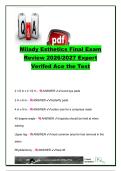
Milady Esthetics Final Exam
Review 2026/2027 Expert
Verifed Ace the Test


2 1/2 in x 2 1/2 in - ANSWER ✔✔round eye pads


2 in x 6 in - ANSWER ✔✔butterfly pads


4 in x 9 in - ANSWER ✔✔cotton size for a compress mask


45 degree angle - ANSWER ✔✔spatula should be held at when

waxing


Upper leg - ANSWER ✔✔most common area for hair removal in the

salon


Rhytidectomy - ANSWER ✔✔face lift

,Blepharaplasty - ANSWER ✔✔correction of the eye/eye lift


Submandibularlipectomy - ANSWER ✔✔chin tuck


Rhinoplasty - ANSWER ✔✔surgery of the nose


Spicy Blends - ANSWER ✔✔cinnamon, clove, vanilla, ginger


Distillation - ANSWER ✔✔uses steam or boiling water to separate the

water and fragrant oil


Expression - ANSWER ✔✔is the method where the essential oils are

pressed of the substances


Phytotherapy - ANSWER ✔✔The use of herbs to treat various

disorders


Aromatherapy - ANSWER ✔✔utilizes just the essential oils from the

plants


Herbal therapy - ANSWER ✔✔uses either the flowers, leaves or roots

of the plants


Reflexology - ANSWER ✔✔a system of massage that balances the

inner organs of the body

,The reflexology massage always starts - ANSWER ✔✔in the left foot,

which is the negative pole, and ends on the right foot.


Lymphatic drainage massage - ANSWER ✔✔is a system of massage

that helps move waste matter through the body through the lymphatic

system, thus detoxifying the body


Thalassotherapy - ANSWER ✔✔utilizes sea water and products from

the sea


Balneotherapy - ANSWER ✔✔utilize fresh water (aqua therapy)


Primary Colors - ANSWER ✔✔Red, Yellow, Blue


Secondary Colors - ANSWER ✔✔Violet, Green, Orance


Hue is - ANSWER ✔✔a color as the eye perceives it


Value is - ANSWER ✔✔the lightness or darkness of a color (light,

medium, dark red)


Tint - ANSWER ✔✔having a high color value or a lightness of the

color


Intensity is - ANSWER ✔✔the brightness or dullness of a color


3
COPYRIGHT©JOSHCLAY 2026/2027. YEAR PUBLISHED 2026. COMPANY REGISTRATION NUMBER: 619652435. TERMS OF USE. PRIVACY
STATEMENT. ALL RIGHTS RESERVED

, Shade is - ANSWER ✔✔having a low color value or the darkness of a

color


Monochromatic - ANSWER ✔✔color scheme is a single color with

variations of lightness and darkness


Analogous - ANSWER ✔✔color scheme is achieved by use of three

colors that lie adjacent to each other on the color wheel


Triadic - ANSWER ✔✔color scheme is a combination achieved by

using three colors that are equal distances apart on the color wheel


Vapor should be set approximately - ANSWER ✔✔16 inches


Wax mask (paraffin mask) - ANSWER ✔✔are generally beneficial to

dry, dehydrated skin type


Epilation - ANSWER ✔✔the removal of hair by the roots


Apply in the direction of hair growth, remove - ANSWER ✔✔in

opposite direction of the hair growth


Electrolysis - ANSWER ✔✔permanent hair can only be achieved by

using this method


Oval face - ANSWER ✔✔face shape used to form the basis for

corrective make up application

Document information

Uploaded on
August 27, 2026
Number of pages
72
Written in
2026/2027
Type
Exam (elaborations)
Contains
Questions & answers
$18.99

Wrong document? Swap it for free Within 14 days of purchase and before downloading, you can choose a different document. You can simply spend the amount again.
Written by students who passed
Immediately available after payment
Read online or as PDF

Seller avatar
Reputation scores are based on the amount of documents a seller has sold for a fee and the reviews they have received for those documents. There are three levels: Bronze, Silver and Gold. The better the reputation, the more your can rely on the quality of the sellers work.
JOSHCLAY
3.5
(83)
Sold
390
Followers
16
Items
20497
Last sold
1 day ago


Why students choose Stuvia

Created by fellow students, verified by reviews

Quality you can trust: written by students who passed their tests and reviewed by others who've used these notes.

Didn't get what you expected? Choose another document

No worries! You can instantly pick a different document that better fits what you're looking for.

Pay as you like, start learning right away

No subscription, no commitments. Pay the way you're used to via credit card and download your PDF document instantly.

Student with book image

“Bought, downloaded, and aced it. It really can be that simple.”

Alisha Student

Working on your references?

Create accurate citations in APA, MLA and Harvard with our free citation generator.

Working on your references?

Frequently asked questions

