
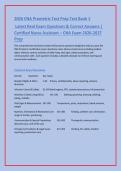
2026 CNA Prometric Test Prep Test Bank 1
Latest Real Exam Questions & Correct Answers |
Certified Nurse Assistant – CNA Exam 2026-2027
Prep
This comprehensive test bank contains 450 practice questions designed to help you pass the
CNA Prometric certification exam. Questions cover all key content areas including resident
rights, infection control, activities of daily living, vital signs, safety procedures, and
communication skills . Each question includes a detailed rationale to reinforce learning and
ensure exam readiness.
Content Area Overview
Domain Questions Key Topics
Resident Rights & Ethics 1-60 Privacy, confidentiality, abuse reporting, advance
directives
Infection Control & Safety 61-140 Hand hygiene, PPE, standard precautions, fall prevention
Activities of Daily Living (ADLs) 141-240 Bathing, grooming, dressing, toileting,
eating, mobility
Vital Signs & Measurements 241-300 Temperature, pulse, respirations, blood pressure,
weight
Nutrition, Elimination & Restorative Care 301-380 Feeding, catheter care, elimination,
range of motion, positioning
Communication & Special Populations 381-420 Therapeutic communication,
dementia care, end-of-life care
Emergency Procedures & Legal Issues 421-450 Choking, fire safety, incident
reporting, postmortem care
,SECTION 1: RESIDENT RIGHTS & ETHICS (Questions 1-60)
Question 1: A resident has an advance directive stating they do not wish to be resuscitated. The
family disagrees and wants the CNA to call 911 if the resident stops breathing. What should the
CNA do?
A) Follow the family's wishes to avoid conflict
B) Follow the advance directive as it is legally binding
C) Call the nurse and ask the nurse to handle it
D) Call 911 and let the paramedics decide
Correct Answer: B
Rationale: An advance directive is legally binding and reflects the resident's wishes. The CNA
should follow the advance directive and notify the charge nurse . The family's wishes do not
override a legally valid advance directive.
Question 2: A resident confides to the CNA that they feel depressed and "don't want to be here
anymore." What should the CNA do?
A) Tell the resident "it will get better" and change the subject
B) Report the resident's statement to the charge nurse immediately
C) Promise the resident you will not tell anyone
D) Ignore the comment since it's probably not serious
Correct Answer: B
Rationale: Statements indicating hopelessness or suicidal ideation must be reported
immediately to the nurse. The CNA should not promise confidentiality and should take all such
statements seriously .
, Question 3: Which of the following is a violation of a resident's right to privacy?
A) Pulling the privacy curtain during care
B) Closing the door before a bath
C) Discussing the resident's condition in the hallway
D) Knocking before entering the room
Correct Answer: C
Rationale: Discussing a resident's condition in a public area (hallway, cafeteria, elevator)
violates confidentiality and HIPAA. All resident information must be shared only with healthcare
team members and in private settings .
Question 4: A nurse aide sees another staff member roughly handling a resident. What should
the nurse aide do?
A) Ignore it because it's not their business
B) Confront the staff member directly
C) Report the observation to the charge nurse immediately
D) Wait to see if it happens again
Correct Answer: C
Rationale: Suspected abuse or rough handling must be reported immediately to the charge
nurse. CNAs are mandated reporters and have a legal and ethical obligation to protect residents
from harm .
Latest Real Exam Questions & Correct Answers |
Certified Nurse Assistant – CNA Exam 2026-2027
Prep
This comprehensive test bank contains 450 practice questions designed to help you pass the
CNA Prometric certification exam. Questions cover all key content areas including resident
rights, infection control, activities of daily living, vital signs, safety procedures, and
communication skills . Each question includes a detailed rationale to reinforce learning and
ensure exam readiness.
Content Area Overview
Domain Questions Key Topics
Resident Rights & Ethics 1-60 Privacy, confidentiality, abuse reporting, advance
directives
Infection Control & Safety 61-140 Hand hygiene, PPE, standard precautions, fall prevention
Activities of Daily Living (ADLs) 141-240 Bathing, grooming, dressing, toileting,
eating, mobility
Vital Signs & Measurements 241-300 Temperature, pulse, respirations, blood pressure,
weight
Nutrition, Elimination & Restorative Care 301-380 Feeding, catheter care, elimination,
range of motion, positioning
Communication & Special Populations 381-420 Therapeutic communication,
dementia care, end-of-life care
Emergency Procedures & Legal Issues 421-450 Choking, fire safety, incident
reporting, postmortem care
,SECTION 1: RESIDENT RIGHTS & ETHICS (Questions 1-60)
Question 1: A resident has an advance directive stating they do not wish to be resuscitated. The
family disagrees and wants the CNA to call 911 if the resident stops breathing. What should the
CNA do?
A) Follow the family's wishes to avoid conflict
B) Follow the advance directive as it is legally binding
C) Call the nurse and ask the nurse to handle it
D) Call 911 and let the paramedics decide
Correct Answer: B
Rationale: An advance directive is legally binding and reflects the resident's wishes. The CNA
should follow the advance directive and notify the charge nurse . The family's wishes do not
override a legally valid advance directive.
Question 2: A resident confides to the CNA that they feel depressed and "don't want to be here
anymore." What should the CNA do?
A) Tell the resident "it will get better" and change the subject
B) Report the resident's statement to the charge nurse immediately
C) Promise the resident you will not tell anyone
D) Ignore the comment since it's probably not serious
Correct Answer: B
Rationale: Statements indicating hopelessness or suicidal ideation must be reported
immediately to the nurse. The CNA should not promise confidentiality and should take all such
statements seriously .
, Question 3: Which of the following is a violation of a resident's right to privacy?
A) Pulling the privacy curtain during care
B) Closing the door before a bath
C) Discussing the resident's condition in the hallway
D) Knocking before entering the room
Correct Answer: C
Rationale: Discussing a resident's condition in a public area (hallway, cafeteria, elevator)
violates confidentiality and HIPAA. All resident information must be shared only with healthcare
team members and in private settings .
Question 4: A nurse aide sees another staff member roughly handling a resident. What should
the nurse aide do?
A) Ignore it because it's not their business
B) Confront the staff member directly
C) Report the observation to the charge nurse immediately
D) Wait to see if it happens again
Correct Answer: C
Rationale: Suspected abuse or rough handling must be reported immediately to the charge
nurse. CNAs are mandated reporters and have a legal and ethical obligation to protect residents
from harm .


