

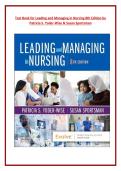
Test Bank for Leading and Managing in Nursing 8th Edition by
Patricia S. Yoder-Wise & Susan Sportsman
,Test Bank for Leading and Managing in Nursing 8th Edition by Patricia S. Yoder-
Wise & Susan Sportsman
Leadership and Management
1. Which statement best distinguishes leadership from management?
A. Leadership focuses primarily on policies
B. Management focuses primarily on vision
C. Leadership influences people toward a shared goal
D. Management eliminates the need for delegation
Answer: C
Rationale: Leadership emphasizes influence, vision, relationships, and
movement toward common goals, whereas management emphasizes
planning, organizing, coordinating, and controlling resources.
2. A nurse manager develops a staffing plan for the next month.
Which management function is demonstrated?
A. Controlling
B. Planning
C. Directing
D. Evaluating
Answer: B
Rationale: Planning involves determining goals and deciding how
resources and activities will be organized to achieve them.
3. Which behavior is characteristic of an effective transformational
leader?
A. Maintaining existing routines
B. Inspiring staff to pursue a shared vision
C. Making all decisions independently
D. Avoiding organizational change
Answer: B
,Rationale: Transformational leaders inspire followers, promote
innovation, and motivate people toward a compelling shared vision.
4. A nurse leader asks staff members to participate in developing a
new patient-safety procedure. This reflects which leadership
approach?
A. Autocratic
B. Democratic
C. Laissez-faire
D. Bureaucratic
Answer: B
Rationale: Democratic leadership involves staff participation in
decision-making.
5. Which leadership style gives employees substantial autonomy with
minimal direct supervision?
A. Autocratic
B. Transactional
C. Laissez-faire
D. Bureaucratic
Answer: C
Rationale: Laissez-faire leadership provides considerable freedom and
limited direct intervention by the leader.
6. A manager rewards an employee for meeting a performance target.
Which leadership theory is most consistent with this action?
A. Transformational
B. Transactional
C. Servant
D. Situational
Answer: B
, Rationale: Transactional leadership relies on exchanges such as
rewards for desired performance.
7. Which action best reflects servant leadership?
A. Protecting managerial authority
B. Prioritizing the development and well-being of staff
C. Avoiding staff input
D. Using punishment to motivate employees
Answer: B
Rationale: Servant leaders emphasize serving others, supporting
development, and meeting the needs of followers.
8. A nurse manager changes leadership style depending on an
employee's competence and confidence. Which theory is being
applied?
A. Situational leadership
B. Trait theory
C. Bureaucratic theory
D. Scientific management
Answer: A
Rationale: Situational leadership adapts leadership behaviors to
follower readiness, competence, and circumstances.
9. Which characteristic is most important for effective nursing
leadership?
A. Inflexibility
B. Self-awareness
C. Avoidance of feedback
D. Dependence on authority
Answer: B
Rationale: Self-awareness allows leaders to understand their strengths,
limitations, emotions, and impact on others.
Patricia S. Yoder-Wise & Susan Sportsman
,Test Bank for Leading and Managing in Nursing 8th Edition by Patricia S. Yoder-
Wise & Susan Sportsman
Leadership and Management
1. Which statement best distinguishes leadership from management?
A. Leadership focuses primarily on policies
B. Management focuses primarily on vision
C. Leadership influences people toward a shared goal
D. Management eliminates the need for delegation
Answer: C
Rationale: Leadership emphasizes influence, vision, relationships, and
movement toward common goals, whereas management emphasizes
planning, organizing, coordinating, and controlling resources.
2. A nurse manager develops a staffing plan for the next month.
Which management function is demonstrated?
A. Controlling
B. Planning
C. Directing
D. Evaluating
Answer: B
Rationale: Planning involves determining goals and deciding how
resources and activities will be organized to achieve them.
3. Which behavior is characteristic of an effective transformational
leader?
A. Maintaining existing routines
B. Inspiring staff to pursue a shared vision
C. Making all decisions independently
D. Avoiding organizational change
Answer: B
,Rationale: Transformational leaders inspire followers, promote
innovation, and motivate people toward a compelling shared vision.
4. A nurse leader asks staff members to participate in developing a
new patient-safety procedure. This reflects which leadership
approach?
A. Autocratic
B. Democratic
C. Laissez-faire
D. Bureaucratic
Answer: B
Rationale: Democratic leadership involves staff participation in
decision-making.
5. Which leadership style gives employees substantial autonomy with
minimal direct supervision?
A. Autocratic
B. Transactional
C. Laissez-faire
D. Bureaucratic
Answer: C
Rationale: Laissez-faire leadership provides considerable freedom and
limited direct intervention by the leader.
6. A manager rewards an employee for meeting a performance target.
Which leadership theory is most consistent with this action?
A. Transformational
B. Transactional
C. Servant
D. Situational
Answer: B
, Rationale: Transactional leadership relies on exchanges such as
rewards for desired performance.
7. Which action best reflects servant leadership?
A. Protecting managerial authority
B. Prioritizing the development and well-being of staff
C. Avoiding staff input
D. Using punishment to motivate employees
Answer: B
Rationale: Servant leaders emphasize serving others, supporting
development, and meeting the needs of followers.
8. A nurse manager changes leadership style depending on an
employee's competence and confidence. Which theory is being
applied?
A. Situational leadership
B. Trait theory
C. Bureaucratic theory
D. Scientific management
Answer: A
Rationale: Situational leadership adapts leadership behaviors to
follower readiness, competence, and circumstances.
9. Which characteristic is most important for effective nursing
leadership?
A. Inflexibility
B. Self-awareness
C. Avoidance of feedback
D. Dependence on authority
Answer: B
Rationale: Self-awareness allows leaders to understand their strengths,
limitations, emotions, and impact on others.


