TOPIC 1
Carbs, lipids and proteins on fl ashcards
DNA and protein synthesis
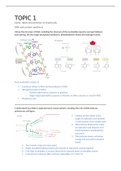
i Know the structure of DNA, including the structure of the nucleotides (purines and pyrimidines),
base pairing, the two sugar-phosphate backbones, phosphodiester bonds and hydrogen bonds.
Hydrogen bond
Each nucleotide consists of
A pentose (ribose in RNA and deoxyribose in DNA)
Nitrogenous base of either
o Double ringed purine (adenine or guanine)
o Single ringed pyrimidine (cytosine or thymine in DNA; cytosine or uracil in RNA)
Phosphoric acid
ii Understand how DNA is replicated semi-conservatively, including the role of DNA helicase,
polymerase and ligase.
1. Initiator protein binds to the
origin of replication and unwinds
a small section of the double helix
2. DNA helicase binds to the origin
of replication and attaches to H
bonds between complimentary
base pairs
3. DNA helicase lowers activation
energy and uses ATP to break H
bonds
4. Two strands unzip and move apart
5. Single stranded binding proteins join strands to stop them coming together
6. Free DNA nucleotides in nucleus attracted to exposed bases on template strand
7. H bonds form between DNA and free nucleotides: A=T and C=G
, 8. DNA polymerase binds to DNA strands
9. DNA polymerase moves along template strands in 3’->5’
10. The leading strand of DNA has nucleotides adding at 3’ end continuously as helix unwind
11. The lagging strand of DNA adds 150-200 nucleotides discontinuously at 5’ end as helix
unwinds
12. Okazaki fragments linked by DNA ligase which forms phosphodiester bonds between
deoxyribose on one nucleotide and phosphate on next
https://www.youtube.com/watch?v=cDwJTLnGEyw
DNA is a semiconservative process because when a new double stranded DNA molecule is
formed, one strand will be from the original template molecule and one strand will be newly
synthesised
iii Know that a gene is a sequence of bases on a DNA molecule coding for a sequence of amino acids
in a polypeptide chain.
Gene – a sequence of DNA nucleotide bases that encodes the sequence of amino acids in a
functional polypeptide
iv Know the structure of mRNA including nucleotides, the sugar phosphate backbone and the role of
hydrogen bonds.
Messenger RNA (mRNA) – carries a copy of a single gene to a cells ribosome
v Know the structure of tRNA, including nucleotides, the role of hydrogen
bonds and the anticodon.
Transfer RNA (tRNA) – carries individual amino acids to ribosomes during
protein synthesis.
H bonds between bases hold together the L structure of tRNA sequence.
Each tRNA contains a set of three nucleotides called an anticodon which can
bind to one or a few specific mRNA codons. tRNA molecules also carry the
amino acid encoded by the codons that the tRNA binds
Carbs, lipids and proteins on fl ashcards
DNA and protein synthesis
i Know the structure of DNA, including the structure of the nucleotides (purines and pyrimidines),
base pairing, the two sugar-phosphate backbones, phosphodiester bonds and hydrogen bonds.
Hydrogen bond
Each nucleotide consists of
A pentose (ribose in RNA and deoxyribose in DNA)
Nitrogenous base of either
o Double ringed purine (adenine or guanine)
o Single ringed pyrimidine (cytosine or thymine in DNA; cytosine or uracil in RNA)
Phosphoric acid
ii Understand how DNA is replicated semi-conservatively, including the role of DNA helicase,
polymerase and ligase.
1. Initiator protein binds to the
origin of replication and unwinds
a small section of the double helix
2. DNA helicase binds to the origin
of replication and attaches to H
bonds between complimentary
base pairs
3. DNA helicase lowers activation
energy and uses ATP to break H
bonds
4. Two strands unzip and move apart
5. Single stranded binding proteins join strands to stop them coming together
6. Free DNA nucleotides in nucleus attracted to exposed bases on template strand
7. H bonds form between DNA and free nucleotides: A=T and C=G
, 8. DNA polymerase binds to DNA strands
9. DNA polymerase moves along template strands in 3’->5’
10. The leading strand of DNA has nucleotides adding at 3’ end continuously as helix unwind
11. The lagging strand of DNA adds 150-200 nucleotides discontinuously at 5’ end as helix
unwinds
12. Okazaki fragments linked by DNA ligase which forms phosphodiester bonds between
deoxyribose on one nucleotide and phosphate on next
https://www.youtube.com/watch?v=cDwJTLnGEyw
DNA is a semiconservative process because when a new double stranded DNA molecule is
formed, one strand will be from the original template molecule and one strand will be newly
synthesised
iii Know that a gene is a sequence of bases on a DNA molecule coding for a sequence of amino acids
in a polypeptide chain.
Gene – a sequence of DNA nucleotide bases that encodes the sequence of amino acids in a
functional polypeptide
iv Know the structure of mRNA including nucleotides, the sugar phosphate backbone and the role of
hydrogen bonds.
Messenger RNA (mRNA) – carries a copy of a single gene to a cells ribosome
v Know the structure of tRNA, including nucleotides, the role of hydrogen
bonds and the anticodon.
Transfer RNA (tRNA) – carries individual amino acids to ribosomes during
protein synthesis.
H bonds between bases hold together the L structure of tRNA sequence.
Each tRNA contains a set of three nucleotides called an anticodon which can
bind to one or a few specific mRNA codons. tRNA molecules also carry the
amino acid encoded by the codons that the tRNA binds