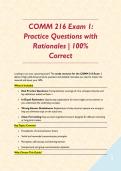
COMM 216 Exam 1:
Practice Questions with
Rationales | 100%
Correct
Looking to ace your upcoming exam? This study resource for the COMM 216 Exam 1
delivers High yield, Actual practice questions and detailed rationales you need to master the
material and boost your GPA.
What is Included
• Real Practice Questions: Comprehensive coverage of core concepts, theories, and
key definitions tested on Exam 1.
• In-Depth Rationales: Step-by-step explanations for every single correct answer so
you understand the underlying concepts.
• Wrong-Answer Breakdowns: Explanations of why incorrect options are wrong to
help you eliminate traps on the actual test.
• Clean Formatting: Easy-to-read, organized structure designed for efficient cramming
or long-term review.
Key Topics Covered
• Foundations of communication theory
• Verbal and nonverbal communication principles
• Perception, self-concept, and listening barriers
• Interpersonal and group communication dynamics
Why Choose This Guide?
1
, • Save Time: Skip hours of highlighting textbooks; get straight to the high-yield material.
• Study Smarter: Test your knowledge first, then use the rationales to fix your weak
spots immediately.
• Proven Success: Created specifically to match the rigor and style of COMM 216 exam
questions.
Q1. What do enduring, successful companies commonly have in common?
[Multiple Choice]
A) A set of clear, strongly held core values
B) A requirement that every employee hold the same job title
C) A policy of focusing only on profits
D) A strategy of avoiding relationships with publics
Answer: A set of clear, strongly held core values
Explanation: Strong core values give an enduring company a clear basis for decisions and
behavior. The alternatives describe narrow profit focus, an employment detail, or avoidance of
the relationships organizations need to build.
Q2. A public is any group whose members have _____ in a particular situation.
[Fill in the Blank]
Answer: common interests or values
Explanation: A public is defined by what its members share in a specific situation: common
interests or values. This shared connection distinguishes the group as a public.
Q3. Public relations work conducted on behalf of churches, foundations, or
hospitals is generally categorized under which employment category? [Multiple
Choice]
A) Government
B) Nonprofit organizations and trade associations
C) Corporations
D) Public relations agencies
Answer: Nonprofit organizations and trade associations
2
Practice Questions with
Rationales | 100%
Correct
Looking to ace your upcoming exam? This study resource for the COMM 216 Exam 1
delivers High yield, Actual practice questions and detailed rationales you need to master the
material and boost your GPA.
What is Included
• Real Practice Questions: Comprehensive coverage of core concepts, theories, and
key definitions tested on Exam 1.
• In-Depth Rationales: Step-by-step explanations for every single correct answer so
you understand the underlying concepts.
• Wrong-Answer Breakdowns: Explanations of why incorrect options are wrong to
help you eliminate traps on the actual test.
• Clean Formatting: Easy-to-read, organized structure designed for efficient cramming
or long-term review.
Key Topics Covered
• Foundations of communication theory
• Verbal and nonverbal communication principles
• Perception, self-concept, and listening barriers
• Interpersonal and group communication dynamics
Why Choose This Guide?
1
, • Save Time: Skip hours of highlighting textbooks; get straight to the high-yield material.
• Study Smarter: Test your knowledge first, then use the rationales to fix your weak
spots immediately.
• Proven Success: Created specifically to match the rigor and style of COMM 216 exam
questions.
Q1. What do enduring, successful companies commonly have in common?
[Multiple Choice]
A) A set of clear, strongly held core values
B) A requirement that every employee hold the same job title
C) A policy of focusing only on profits
D) A strategy of avoiding relationships with publics
Answer: A set of clear, strongly held core values
Explanation: Strong core values give an enduring company a clear basis for decisions and
behavior. The alternatives describe narrow profit focus, an employment detail, or avoidance of
the relationships organizations need to build.
Q2. A public is any group whose members have _____ in a particular situation.
[Fill in the Blank]
Answer: common interests or values
Explanation: A public is defined by what its members share in a specific situation: common
interests or values. This shared connection distinguishes the group as a public.
Q3. Public relations work conducted on behalf of churches, foundations, or
hospitals is generally categorized under which employment category? [Multiple
Choice]
A) Government
B) Nonprofit organizations and trade associations
C) Corporations
D) Public relations agencies
Answer: Nonprofit organizations and trade associations
2