

Written by students who passed Immediately available after payment Read online or as PDF Wrong document? Swap it for free 4.6 TrustPilot
logo-home
Document preview thumbnail
Preview 3 out of 26 pages
Exam (elaborations)

NDAEB Exam 2026/2027 – 130+ Questions & Answers | Dental Radiography, Oral Pathology, Impressions, Infection Control & Clinical Cases – National Dental Assisting Examining Board

Document preview thumbnail
Preview 3 out of 26 pages

This NDAEB Exam 2026/2027 study resource contains 130+ questions and answers across 26 pages, with focused preparation in dental radiography, oral pathology, clinical dental assisting, vital signs, impressions and dental materials, infection control, microbiology, periodontal care, dental trauma, and chairside procedures. The document combines direct knowledge questions with patient-based clinical scenarios, making it useful for reviewing both terminology and practical application. Early questions address the maxillary sinus as a radiographic landmark, lead-apron protection, brachial artery positioning for blood-pressure measurement, diagnostic casts, pellicle, bitewing radiographs, TMJ synovial fluid, amalgam handling, and sterilization. A major component is dental radiography and digital imaging. Students review the control panel, extension arm, tubehead, factors affecting X-ray beam quality and quantity, voltage, kilovoltage peak, amperage, milliamperage, exposure time, density, contrast, dental X-ray film composition, direct and indirect digital receptors, CCD sensors and phosphor storage plates (PSP). The radiographic anatomy section covers the incisive foramen, superior foramina, lateral fossa, median palatal suture, nasal cavity, nasal septum, floor of the nasal cavity, anterior nasal spine, and maxillary sinus, including whether structures appear radiopaque or radiolucent. The document includes several detailed clinical vignettes. One case concerns gingival recession and cervical abrasion with exposed dentinal tubules and potassium nitrate; another addresses a young heavy smoker with necrotizing periodontitis and heavy biofilm accumulation. A dental-trauma scenario reviews an avulsed permanent tooth, reimplantation, stabilization, and pulp capping, while an older-adult case connects rheumatoid arthritis and type II diabetes with xerostomia, root caries, gingival recession, the Bass sulcular brushing technique, and modified oral-hygiene aids. Students also encounter restorative, prosthodontic, and endodontic-style cases. The material reviews bridge preparation, mesial tooth drift, custom acrylic provisional restorations, alginate impressions, bridge units, pulp vitality testing, direct digital periapical radiographs, control teeth, cold testing, and irreversible pulpitis. Dental dam questions test recognition of common punching and placement errors, including a flat or excessively curved arch, oversized holes, excessive spacing, bunching, stretching, leakage, and tearing of the dam septa. Another substantial section covers vital signs and diagnostic procedures. Topics include temperature, pulse, respiration, blood pressure, radial and brachial arteries, normal ranges presented in the document, factors affecting vital-sign measurements, medical and dental histories, extraoral and intraoral examinations, radiographs, photographs, study models, and treatment planning. Students also review preliminary impressions, diagnostic models, custom trays, orthodontic appliances, provisional coverage, bite registrations, occlusal relationships, and centric relationships. The dental impressions and materials section provides extensive exam review of stock and custom trays, quadrant and sectional trays, utility wax, perforated trays, negative impressions and positive models, bite and triple trays, alginate, irreversible and reversible hydrocolloids, imbibition, syneresis, working and setting times, powder-to-water ratios, conditioning baths, polysulfide, polyether, silicone, polysiloxane, ZOE bite-registration paste, light-body material, and impression disinfection. This gives students a concentrated review of material properties and manipulation procedures used in dental assisting. Oral pathology and developmental conditions are another key focus. Questions cover erosion, abscesses, cysts, hematomas, ecchymosis, leukoplakia, candidiasis, aphthous ulcers, cellulitis, glossitis, geographic tongue, pernicious anemia, leukemia, carcinoma, hairy leukoplakia, Kaposi's sarcoma, lymphoma, macrognathia, torus palatinus, ankyloglossia, dens in dente, microdontia, gemination, ankylosis, dentinogenesis imperfecta, attrition, abrasion, and erosion associated with bulimia. This section is particularly relevant for students expected to recognize common oral lesions, abnormalities, and terminology. The final sections concentrate on microbiology and infection prevention. Students review cocci, bacilli, spirochetes, Gram-positive and Gram-negative organisms, aerobes, bacterial spores, prions, hepatitis, HIV, West Nile virus, H1N1, tuberculosis, tetanus, syphilis, pandemics, routes of contamination, droplet infection, standard precautions, blood-borne pathogen standards, hand hygiene, masks, gloves, immunization, and employee training records. The resource concludes with dental-office ergonomics and equipment, including the operator, transfer, assistant and static zones, nitrous oxide and oxygen cylinder colors, high- and slow-speed handpieces, gingivectomy, gingivoplasty, and pulp capping. The uploaded file identifies itself as “NDAEB EXAM 2026/2027 EXAM QUESTIONS AND ANSWERS | 100% PASS.” However, the document displays separate publisher/copyright information and does not establish that it is an official publication of the National Dental Assisting Examining Board. For an accurate student listing, it should therefore be presented as an NDAEB exam-preparation resource, without claiming official endorsement or guaranteeing a passing result. Relevant Students: This document is especially relevant to Canadian dental assisting students and NDAEB candidates preparing for the 2026/2027 examination period. It can also support dental assisting students reviewing radiography, digital imaging, oral pathology, microbiology, infection prevention and control, impressions, dental materials, vital signs, periodontal conditions, dental trauma, restorative assisting, chairside procedures, dental dams, and clinical patient scenarios. Keywords: NDAEB Exam 2026, NDAEB Exam 2027, NDAEB questions and answers, NDAEB practice questions, NDAEB study guide, NDAEB exam preparation, dental assisting exam, Canadian dental assistant exam, dental assisting questions and answers, dental radiography, digital radiography, dental X ray anatomy, bitewing radiograph, periapical radiograph, CCD sensor, phosphor storage plate, maxillary sinus, radiopaque landmarks, radiolucent landmarks, oral pathology, leukoplakia, candidiasis, aphthous ulcer, Kaposi sarcoma, dental infection control, dental microbiology, blood borne pathogens, standard precautions, Gram positive bacteria, Gram negative bacteria, hepatitis, HIV, dental impressions, alginate impression, hydrocolloid, polysulfide, polyether, polysiloxane, bite registration, diagnostic casts, dental vital signs, periodontal disease, necrotizing periodontitis, dental trauma, avulsed tooth, pulp vitality testing, irreversible pulpitis, dental dam errors, coronal polishing stains, dental assistant clinical cases, chairside dental assisting, dental assistant certification exam

Content preview

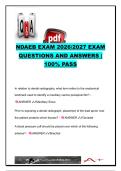
NDAEB EXAM 2026/2027 EXAM
QUESTIONS AND ANSWERS |
100% PASS


In relation to dental radiography, what term refers to the anatomical

landmark used to identify a maxillary canine periapical film? -

ANSWER ✔✔Maxillary Sinus


Prior to exposing a dental radiograph, placement of the lead apron over

the patient protects which tissues? - ANSWER ✔✔Gonadal


A blood pressure cuff should be placed over which of the following

arteries? - ANSWER ✔✔Brachial

,What 3 factors are essential in order to produce accurate diagnostic

casts? - ANSWER ✔✔Water to powder ratio, mixing time and water

temperature

What is the name of the adhesive film that retains bacterial colonies to

the teeth? - ANSWER ✔✔Pellicle


What radiograph image is most useful for inter proximal caries? -

ANSWER ✔✔Bitewing


Which fluid provides lubrication during movements of the TMJ? -

ANSWER ✔✔Synovial Fluid


What is the correct way to store scrap amalgam? - ANSWER ✔✔In a

tightly closed mercury recycling container

In a steam sterilizer, the distilled water is converted to steam then

condensed back into liquid water. What happened to the condensed

water? - ANSWER ✔✔It is drained from the sterilizer and discarded

down the drain in the sink

A patient presents to the dental office with concerns about sensitivity on

a lower canine tooth. The dentist performs an exam and diagnosis

gingival recession and abrasion on the facial root surface of tooth 33.

, The patient has 100% coverage for diagnostic, preventive and

restorative services.


1. What is the etiology of the sensitivity?

2. What could cause the tooth pathology?

3. What term refers to the dentist regarding dental insurance?

4. The patient should be encouraged to use a dentifrice containing

fluoride and which other chemical agent? - ANSWER ✔✔- Exposed

dentinal tubules

- Use of an abrasive dentifrice

- Provider

- Potassium nitrate

A 24 year old patient presents for an emergency exam. During the

interview it is noted that he is a heavy smoker and under emotional

stress. The clinical findings are : a biofilm index of 3 with some ulceration

of interdental papillae.


1. What condition does the patient have?

2. What is the recommended treatment?

COPYRIGHT©NINJANERD 2025/2026. YEAR PUBLISHED 2026. COMPANY REGISTRATION NUMBER: 619652435. TERMS OF USE. PRIVACY
STATEMENT. ALL RIGHTS RESERVED
3


Document information

Uploaded on
August 27, 2026
Number of pages
26
Written in
2026/2027
Type
Exam (elaborations)
Contains
Questions & answers
$18.99

Wrong document? Swap it for free Within 14 days of purchase and before downloading, you can choose a different document. You can simply spend the amount again.
Written by students who passed
Immediately available after payment
Read online or as PDF

Seller avatar
Reputation scores are based on the amount of documents a seller has sold for a fee and the reviews they have received for those documents. There are three levels: Bronze, Silver and Gold. The better the reputation, the more your can rely on the quality of the sellers work.
NinjaNerd
3.4
(77)
Sold
415
Followers
6
Items
15717
Last sold
2 days ago


Why students choose Stuvia

Created by fellow students, verified by reviews

Quality you can trust: written by students who passed their tests and reviewed by others who've used these notes.

Didn't get what you expected? Choose another document

No worries! You can instantly pick a different document that better fits what you're looking for.

Pay as you like, start learning right away

No subscription, no commitments. Pay the way you're used to via credit card and download your PDF document instantly.

Student with book image

“Bought, downloaded, and aced it. It really can be that simple.”

Alisha Student

Working on your references?

Create accurate citations in APA, MLA and Harvard with our free citation generator.

Working on your references?

Frequently asked questions
