

Written by students who passed Immediately available after payment Read online or as PDF Wrong document? Swap it for free 4.6 TrustPilot
logo-home
Document preview thumbnail
Preview 2 out of 13 pages
Exam (elaborations)

CSE 330 Operating Systems Final Exam 2026/2027 – 40 Questions & Answers | Concurrency, I/O, Storage, File Systems – Arizona State University

Document preview thumbnail
Preview 2 out of 13 pages

This CSE 330 Operating Systems Final Exam 2026/2027 study document contains 40 exam questions with correct answers covering major operating-systems concepts tested throughout the material. The 13-page resource includes true/false questions, multiple-choice questions, applied scenarios, and calculation-based problems on data races, mutex locks, deadlocks, spinlocks, concurrency, I/O communication, device registers, interrupts, DMA controllers, programmed I/O (PIO), block-layer abstractions, HDDs, SSDs, FIFO, SCAN and C-SCAN disk scheduling, Linux kernel/user-space interaction, page tables, filesystems, inodes, filesystem logging, IOMMU, and context switching. The document is particularly useful for reviewing practical operating-systems concepts such as synchronization and atomicity, device communication, storage performance, disk scheduling, virtual files, copy_from_user, file descriptors, address translation, and filesystem consistency. It also contains numerical applications involving HDD head movement and sequential versus random read latency, making it useful for both conceptual and calculation-focused exam preparation. These topics closely correspond to the published scope of CSE 330: Operating Systems at Arizona State University. ASU describes the course as covering operating-system fundamentals including CPU and memory management, process scheduling, device drivers, filesystems, synchronization, page tables, system calls, interrupts, and device management. ASU's 2026 program requirements also list CSE 330 Operating Systems as a three-credit course in both Computer Science and Computer Systems Engineering curricula. For additional academic study, the material can be paired with Operating Systems: Three Easy Pieces by Remzi H. Arpaci-Dusseau and Andrea C. Arpaci-Dusseau. The text organizes operating-systems study around virtualization, concurrency, and persistence and includes chapters on threads, locks, concurrency bugs, I/O devices, hard disk drives, files and directories, file-system implementation, and journaling—areas that substantially overlap with the topics represented in this exam-preparation document. An ASU CSE 330 syllabus also identifies Operating System Concepts by Abraham Silberschatz, Peter Baer Galvin, and Greg Gagne as a textbook for understanding lectures and preparing for examinations. APA references: Arpaci-Dusseau, R. H., & Arpaci-Dusseau, A. C. (2023). Operating Systems: Three Easy Pieces (Version 1.10). Arpaci-Dusseau Books. Silberschatz, A., Galvin, P. B., & Gagne, G. Operating System Concepts. Wiley; this title is identified in ASU's CSE 330 syllabus as an exam-preparation textbook. Relevant Students This document is most relevant to Arizona State University students taking CSE 330 Operating Systems, particularly students preparing for a final examination or reviewing core course concepts. It may also be useful to Computer Science and Computer Systems Engineering students studying operating systems, Linux kernel concepts, concurrency, memory management, storage systems, and filesystems. ASU's current degree requirements include CSE 330 within both Computer Science and Computer Systems Engineering programs. Keywords CSE 330 final exam, CSE 330 exam questions, CSE 330 exam answers, operating systems final exam, operating systems questions and answers, ASU operating systems, Spring final exam 2026, Spring final exam 2027, concurrency questions, mutex locks, data races, deadlocks, spinlocks, DMA controllers, programmed I/O, disk scheduling, FIFO scheduling, SCAN scheduling, C-SCAN scheduling, HDD questions, SSD questions, Linux kernel, page tables, filesystems, inodes, filesystem logging, IOMMU, context switching, operating systems exam preparation, operating systems practice questions

Content preview

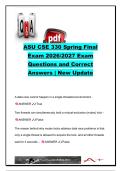
ASU CSE 330 Spring Final
Exam 2026/2027 Exam
Questions and Correct
Answers | New Update


A data race cannot happen in a single-threaded environment -

ANSWER ✔✔True


Two threads can simultaneously hold a mutual-exclusion (mutex) lock -

ANSWER ✔✔False


The reason behind why mutex locks address data race problems is that

only a single thread is allowed to acquire the lock, and all other threads

wait for 3 seconds. - ANSWER ✔✔False

, Imagine you have a single variable (object) that you want to change from

0 to 1 atomically (no data races). You cannot use a test-and-swap

instruction to achieve this. - ANSWER ✔✔False


One reason why inconsistent lock usage leads to data races is because

developers may use different locks to access an object. - ANSWER

✔✔True


A deadlock cannot occur in a single core system. - ANSWER

✔✔False


A spinlock is an efficient way to ensure atomicity in long-running code. -

ANSWER ✔✔False


Using a mutex lock hurts the performance of the system because it

makes computations run sequentially instead of in parallel. -

ANSWER ✔✔True


Which of the following are the three typical device registers?

I. Status, command, sync

II. Data, command, info

III. Status, command, data


IV. Status, command, data. - ANSWER ✔✔III. Status, command, data

Document information

Uploaded on
August 27, 2026
Number of pages
13
Written in
2026/2027
Type
Exam (elaborations)
Contains
Questions & answers
$18.99

Wrong document? Swap it for free Within 14 days of purchase and before downloading, you can choose a different document. You can simply spend the amount again.
Written by students who passed
Immediately available after payment
Read online or as PDF

Seller avatar
Reputation scores are based on the amount of documents a seller has sold for a fee and the reviews they have received for those documents. There are three levels: Bronze, Silver and Gold. The better the reputation, the more your can rely on the quality of the sellers work.
NinjaNerd
3.4
(77)
Sold
415
Followers
6
Items
15691
Last sold
1 day ago


Why students choose Stuvia

Created by fellow students, verified by reviews

Quality you can trust: written by students who passed their tests and reviewed by others who've used these notes.

Didn't get what you expected? Choose another document

No worries! You can instantly pick a different document that better fits what you're looking for.

Pay as you like, start learning right away

No subscription, no commitments. Pay the way you're used to via credit card and download your PDF document instantly.

Student with book image

“Bought, downloaded, and aced it. It really can be that simple.”

Alisha Student

Working on your references?

Create accurate citations in APA, MLA and Harvard with our free citation generator.

Working on your references?

Frequently asked questions

