

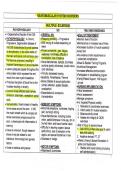
NEUROMUSCULAR SYSTEM DISORDERS
MULTIPLE SCLEROSIS
PATHOPHYSIOLOGY SIS TREATMENT/MEDS/NSG
e A Degenerative Disorder of the CNS eGENERAL S/S: eGOAL OF TREATEMENT:
e PATHOPHYSIOLOGY: A Chronic, eRelapsing remitting — Progressive eMaintain level of function
Progressive, Degenerative disease of ¢S&S varying & multiple depending on eMaintenance or increased use of limbs
the CNS characterized by small patches lesion eDecreased duration of muscle spasticity
of demyelination in the white matter of ePrimary symptoms: pain, fatigue, e|ntact Skin
weakness, numbness, difficulty in eNo evidence of skin impairments or
the brain and spinal cord and brain stem
coordination, loss of balance unplanned complications
that become sclerosed, resulting in
oVisual disturbances, diplopia, blurriness, eBowel & Bladder Training Programs
impaired transmission of nerve impulses scotoma (patchy blindness), double vision, eNutritional Management
e Lesions (plaques) appear throughout the color blindness
eIncreased effective communication
white matter which represent the end eTinnutis, decreased hearing eParticipation in rehabilitative program
result of an cute myelin breakdown eSpasticity, Paresthesias, Tremors eFamily/Patient Support; MS Support
¢ Produces disruption of blood flow to the eBowel, Bladder & sexual dysfunction groups
muscles resulting in atrophy (urinary retention, spastic bladder, *NURSING IMPLEMENTATION:
constipation)
e Common areas affected optic nerves, eVisual assessment
eExacerbations & remissions
cerebrum, brain stem, cerebellum, spinal eNeuro assessment
characteristics
cord eManage symptoms
e Demyelination: Myelin sheath of healthy *SENSORY SYMPTOMS: eFor Impaired Physical mobility:
1. Relaxation & coordination exercises
nerve wraps around the axon. In MS, eAbnormal sensations, numbness, tingling,
2. Warm packs for muscle relaxation
the myelin sheath which is a single cell pain, burning & itching
3. Balance activity w/rest
whose membrane wraps around the oVisual disturbances, including double
4. Assess skin integrity & C&DB
vision, partial blindness in one eye, dim or
axon, is destroyed with inflammation & exercises
blurred vision, and loss of central vision
scarring e Risk of Injury to sensory/visual
oDifficulty in reaching orgasm (sexual 1. Gait training w/feet wide apart & watch
e Cause is unknown, though research dysfunction), lack of sensation in the
feet while walking '
shows it may be related to viral vagina, and sexual impotence in men
2. Assistive devices, PT, OT
infections; immunologic &/or genetic eDizziness or Vertigo o Altered Urinary & Bowel Elimination r/t
factors spinal cord dysfunction
e Onset is insidious and gradual *MOTOR SYMPTOMS: 1. Bladder and bowel training (including
e\Weakness & clumsiness self catheterization)
, | mulibf)fl/e, Scle o6
fathophysielofl/ ote- Symfo—— foarsiy In—f/z:f-as
e Environmental factors shows MS is more | e Difficulty walking or fhaintaining balance 2. Be_dpan &K’drinal available
prevalent in the colder northern latitudes | eTremors 3. Voiding time schedule
e Most disabling diseases of young adults eUncoordinated eye movements 4. Adequate fluids & fiber, bowel training
eProblems with control of urination & bowel eMEDICATIONS:
20-40 years of age
movements ¢CORTICOSTEROIDS- (PREDNISONE &
e Usually higher incidences in women METHYLPREDNISOLONE) & ACTH as
eConstipation
e Prognosis: Approx 60% of the cases, anti-inflammatory agents
o Stiffness, unsteadiness, and unusual
diseases is characterized by fatigue ¢INTERFERONS used in relapsing
exacerbation & remissions over many remitting MS
years from different sites in the CNS oPSYCHOLOGIC/NEUROLOGIC 1. Interferon-Beta 1a (Avonex)
e Initially there is normal to near normal SYMPTOMS: 2. Interferon-Beta-1b (Betaseron)
neurologic function between eMood Swings ¢ Baclofen for spasticity
e|nappropriate elation or giddiness ¢ Propranolol (Inderal) to increase blood
exacerbations
eDepression flow to the brain
e As disease progresses, there is less ¢ Neurotonin & Klonopin for ataxia
e|nability to control emotions (for example:
improvement between exacerbations & e Symmetrel or Prozac for fatigue
crying, or laughing without reason)
decreasing neurologic dysfunction eSubtle or obvious mental impairment e NON STEROIDAL
e Average life expectancy after onset of IMMUNOSUPPRESSIVES (Imuran,
symptoms is 25yrs *DIAGNOSIS/ASSESSMENT TOOLS Cytoxin, Sandimmune)
e NURSING DIAGNOSIS *MRI PRIMARY ASSESSMENT TOOL o Glatiramer acetate (Copaxone)
oCT Scan ¢ Mitoxantrone (Novantrone) for 2ndary
e Impaired physical mobility r/t
eElectrophoresis of CSF (shows oligoclonal progressive MS
e Goal: Promotion of physical mobility
banding)
e Altered Urinary & Bowel Elimination r/t
oH & P (revealing possible familial
spinal cord dysfunction tendencies)
e Goal: Achievement of continence & eEvoked potential studies
improved bowel & bladder control eDiagnosis of MS is difficult because there
e Self Care deficit r/t is no specific lab test for the disease
e High Risk for impaired skin integrity r/t
e Sensory Perceptual Alteration r/t
o Self-Esteem Disturbance r/t
e Alteration in family processes r/t
o Knowledge Deficit r/t
MULTIPLE SCLEROSIS
PATHOPHYSIOLOGY SIS TREATMENT/MEDS/NSG
e A Degenerative Disorder of the CNS eGENERAL S/S: eGOAL OF TREATEMENT:
e PATHOPHYSIOLOGY: A Chronic, eRelapsing remitting — Progressive eMaintain level of function
Progressive, Degenerative disease of ¢S&S varying & multiple depending on eMaintenance or increased use of limbs
the CNS characterized by small patches lesion eDecreased duration of muscle spasticity
of demyelination in the white matter of ePrimary symptoms: pain, fatigue, e|ntact Skin
weakness, numbness, difficulty in eNo evidence of skin impairments or
the brain and spinal cord and brain stem
coordination, loss of balance unplanned complications
that become sclerosed, resulting in
oVisual disturbances, diplopia, blurriness, eBowel & Bladder Training Programs
impaired transmission of nerve impulses scotoma (patchy blindness), double vision, eNutritional Management
e Lesions (plaques) appear throughout the color blindness
eIncreased effective communication
white matter which represent the end eTinnutis, decreased hearing eParticipation in rehabilitative program
result of an cute myelin breakdown eSpasticity, Paresthesias, Tremors eFamily/Patient Support; MS Support
¢ Produces disruption of blood flow to the eBowel, Bladder & sexual dysfunction groups
muscles resulting in atrophy (urinary retention, spastic bladder, *NURSING IMPLEMENTATION:
constipation)
e Common areas affected optic nerves, eVisual assessment
eExacerbations & remissions
cerebrum, brain stem, cerebellum, spinal eNeuro assessment
characteristics
cord eManage symptoms
e Demyelination: Myelin sheath of healthy *SENSORY SYMPTOMS: eFor Impaired Physical mobility:
1. Relaxation & coordination exercises
nerve wraps around the axon. In MS, eAbnormal sensations, numbness, tingling,
2. Warm packs for muscle relaxation
the myelin sheath which is a single cell pain, burning & itching
3. Balance activity w/rest
whose membrane wraps around the oVisual disturbances, including double
4. Assess skin integrity & C&DB
vision, partial blindness in one eye, dim or
axon, is destroyed with inflammation & exercises
blurred vision, and loss of central vision
scarring e Risk of Injury to sensory/visual
oDifficulty in reaching orgasm (sexual 1. Gait training w/feet wide apart & watch
e Cause is unknown, though research dysfunction), lack of sensation in the
feet while walking '
shows it may be related to viral vagina, and sexual impotence in men
2. Assistive devices, PT, OT
infections; immunologic &/or genetic eDizziness or Vertigo o Altered Urinary & Bowel Elimination r/t
factors spinal cord dysfunction
e Onset is insidious and gradual *MOTOR SYMPTOMS: 1. Bladder and bowel training (including
e\Weakness & clumsiness self catheterization)
, | mulibf)fl/e, Scle o6
fathophysielofl/ ote- Symfo—— foarsiy In—f/z:f-as
e Environmental factors shows MS is more | e Difficulty walking or fhaintaining balance 2. Be_dpan &K’drinal available
prevalent in the colder northern latitudes | eTremors 3. Voiding time schedule
e Most disabling diseases of young adults eUncoordinated eye movements 4. Adequate fluids & fiber, bowel training
eProblems with control of urination & bowel eMEDICATIONS:
20-40 years of age
movements ¢CORTICOSTEROIDS- (PREDNISONE &
e Usually higher incidences in women METHYLPREDNISOLONE) & ACTH as
eConstipation
e Prognosis: Approx 60% of the cases, anti-inflammatory agents
o Stiffness, unsteadiness, and unusual
diseases is characterized by fatigue ¢INTERFERONS used in relapsing
exacerbation & remissions over many remitting MS
years from different sites in the CNS oPSYCHOLOGIC/NEUROLOGIC 1. Interferon-Beta 1a (Avonex)
e Initially there is normal to near normal SYMPTOMS: 2. Interferon-Beta-1b (Betaseron)
neurologic function between eMood Swings ¢ Baclofen for spasticity
e|nappropriate elation or giddiness ¢ Propranolol (Inderal) to increase blood
exacerbations
eDepression flow to the brain
e As disease progresses, there is less ¢ Neurotonin & Klonopin for ataxia
e|nability to control emotions (for example:
improvement between exacerbations & e Symmetrel or Prozac for fatigue
crying, or laughing without reason)
decreasing neurologic dysfunction eSubtle or obvious mental impairment e NON STEROIDAL
e Average life expectancy after onset of IMMUNOSUPPRESSIVES (Imuran,
symptoms is 25yrs *DIAGNOSIS/ASSESSMENT TOOLS Cytoxin, Sandimmune)
e NURSING DIAGNOSIS *MRI PRIMARY ASSESSMENT TOOL o Glatiramer acetate (Copaxone)
oCT Scan ¢ Mitoxantrone (Novantrone) for 2ndary
e Impaired physical mobility r/t
eElectrophoresis of CSF (shows oligoclonal progressive MS
e Goal: Promotion of physical mobility
banding)
e Altered Urinary & Bowel Elimination r/t
oH & P (revealing possible familial
spinal cord dysfunction tendencies)
e Goal: Achievement of continence & eEvoked potential studies
improved bowel & bladder control eDiagnosis of MS is difficult because there
e Self Care deficit r/t is no specific lab test for the disease
e High Risk for impaired skin integrity r/t
e Sensory Perceptual Alteration r/t
o Self-Esteem Disturbance r/t
e Alteration in family processes r/t
o Knowledge Deficit r/t


