

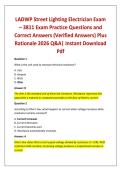
LADWP Street Lighting Electrician Exam
– 3811 Exam Practice Questions and
Correct Answers (Verified Answers) Plus
Rationale 2026 Q&A| Instant Download
Pdf
Question 1
What is the unit used to measure electrical resistance?
A. Volt
B. Ampere
C. Watt
D. Ohm
Answer: D
The ohm is the standard unit of electrical resistance. Resistance represents the
opposition a material or component provides to the flow of electric current.
Question 2
According to Ohm's law, what happens to current when voltage increases while
resistance remains constant?
A. Current increases
B. Current decreases
C. Current becomes zero
D. Resistance automatically increases
Answer: A
Ohm's law states that current equals voltage divided by resistance (I = V/R). With
resistance held constant, increasing voltage produces a proportional increase in
current.
,Question 3
What is the primary function of a conductor in an electrical circuit?
A. Interrupt current flow
B. Provide a path for electrical current
C. Convert AC to mechanical energy
D. Prevent voltage from existing
Answer: B
A conductor provides a relatively low-resistance path through which electrical
current can flow. Copper and aluminum are commonly used because they have
good electrical conductivity.
Question 4
Which material is commonly used as an electrical conductor?
A. Glass
B. Rubber
C. Copper
D. Porcelain
Answer: C
Copper has high electrical conductivity and is widely used for electrical conductors.
Its electrical and mechanical properties make it suitable for many wiring
applications.
Question 5
What is the primary purpose of insulation on an electrical conductor?
A. Increase current flow
B. Increase conductor resistance indefinitely
C. Reduce unintended contact between the conductor and surrounding
materials
D. Increase circuit voltage
Answer: C
,Electrical insulation surrounds a conductor and helps prevent unintended current
paths, contact with other conductors, and electrical shock hazards.
Question 6
In a series circuit, what happens if one component becomes an open circuit?
A. Current increases throughout the circuit
B. Current stops flowing through the series path
C. Voltage automatically doubles
D. The circuit becomes parallel
Answer: B
In a series circuit, all components share a single current path. An open circuit
anywhere in that path interrupts current flow through the circuit.
Question 7
What is the primary characteristic of a parallel circuit?
A. Every component has the same current
B. Multiple current paths are available
C. There is only one possible current path
D. Voltage must always be zero
Answer: B
A parallel circuit contains multiple branches, providing separate paths for current.
The voltage across parallel branches is ideally the same when they are connected
across the same two points.
Question 8
What does electrical power represent?
A. Opposition to current flow
B. Electrical pressure only
C. The rate at which electrical energy is transferred or used
D. The physical size of a conductor
Answer: C
, Electrical power describes the rate at which electrical energy is transferred or
consumed. It is commonly expressed in watts and, in a basic circuit, can be
calculated using relationships such as P = V × I.
Question 9
A 120-volt circuit supplies 10 amperes to a load. What is the approximate
electrical power?
A. 12 watts
B. 120 watts
C. 1,200 watts
D. 12,000 watts
Answer: C
For a basic load, electrical power can be calculated as P = V × I. Therefore, 120
volts multiplied by 10 amperes equals 1,200 watts.
Domain II — AC Power & Distribution
Question 10
What type of electrical power is commonly supplied by utility distribution
systems?
A. Static current
B. Alternating current (AC)
C. Chemical current
D. Mechanical current
Answer: B
Utility electrical distribution systems commonly use alternating current. AC
periodically changes direction and is suitable for generation, transmission, and
distribution.
Question 11
What is the purpose of a transformer in an electrical distribution system?
– 3811 Exam Practice Questions and
Correct Answers (Verified Answers) Plus
Rationale 2026 Q&A| Instant Download
Question 1
What is the unit used to measure electrical resistance?
A. Volt
B. Ampere
C. Watt
D. Ohm
Answer: D
The ohm is the standard unit of electrical resistance. Resistance represents the
opposition a material or component provides to the flow of electric current.
Question 2
According to Ohm's law, what happens to current when voltage increases while
resistance remains constant?
A. Current increases
B. Current decreases
C. Current becomes zero
D. Resistance automatically increases
Answer: A
Ohm's law states that current equals voltage divided by resistance (I = V/R). With
resistance held constant, increasing voltage produces a proportional increase in
current.
,Question 3
What is the primary function of a conductor in an electrical circuit?
A. Interrupt current flow
B. Provide a path for electrical current
C. Convert AC to mechanical energy
D. Prevent voltage from existing
Answer: B
A conductor provides a relatively low-resistance path through which electrical
current can flow. Copper and aluminum are commonly used because they have
good electrical conductivity.
Question 4
Which material is commonly used as an electrical conductor?
A. Glass
B. Rubber
C. Copper
D. Porcelain
Answer: C
Copper has high electrical conductivity and is widely used for electrical conductors.
Its electrical and mechanical properties make it suitable for many wiring
applications.
Question 5
What is the primary purpose of insulation on an electrical conductor?
A. Increase current flow
B. Increase conductor resistance indefinitely
C. Reduce unintended contact between the conductor and surrounding
materials
D. Increase circuit voltage
Answer: C
,Electrical insulation surrounds a conductor and helps prevent unintended current
paths, contact with other conductors, and electrical shock hazards.
Question 6
In a series circuit, what happens if one component becomes an open circuit?
A. Current increases throughout the circuit
B. Current stops flowing through the series path
C. Voltage automatically doubles
D. The circuit becomes parallel
Answer: B
In a series circuit, all components share a single current path. An open circuit
anywhere in that path interrupts current flow through the circuit.
Question 7
What is the primary characteristic of a parallel circuit?
A. Every component has the same current
B. Multiple current paths are available
C. There is only one possible current path
D. Voltage must always be zero
Answer: B
A parallel circuit contains multiple branches, providing separate paths for current.
The voltage across parallel branches is ideally the same when they are connected
across the same two points.
Question 8
What does electrical power represent?
A. Opposition to current flow
B. Electrical pressure only
C. The rate at which electrical energy is transferred or used
D. The physical size of a conductor
Answer: C
, Electrical power describes the rate at which electrical energy is transferred or
consumed. It is commonly expressed in watts and, in a basic circuit, can be
calculated using relationships such as P = V × I.
Question 9
A 120-volt circuit supplies 10 amperes to a load. What is the approximate
electrical power?
A. 12 watts
B. 120 watts
C. 1,200 watts
D. 12,000 watts
Answer: C
For a basic load, electrical power can be calculated as P = V × I. Therefore, 120
volts multiplied by 10 amperes equals 1,200 watts.
Domain II — AC Power & Distribution
Question 10
What type of electrical power is commonly supplied by utility distribution
systems?
A. Static current
B. Alternating current (AC)
C. Chemical current
D. Mechanical current
Answer: B
Utility electrical distribution systems commonly use alternating current. AC
periodically changes direction and is suitable for generation, transmission, and
distribution.
Question 11
What is the purpose of a transformer in an electrical distribution system?


